
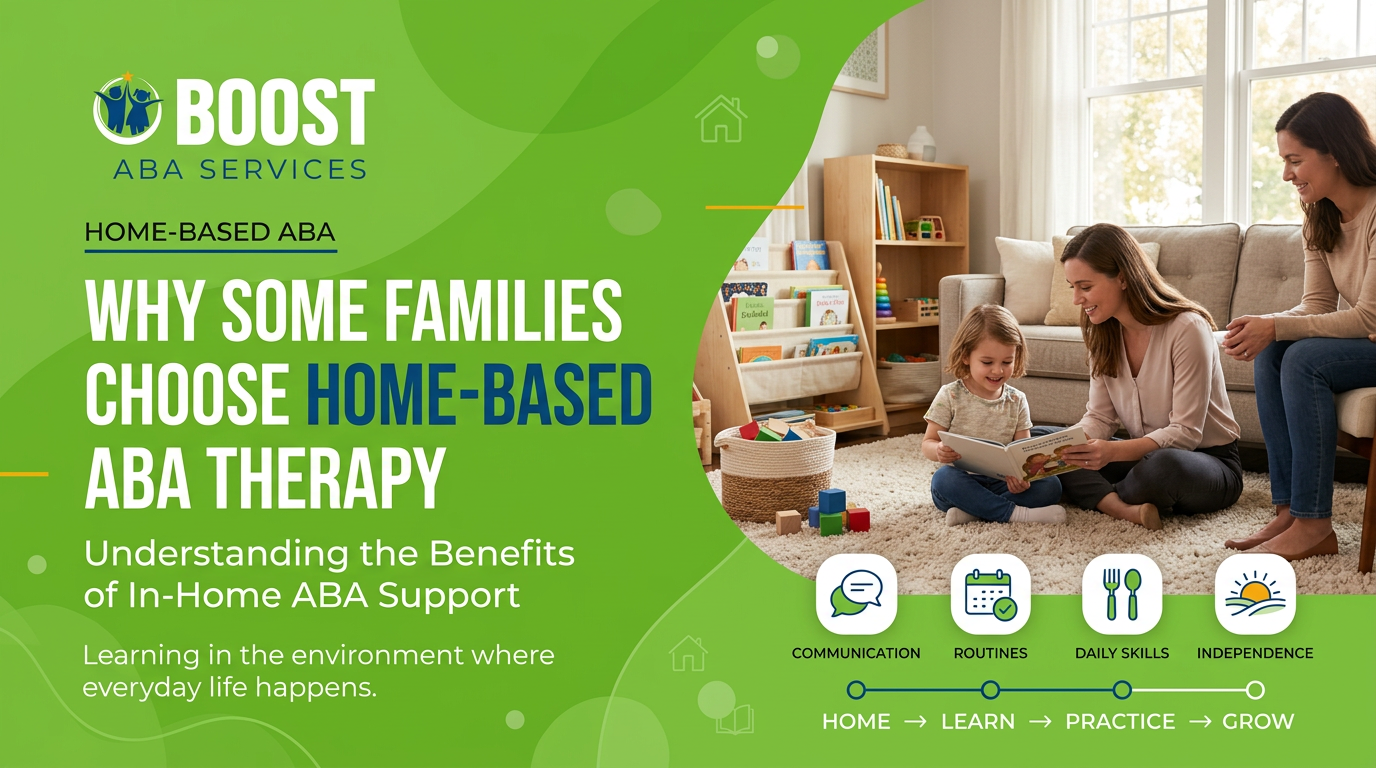
When parents begin researching ABA therapy, one of the first questions they may have is:
“Why does ABA happen at home?”
For some families, home-based ABA therapy can provide a familiar environment where appropriate skills can be practiced within everyday routines and activities.
Getting dressed, playing, eating a meal, asking for help, cleaning up, and transitioning between activities all happen naturally at home. Depending on a child’s individualized treatment plan, these routines may provide meaningful opportunities to practice communication, daily living skills, social interaction, and independence.
At Boost ABA Services, we provide individualized home-based ABA therapy for children across New York, Texas, and Arizona. Our approach focuses on the individual child and the skills that are meaningful to their everyday life.
What Is Home-Based ABA Therapy?
Home-based ABA therapy, also called in-home ABA therapy, is ABA support provided within a child’s home environment.
ABA stands for Applied Behavior Analysis, an evidence-based approach based on principles of learning and behavior.
Depending on the child’s individual treatment plan, ABA therapy may support areas such as:
- Communication
- Daily living skills
- Social interaction
- Play
- Everyday routines
- Transitions
- Learning
- Making choices
- Asking for help
- Greater independence
The specific goals and strategies should be individualized for each child.
Home-based ABA does not mean that every activity in the home becomes therapy. Instead, appropriate treatment goals can sometimes be incorporated into familiar activities and routines where the child naturally uses those skills.
Why Do Some Families Choose Home-Based ABA?
Every family’s situation is different.
Some families choose home-based ABA therapy because they want services to take place within a familiar environment.
For others, the home provides natural opportunities to work on everyday skills that are important to their child’s daily life.
There can also be practical considerations, such as reducing travel to a therapy location or making services fit more naturally into the family’s routine.
Most importantly, whether home-based ABA is appropriate depends on the individual child, family circumstances, treatment plan, service availability, and other relevant factors.
1. Familiar Surroundings Can Provide Natural Learning Opportunities
A child’s home is filled with familiar people, activities, and routines.
Because these routines are already part of everyday life, appropriate therapy goals can sometimes be practiced within situations that are meaningful to the child.
For example, if a child’s individualized goal involves increasing participation in getting dressed, practicing appropriate skills during the actual morning routine may provide useful context.
Similarly, a communication goal may be practiced while the child is requesting something they naturally want.
2. Morning Routines Can Become Learning Opportunities
Mornings involve many different activities.
A child may need to:
Wake up → Get dressed → Brush teeth → Eat breakfast → Get shoes → Leave home
For some children, these routines can be challenging.
Depending on the child’s goals, in-home ABA therapy may provide opportunities to practice appropriate skills within the morning routine.
These might include:
- Following a visual schedule
- Completing steps of a routine
- Communicating a need
- Asking for help
- Making choices
- Transitioning between activities
- Increasing participation in age-appropriate tasks
The goal isn’t to make every morning perfect.
Instead, the focus can be on individualized skill development.
3. Play Can Support Learning
Play is a natural part of childhood.
It can also provide opportunities for meaningful skill development.
During play, a child may have opportunities to practice:
- Communication
- Turn-taking
- Making choices
- Social interaction
- Following directions
- Problem-solving
- Requesting help
- Independent play
For example, a child playing with blocks might request another block, choose a color, take turns, or ask for assistance.
The activity still looks like play.
However, when it aligns with the child’s treatment goals, the therapist can use appropriate opportunities within the activity to support skill development.
4. Mealtime Can Support Everyday Skills
Mealtime is another routine that happens naturally at home.
Depending on the child’s individualized goals, mealtime may provide opportunities to practice:
- Making choices
- Communicating preferences
- Requesting assistance
- Following a familiar routine
- Participating in age-appropriate tasks
- Cleaning up afterward
For example, a child might practice requesting a preferred item or participating in part of the mealtime routine.
However, feeding concerns can involve medical, nutritional, sensory, oral-motor, or other factors.
Therefore, feeding-related concerns should be addressed by appropriately qualified professionals, and ABA services should remain within the provider’s professional scope and the child’s treatment plan.
5. Transitions Happen All Day
Children transition between activities constantly.
For example:
Play → Cleanup
Breakfast → Getting Ready
Screen Time → Another Activity
Indoor Play → Leaving Home
Activity → Bedtime
Some children may need additional support when moving from one activity to another.
Depending on the child’s individualized goals, a home-based ABA therapist may work with strategies such as:
- Visual schedules
- Clear language
- Countdown warnings
- First-then language
- Appropriate choices
- Reinforcement
The specific approach depends on the individual child.
The goal isn’t necessarily to eliminate every difficult transition.
Instead, appropriate support can help children develop skills that may make everyday changes more predictable and manageable.
6. Communication Can Happen Throughout the Day
One of the benefits of practicing skills at home is that communication opportunities happen naturally.
A child may communicate when they:
- Want a toy
- Need help
- Want more
- Are finished
- Want a break
- Want someone’s attention
- Need something opened
- Want to make a choice
Communication can take many forms.
It may include:
- Spoken language
- Gestures
- Pointing
- Pictures
- Signs
- AAC
- Other individualized communication methods
With home-based ABA therapy, appropriate communication goals can sometimes be practiced within the situations where the child naturally needs to communicate.
7. Daily Living Skills Happen at Home
Many important daily living skills are naturally connected to the home.
These can include:
Getting Dressed
Participating in age-appropriate steps of the dressing routine.
Personal Hygiene
Practicing appropriate steps involved in brushing teeth, washing hands, or other routines.
Cleaning Up
Participating in putting toys or belongings away.
Making Choices
Choosing between appropriate options during everyday activities.
Asking for Help
Communicating when assistance is needed.
Following Routines
Participating in familiar sequences of activities.
These skills may be particularly meaningful because they are directly connected to everyday life.
8. Home-Based ABA Can Help Connect Therapy With Real Life
One reason families explore ABA therapy at home is the opportunity to connect appropriate treatment goals with the environments where those skills are actually used.
Imagine a child is learning to ask for help.
During a structured therapy activity, they may practice the skill.
At home, there may be many natural situations where asking for help is relevant:
A container is difficult to open.
A toy is out of reach.
A shoe won’t go on.
A child needs assistance with part of a routine.
These everyday situations can provide opportunities to practice functional communication when appropriate.
Home-Based ABA Is Still Individualized
Choosing home-based services doesn’t mean every child receives the same program.
In fact, individualized care remains important regardless of where ABA therapy takes place.
A treatment plan may consider:
- Current skills
- Individual needs
- Communication
- Strengths
- Interests
- Family priorities
- Daily routines
- Treatment goals
- Progress over time
Two children receiving home-based ABA therapy may have completely different goals.
One may work primarily on communication.
Another may focus on daily living skills.
Another may work on transitions or social interaction.
The setting is only one part of the overall approach.
Parents and Caregivers Are Part of the Team
Home-based services can also create opportunities for collaboration with parents and caregivers.
Parents know their child’s everyday life.
They know:
- What routines are easy
- What routines are difficult
- What their child enjoys
- How their child communicates
- What motivates their child
- What situations may be challenging
- Which skills could make everyday life more manageable
This information can be valuable to the ABA team.
Depending on the treatment plan, caregiver involvement may include:
- Sharing observations
- Discussing family priorities
- Participating in caregiver training
- Learning about appropriate strategies
- Practicing appropriate skills during routines
- Communicating with the clinical team
Parents don’t need to become therapists.
Instead, they can be collaborative partners in their child’s support.
What Does a Home-Based ABA Session Look Like?
Parents sometimes wonder whether a therapist will simply sit with their child at a table.
However, home-based ABA sessions can look different depending on the child’s individualized goals.
A session might involve:
- Playing with blocks
- Reading a book
- Practicing communication
- Using a visual schedule
- Working through a morning routine
- Practicing transitions
- Completing an age-appropriate daily living activity
- Making choices
- Participating in a family routine
- Learning through a preferred activity
Some activities may be structured.
Others may happen naturally.
The important part is that the activities connect to appropriate individualized goals.
Home-Based ABA Can Make Everyday Routines Part of the Conversation
One useful aspect of providing ABA in the home is that the clinical team can learn more about the child’s everyday environment.
For example, a parent may say:
“Mornings are really difficult for us.”
Instead of only discussing that challenge in theory, the team may be able to better understand the routine, environment, and circumstances involved.
Similarly, a family may have a goal that is particularly important at home, such as participating in cleanup, communicating during mealtime, or completing part of a bedtime routine.
When appropriate, those real-life priorities can inform individualized treatment planning.
Is Home-Based ABA Therapy Right for Every Child?
Not necessarily.
Every child and family is different.
Whether home-based ABA therapy is appropriate depends on factors such as:
- The child’s individual needs
- Treatment goals
- Family circumstances
- Professional recommendations
- Service availability
- Insurance requirements
- The provider’s service model
Parents considering ABA should discuss their child’s needs with qualified professionals and ask potential providers how their home-based services work.
Questions to Ask a Home-Based ABA Provider
If you’re considering in-home ABA therapy, ask:
1. How will my child’s goals be individualized?
2. What does a typical home-based session look like?
3. Who supervises my child’s treatment?
4. How will parents and caregivers participate?
5. How will progress be measured?
6. How will therapy fit into our family’s routines?
7. How does insurance verification work?
8. Do you provide services in my area?
The answers can help you understand whether a provider’s approach fits your family’s needs.
Home-Based ABA Therapy in New York, Texas & Arizona
Boost ABA Services provides home-based ABA therapy in New York, Texas, and Arizona.
Our approach is centered around individualized support and meaningful everyday skills.
Depending on the child’s treatment plan, services may support:
Communication
Daily Living Skills
Everyday Routines
Social Interaction
Play
Transitions
Learning
Independence
Service availability may vary by location.
Home-Based ABA Therapy in New York
Families looking for home-based ABA therapy in New York can contact Boost ABA Services to learn about available services and the process of getting started.
Home-Based ABA Therapy in Texas
If you’re searching for home-based ABA therapy in Texas, our team can help you learn more about Boost ABA Services and discuss service availability.
Home-Based ABA Therapy in Arizona
Families looking for home-based ABA therapy in Arizona can contact our team to learn more about our approach and potential next steps.
Home-Based ABA at Boost ABA Services
At Boost ABA Services, we believe meaningful learning can happen within everyday life.
Our home-based approach provides individualized ABA support within familiar environments while keeping the child’s needs, goals, and family priorities at the center.
We don’t believe every child should have the same ABA experience.
We believe support should be individualized.
Learn More About Home-Based ABA Therapy
If you’re considering home-based ABA therapy for your child, you don’t need to have every answer before contacting us.
The Boost ABA Services team can help you learn more about our services, home-based approach, insurance verification, and the process of getting started.
Boost ABA Services
Home-Based ABA Therapy | NY • TX • AZ
📞 845-377-0024
Open Monday – Friday
Big Progress Starts With Small Steps.
