
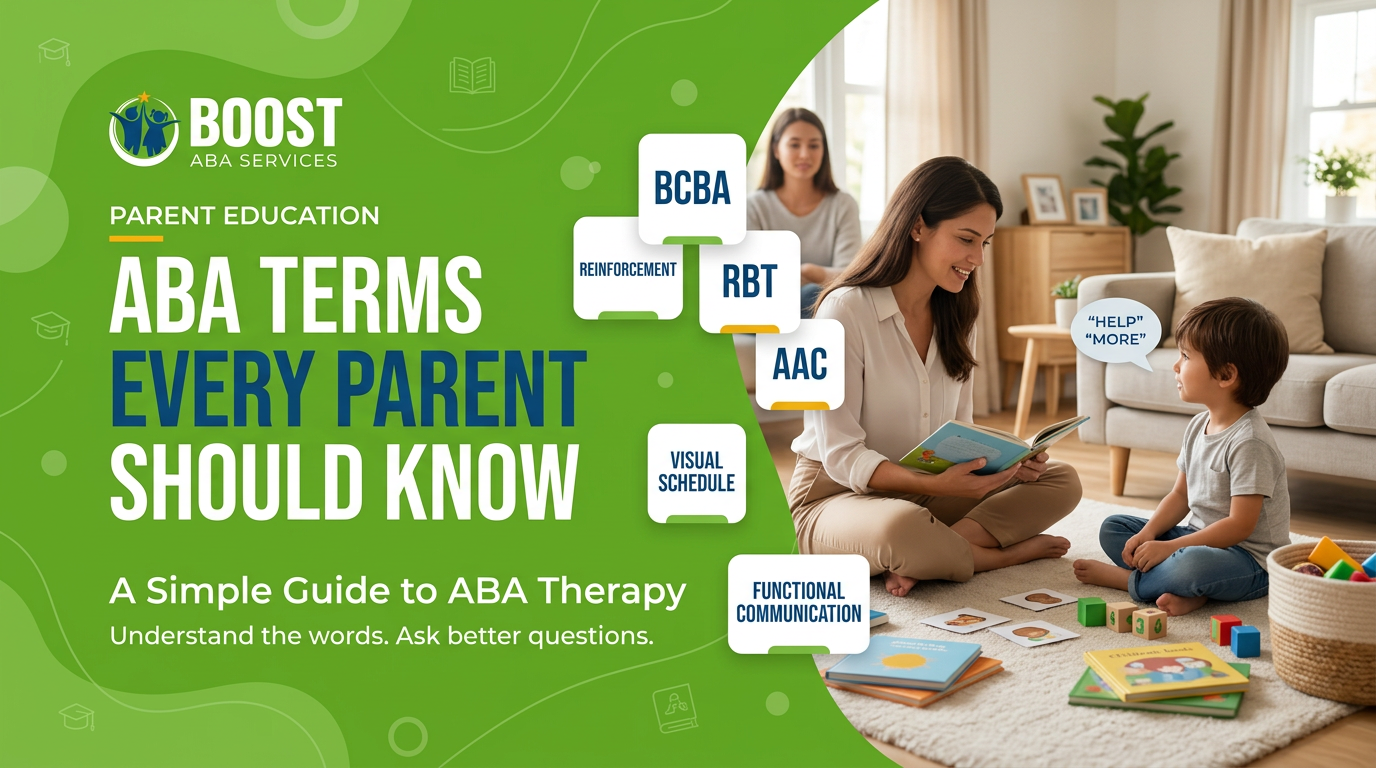
If your child is starting ABA therapy, you may suddenly hear words and abbreviations that are completely new to you.
BCBA. RBT. Reinforcement. Prompting. AAC. Visual schedules.
At first, ABA terminology can feel confusing. However, you don’t need a clinical background to understand the basics.
At Boost ABA Services, we provide individualized home-based ABA therapy for children and families across New York, Texas, and Arizona. We believe parents should feel comfortable asking questions and understanding the language used by their child’s ABA team.
This simple guide explains some common ABA terms for parents without the heavy clinical language.
What Is ABA Therapy?
Before learning the terminology, it helps to understand what ABA means.
ABA stands for Applied Behavior Analysis.
ABA is an evidence-based approach that uses principles of learning and behavior to support meaningful skill development.
Depending on the child’s individualized treatment plan, ABA therapy may support areas such as:
- Communication
- Social interaction
- Daily living skills
- Everyday routines
- Play
- Learning
- Transitions
- Asking for help
- Making choices
- Greater independence
ABA therapy should be individualized because every child has different strengths, needs, interests, communication styles, and goals.
Now let’s break down some of the words you may hear.
1. BCBA: Board Certified Behavior Analyst
BCBA stands for Board Certified Behavior Analyst.
A BCBA is a professional who has met the certification requirements established by the Behavior Analyst Certification Board (BACB).
Depending on the child’s service model and applicable requirements, a BCBA may be involved in:
- Assessing the child’s needs
- Developing treatment goals
- Designing behavior-analytic interventions
- Overseeing treatment
- Monitoring progress
- Supervising other members of the ABA team
- Adjusting treatment strategies when appropriate
In simple terms:
The BCBA helps design, oversee, and evaluate the child’s individualized ABA program.
If you’re choosing an ABA provider, you can ask:
“How will the BCBA be involved in my child’s treatment?”
2. RBT: Registered Behavior Technician
RBT stands for Registered Behavior Technician.
An RBT is a paraprofessional who has met the requirements for RBT certification through the BACB and provides behavior-analytic services under the direction and supervision of qualified professionals.
An RBT may work directly with your child during scheduled ABA sessions.
Depending on the child’s treatment plan, an RBT may help implement strategies related to:
- Communication
- Play
- Daily living skills
- Learning
- Social interaction
- Routines
- Transitions
In simple terms:
The RBT may be one of the professionals working directly with your child while implementing the individualized treatment plan under appropriate supervision.
3. Behavior Technician
You may also hear the term Behavior Technician, or BT.
The exact role and credentialing requirements can vary by organization and position.
A Behavior Technician may work directly with a child and implement appropriate strategies under clinical supervision.
If your child’s provider uses the title BT, ask:
“What qualifications does the therapist have, and who supervises their work?”
This can help you understand the structure of your child’s care.
4. Reinforcement
Reinforcement is one of the most important ABA terms for parents to understand.
In simple language, reinforcement means that something happens after a behavior and makes that behavior more likely to happen again.
For example, imagine a child appropriately asks for help and receives assistance.
If receiving help makes the child more likely to appropriately ask for help again in a similar situation, that consequence may function as reinforcement.
Reinforcement can look different for different children.
Depending on the child and their individualized plan, reinforcement may involve:
- Praise
- Access to a preferred activity
- A favorite toy
- Choosing an activity
- Social interaction
- Another meaningful reinforcer
Reinforcement isn’t simply the same thing as a reward.
The important question is whether the consequence actually increases the likelihood of the desired behavior.
5. Prompting
Prompting means providing additional assistance to help a person complete a skill.
For example, if a child is learning a new routine, a therapist may provide an appropriate prompt to help the child complete the next step.
Prompts can take different forms, depending on the skill and the individual’s needs.
They may include:
- Verbal prompts
- Visual prompts
- Gestural prompts
- Modeling
- Other appropriate forms of assistance
The goal of prompting is not necessarily to have an adult help forever.
Instead, an individualized program may involve gradually reducing assistance when appropriate so the child can become more independent with the skill.
You can ask your child’s ABA team:
“How are you planning to reduce prompts as my child learns the skill?”
6. Visual Schedule
A visual schedule shows a child what activities are coming next.
Instead of relying entirely on spoken instructions, a visual schedule can represent activities using:
- Pictures
- Photographs
- Symbols
- Written words
- Objects
- Checklists
For example:
WAKE UP → GET DRESSED → BREAKFAST → BRUSH TEETH → SHOES
Visual schedules can be useful for some children because they provide a consistent representation of what is happening now and what comes next.
They may be used during:
- Morning routines
- Bedtime
- School preparation
- Cleanup
- Transitions
- Other everyday activities
At Boost ABA Services, our home-based ABA therapy approach can allow appropriate visual supports to be incorporated into familiar household routines when they align with a child’s individualized goals.
7. AAC: Augmentative and Alternative Communication
AAC can include:
- Picture communication
- Communication boards
- Sign language
- Speech-generating devices
- Tablet-based communication systems
- Other communication methods
Communication does not have to look the same for every child.
A child may use spoken language in some situations and AAC in others.
For another child, AAC may be their primary way of communicating.
The goal is to support meaningful communication based on the child’s individual needs.
8. Functional Communication
Functional communication means communicating in a way that serves a meaningful purpose.
For example, a child may communicate:
“Help.”
“More.”
“All done.”
“I want that.”
“Break.”
“No.”
The communication method can vary.
A child may use speech, gestures, pictures, signs, AAC, or another appropriate method.
The important part is that the child has a meaningful way to communicate their needs, preferences, choices, and messages.
9. Skill Acquisition
You may hear your ABA team talk about skill acquisition.
This simply refers to learning a new skill.
A skill could involve:
- Communicating
- Dressing
- Playing
- Following a routine
- Making a choice
- Asking for help
- Completing an age-appropriate task
- Interacting with others
A larger skill can sometimes be divided into smaller steps.
For example, getting dressed involves multiple individual actions.
Breaking a larger skill into smaller steps can make it easier to teach and practice when appropriate.
10. Behavior Reduction
Another term parents may hear is behavior reduction.
This refers to interventions designed to decrease behaviors that interfere with a child’s ability to participate safely or meaningfully in everyday activities.
However, it’s important to understand the bigger picture.
ABA shouldn’t simply focus on stopping a behavior without understanding what may be contributing to it.
A clinical team may consider:
- What happens before the behavior
- What the child may be communicating
- What happens afterward
- Environmental factors
- Communication needs
- Other relevant circumstances
The goal may include teaching appropriate alternative skills that can help the child communicate or participate more effectively.
11. Antecedent
Antecedent is a technical word that simply means what happens immediately before a behavior.
For example:
A child is playing with a favorite toy.
A parent says:
“Time to clean up.”
The instruction is an event that occurred immediately before the child’s response.
The ABA team may look at what happens before behaviors to better understand patterns and identify appropriate strategies.
You may hear professionals refer to this as part of an ABC analysis.
12. Consequence
In ABA terminology, a consequence is what happens immediately after a behavior.
It doesn’t necessarily mean something negative.
For example:
Child asks for help → Adult provides help.
The adult’s response is a consequence.
Understanding what happens after a behavior can help professionals evaluate patterns and determine whether certain responses are affecting future behavior.
13. ABC Data
ABC stands for:
A = Antecedent
What happened before?
B = Behavior
What happened?
C = Consequence
What happened afterward?
For example:
A: A preferred activity ends.
B: Child communicates that they want to continue.
C: Adult responds.
The purpose of looking at these patterns is to better understand behavior and develop appropriate individualized support.
14. Generalization
Generalization means using a skill across different people, places, activities, or situations.
For example, a child may learn to request help from a therapist.
Later, the goal may involve using that communication skill with a parent or caregiver during an everyday activity.
Another example could be learning a routine in one room and eventually using the skill in another appropriate environment.
Generalization can be important because children use skills throughout their lives, not only during therapy sessions.
15. Data Collection
ABA professionals may collect data during therapy.
Data can help the clinical team understand what is happening with specific treatment goals over time.
Depending on the goal, information might relate to:
- Frequency
- Duration
- Accuracy
- Level of assistance
- Successful responses
- Other measurable aspects of a skill
The exact measurement depends on the individualized goal.
Parents can ask:
“What are you measuring, and how will you explain the progress to me?”
16. Treatment Plan
A treatment plan is the individualized plan that outlines the goals and strategies for a child’s ABA services.
It may include information about:
- Individualized goals
- Skills being addressed
- Intervention strategies
- Progress monitoring
- Parent involvement
- Clinical supervision
The treatment plan should reflect the individual child.
As the child develops and circumstances change, the clinical team may review and update goals when appropriate.
17. Caregiver Training
Caregiver training gives parents and caregivers opportunities to learn about appropriate strategies related to their child’s individualized goals.
This may include learning about:
- Communication
- Visual supports
- Reinforcement
- Routines
- Transitions
- Daily living skills
- Other individualized strategies
The purpose isn’t to turn parents into therapists.
Instead, caregiver training can help families understand the child’s goals and support appropriate skills during everyday life.
18. Home-Based ABA Therapy
Home-based ABA therapy, also called in-home ABA therapy, means appropriate ABA services take place within the child’s home environment.
At Boost ABA Services, our services are home-based.
This means therapy can take place within familiar surroundings and, when appropriate, incorporate everyday routines such as:
- Getting dressed
- Brushing teeth
- Mealtime
- Play
- Cleanup
- Asking for help
- Family routines
- Transitions
The home isn’t simply the location where therapy happens.
It can also provide valuable context for practicing appropriate skills connected to everyday life.
19. Individualized ABA Therapy
You may also hear the phrase individualized ABA therapy.
This means the child’s goals and strategies are based on their individual needs rather than applying the exact same program to every child.
For example, one child may focus on communication.
There isn’t one universal ABA checklist that every child needs to follow.
20. Why These ABA Terms Matter
Learning the terminology can make conversations with your child’s ABA team easier.
Instead of hearing:
“We’re working on generalization.”
You can understand that the team is talking about helping a child use a skill across appropriate people or situations.
Instead of:
“We’re using visual supports.”
You know they may be using pictures, schedules, or other visual tools to make information easier to understand.
And instead of feeling lost when you hear BCBA, RBT, reinforcement, prompting, or AAC, you have a basic understanding of what these terms mean.
You can then ask better questions about your child’s individual treatment.
Questions Parents Can Ask Their ABA Team
You don’t need to memorize every ABA term.
Instead, keep these questions handy:
- What are my child’s current goals?
- Why were these goals selected?
- How will you measure progress?
- Who supervises my child’s therapy?
- How will I be involved?
- What strategies are you using?
- How can I support appropriate skills at home?
- How are prompts reduced when appropriate?
- How will skills be practiced across different situations?
- When will the treatment plan be reviewed?
- What should I do if I have concerns?
A good ABA provider should be willing to explain these concepts in language families can understand.
ABA Terms Shouldn’t Feel Intimidating
ABA terminology can seem complicated at first.
However, once you understand the basic concepts, many of the words become much easier to follow.
The most important thing to remember is that your child’s ABA program should be individualized.
The goal isn’t to memorize terminology.
The goal is to understand what your child’s team is working on, why those goals matter, how progress is monitored, and how you can participate in the process.
Home-Based ABA Therapy at Boost ABA Services
At Boost ABA Services, we provide individualized home-based ABA therapy for children and families across New York, Texas, and Arizona.
Our approach focuses on meaningful skills that connect with everyday life.
Depending on the child’s individualized treatment plan, services may support:
Communication • Daily Living Skills • Social Interaction • Play • Routines • Transitions • Learning • Independence
We also encourage parents and caregivers to ask questions and participate in the process.
Because understanding your child’s support should be part of the journey.
Keep This ABA Parent Guide Handy
If your child is starting ABA therapy, save this guide.
You may hear these terms during your first appointment, assessment, caregiver training session, or conversations with your child’s clinical team.
And remember, you don’t have to understand everything at once.
Ask questions.
Take notes.
Learn at your own pace.
Most importantly, focus on understanding your child’s individual goals and support.
Learn More About ABA Therapy
If you’re exploring home-based ABA therapy for your child, contact Boost ABA Services to learn more about our approach, services, insurance verification, and the process of getting started.
Boost ABA Services
Home-Based ABA Therapy | NY • TX • AZ
📞 845-377-0024
Open Monday – Friday
Big Progress Starts With Small Steps.
