
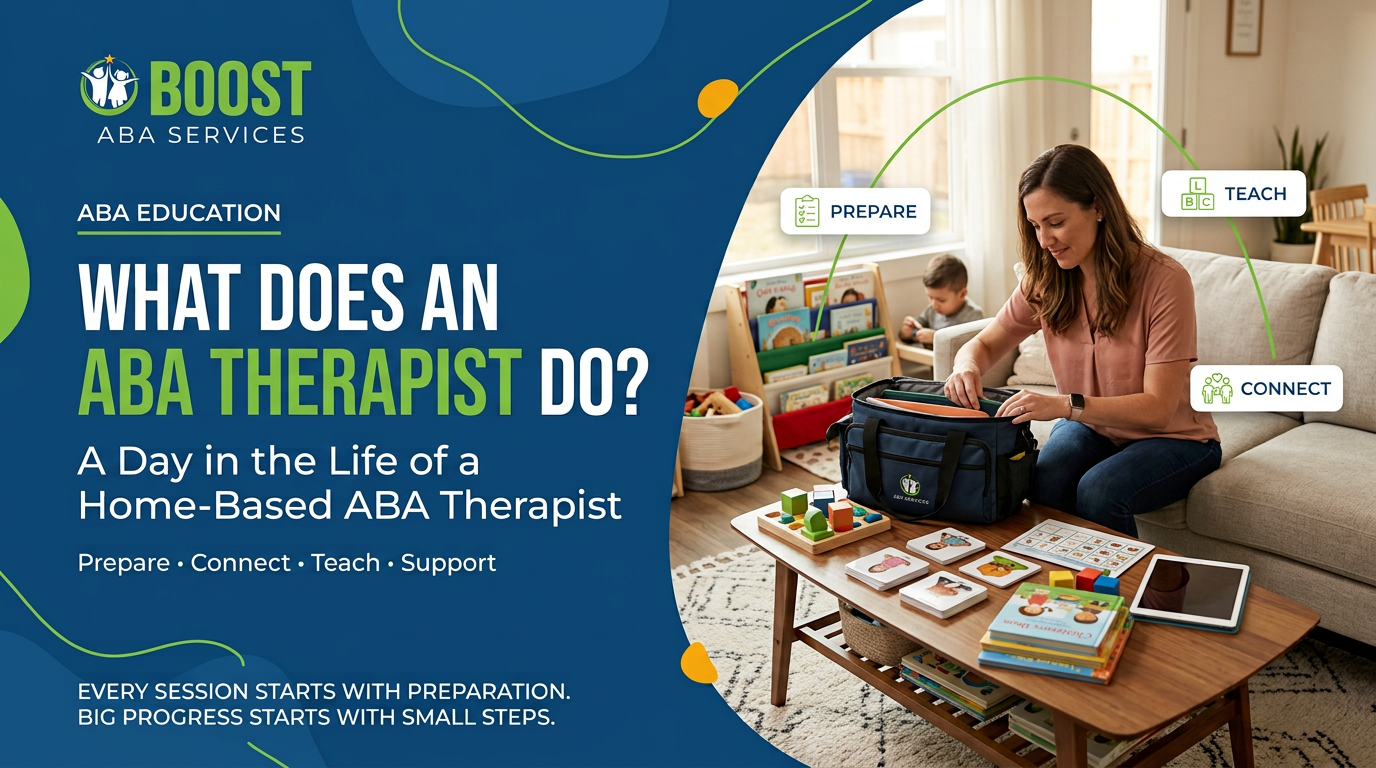
If you’ve ever wondered what an ABA therapist does, you may be surprised by how much happens before, during, and after a therapy session.
An ABA therapist’s day can involve preparing individualized activities, practicing communication and everyday skills, learning through play, supporting routines, observing progress, documenting sessions, and collaborating with families and the clinical team.
At Boost ABA Services, our ABA professionals provide home-based ABA therapy for children and families across New York, Texas, and Arizona. Because services take place in the child’s familiar environment, therapy can connect appropriate learning goals with real everyday routines.
So, what does a typical day in the life of an ABA therapist look like?
Let’s take a closer look.
What Does an ABA Therapist Do?
An ABA therapist works directly with children to implement appropriate strategies based on an individualized treatment plan.
Depending on the child’s goals, an ABA therapist may support skills related to:
- Communication
- Daily living skills
- Play
- Social interaction
- Everyday routines
- Transitions
- Learning
- Making choices
- Asking for help
- Greater independence
The exact activities will vary from child to child.
That’s important because ABA therapy is individualized. A session for one child may look completely different from a session for another.
Before the Session: Preparation Matters
A therapist’s work often starts before they meet the child.
Preparation can involve reviewing appropriate goals, organizing materials, considering the child’s interests, and preparing activities that align with the treatment plan.
For a home-based therapist, this may mean preparing a therapy bag with items such as:
- Picture cards
- Books
- Blocks
- Puzzles
- Visual supports
- Age-appropriate games
- Activity materials
- Other individualized resources
The goal isn’t to bring a huge collection of toys into the home.
Instead, materials should be selected thoughtfully based on the child’s goals and interests.
Why Preparation Matters
A well-prepared session gives the therapist a clear direction while still allowing flexibility.
For example, a therapist may have an activity planned to support communication. However, if the child becomes especially interested in another appropriate activity, the therapist may be able to incorporate that interest into the learning opportunity.
In other words, preparation provides structure, while individualized care allows the session to respond to the child.
Arriving at the Family’s Home
One of the unique parts of home-based ABA therapy is that the therapist enters the child’s familiar environment.
The home may include the child’s:
- Favorite toys
- Family members
- Normal routines
- Preferred activities
- Everyday challenges
- Familiar spaces
This can provide useful context for the therapist and clinical team.
For example, a child may communicate differently during a familiar family routine than they do in a structured therapy setting.
Similarly, a daily living skill may be easier to practice in the environment where the child normally completes that activity.
The Session Begins With Connection
ABA therapy isn’t simply about immediately starting a list of exercises.
Building a comfortable working relationship with the child can be an important part of the session.
The therapist may begin by:
- Greeting the child
- Joining an activity
- Playing
- Following the child’s interests
- Offering appropriate choices
- Observing how the child is doing that day
The therapist can use this time to understand the child’s engagement and identify appropriate opportunities to work toward individualized goals.
Learning Through Play
Play can be a meaningful context for learning.
Depending on the child’s goals, a therapist might use blocks, puzzles, pretend play, books, games, or other activities to create opportunities for practicing skills.
For example, during a simple block activity, a child may practice:
Communication: Requesting another block.
Social interaction: Taking turns.
Choice-making: Selecting a color.
Following directions: Completing a simple step.
Problem-solving: Figuring out how pieces fit together.
The activity itself may look like ordinary play.
However, the therapist can use appropriate opportunities within that activity to support the child’s individualized goals.
Communication Happens Throughout the Day
Communication isn’t limited to a specific communication exercise.
Children communicate throughout everyday activities.
They may communicate when they:
- Want something
- Need help
- Want to stop
- Want more
- Need a break
- Want someone’s attention
- Make a choice
Communication can take many forms, including:
- Spoken words
- Gestures
- Pointing
- Pictures
- Signs
- AAC
- Other individualized communication methods
An ABA therapist may support functional communication during play, routines, meals, transitions, or other appropriate activities.
The goal is not to make every child communicate in the same way.
Instead, the focus should be on meaningful communication that fits the individual child.
Practicing Everyday Skills
One of the biggest differences between home-based ABA therapy and therapy delivered in another environment is the opportunity to work within familiar daily routines.
Depending on the child’s treatment plan, an ABA therapist may support skills related to:
Getting Dressed
Breaking the routine into manageable steps and supporting appropriate participation.
Brushing Teeth
Practicing an age-appropriate sequence of personal care steps.
Cleaning Up
Supporting participation in an everyday household routine.
Mealtime
Working on appropriate communication, choices, or other individualized goals.
Transitions
Practicing movement from one activity to another using appropriate supports.
These activities may look simple, but they can involve multiple skills.
Supporting Transitions
Transitions happen throughout the day.
A child may move from:
Play → Cleanup
Breakfast → Getting Ready
Screen Time → Another Activity
Indoor Play → Leaving Home
Activity → Bedtime
For some children, these changes can be difficult.
Depending on the child’s goals, an ABA therapist may use appropriate strategies such as:
- Visual schedules
- Clear language
- Countdown warnings
- First-then language
- Appropriate choices
- Reinforcement
The exact strategy depends on the individual child and treatment plan.
Observing and Adjusting
An ABA therapist isn’t simply following instructions without paying attention to how the child responds.
Observation is an important part of the process.
The therapist may notice:
- Which activities engage the child
- Which instructions are understood
- Where additional support is needed
- How the child communicates
- What happens during transitions
- How the child responds to different strategies
Based on the treatment plan and supervision provided by the clinical team, these observations can help inform future sessions.
Documentation Is Part of the Job
There is also an important part of ABA therapy that parents may not see.
Documentation.
Depending on the service model and treatment plan, therapists may record relevant information about the session and the child’s progress.
This information can help the clinical team understand what is happening over time.
Documentation can support communication between team members and help BCBAs make informed decisions about individualized treatment.
Therapists should never display private client information publicly.
Working With the BCBA
An ABA therapist doesn’t work alone.
A Board Certified Behavior Analyst (BCBA) may develop and oversee the child’s treatment program and supervise members of the ABA team.
The therapist may implement appropriate strategies under that supervision and provide relevant observations about the child’s sessions.
This creates a team structure involving:
BCBA → Therapist → Child → Family
Each person contributes something different.
The BCBA brings clinical oversight.
The therapist works directly with the child.
The family provides valuable knowledge about the child’s everyday life.
The child brings their own strengths, preferences, communication, and individual needs.
Parents Are Part of the Team
Because Boost ABA Services provides home-based ABA therapy, parents and caregivers may naturally be part of the child’s therapy environment.
That doesn’t mean parents need to become therapists.
Instead, families can contribute by:
- Sharing observations
- Discussing routines
- Explaining what works at home
- Sharing family priorities
- Asking questions
- Participating in caregiver training when appropriate
- Communicating concerns with the clinical team
Parents know their child in a way that no professional can learn from a session alone.
Therefore, collaboration can be an important part of family-centered ABA services.
Every Session Can Look Different
There is no single script for every ABA therapy session.
One day might involve lots of play.
The session should reflect the child’s individualized treatment plan and current needs.
This is why a day in the life of an ABA therapist can look different from one family to another.
The Human Side of ABA Therapy
ABA therapy is also about relationships.
A therapist may spend time learning what a child enjoys, discovering what motivates them, finding ways to make activities engaging, and building trust.
A successful session doesn’t necessarily mean everything went perfectly.
Sometimes meaningful work involves trying something, adjusting the approach, taking a break, and trying again later.
Children have different days just like adults do.
A good therapist recognizes that.
Small Moments Can Matter
The most meaningful moments aren’t always dramatic.
They can be small.
These moments may be part of an individualized treatment plan, depending on the child’s goals.
At Boost ABA Services, we believe meaningful progress can begin with small steps.
Why Home-Based ABA Therapy Can Be Meaningful
Home is where children experience many of their everyday routines.
Because of that, home-based ABA therapy can provide opportunities to connect appropriate treatment goals with real-life activities.
Instead of learning a skill only in an unfamiliar environment, the child may have opportunities to practice appropriate skills within:
- Morning routines
- Play
- Mealtimes
- Personal care
- Family activities
- Transitions
- Communication
- Household routines
The goal isn’t to make home feel like a clinic.
Rather, appropriate learning opportunities can be incorporated into the child’s natural environment when they align with individualized treatment goals.
What Makes a Good ABA Therapist?
Parents may wonder what qualities to look for in an ABA therapist.
A good therapist should work within their role and supervision structure while demonstrating qualities such as:
- Patience
- Professionalism
- Respect
- Communication
- Flexibility
- Attentiveness
- Reliability
- Responsiveness to the child’s needs
- Collaboration with families and the clinical team
Most importantly, the therapist should understand that every child is different.
A Day in the Life of an ABA Therapist at Boost ABA Services
At Boost ABA Services, a typical day can involve much more than simply delivering therapy.
It can include:
Preparing
Reviewing appropriate goals and organizing materials.
Connecting
Building a comfortable relationship with the child.
Teaching
Creating opportunities to practice meaningful skills.
Playing
Using enjoyable activities as appropriate learning opportunities.
Observing
Paying attention to how the child responds.
Documenting
Recording relevant information from the session.
Collaborating
Communicating with families and the clinical team.
Adjusting
Responding appropriately to the child’s individual needs within the treatment plan.
Every day can be different because every child is different.
Home-Based ABA Therapy in New York, Texas & Arizona
Boost ABA Services provides home-based ABA therapy in New York, Texas, and Arizona.
Our approach is centered around individualized goals and meaningful skills that connect with everyday life.
Depending on the child’s treatment plan, ABA services may support:
- Communication
- Daily living skills
- Social interaction
- Play
- Routines
- Transitions
- Learning
- Independence
Service availability may vary by location.
Want to Learn More About ABA Therapy?
If you’ve ever wondered what an ABA therapist does, the answer is more than simply following a schedule.
ABA therapists prepare, observe, teach, play, document, collaborate, and support individualized treatment goals under appropriate clinical supervision.
At Boost ABA Services, our home-based approach allows appropriate therapy goals to connect with the child’s familiar environment and everyday life.
If you’re exploring ABA therapy for your child, our team can answer questions about home-based services, insurance verification, availability, and getting started.
Boost ABA Services
Home-Based ABA Therapy | NY • TX • AZ
📞 845-377-0024
Open Monday – Friday
Big Progress Starts With Small Steps.
