
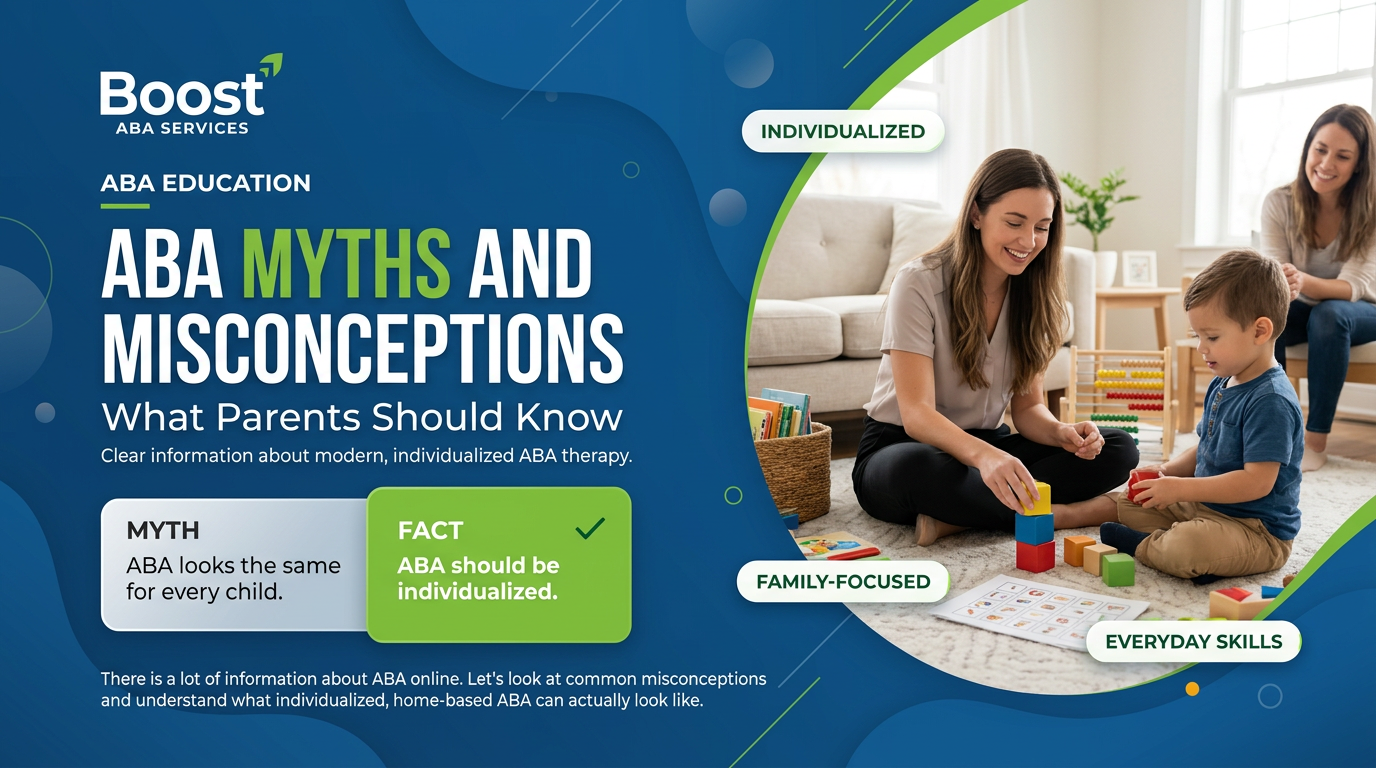
If you’ve searched for ABA therapy online, you’ve probably encountered a wide range of opinions, experiences, and information.
Some of it may be helpful. Some of it may be outdated. And some of it may not explain how individualized ABA services are designed today.
For parents, sorting through all of that information can feel overwhelming.
At Boost ABA Services, we believe families deserve clear, straightforward information when exploring support for their children. We provide individualized home-based ABA therapy across New York, Texas, and Arizona, with an approach centered around the individual child and family.
In this guide, we’ll address several common ABA myths and misconceptions that parents may encounter online.
Myth #1: ABA Therapy Is the Same for Every Child
Fact: ABA Therapy Should Be Individualized
One of the most common ABA therapy misconceptions is that every child receives exactly the same type of therapy.
In reality, children have different strengths, needs, interests, communication styles, learning preferences, and family priorities.
As a result, their treatment goals may look very different.
For example, one child may have individualized goals related to communication. Another may be working on daily living skills. Another may be practicing transitions or social interaction.
Depending on the child’s treatment plan, ABA may support areas such as:
- Communication
- Social interaction
- Daily living skills
- Play
- Everyday routines
- Transitions
- Learning
- Making choices
- Asking for help
- Greater independence
The goal isn’t to make every child follow the same program.
Instead, individualized ABA therapy should be built around the needs and goals of the individual child.
Myth #2: ABA Is Just Sitting at a Table
Fact: ABA Can Happen During Everyday Activities
Another common misconception is that ABA means a child spends the entire session sitting at a table completing repetitive exercises.
Structured activities may be appropriate for certain goals. However, ABA therapy can also involve play, communication, routines, and everyday activities.
This can be particularly relevant with home-based ABA therapy.
For example, appropriate learning opportunities may happen while a child is:
- Getting dressed
- Playing with blocks
- Reading a book
- Eating a meal
- Cleaning up toys
- Asking for help
- Making a choice
- Moving from one activity to another
The activity may look like an ordinary part of the child’s day.
However, when it aligns with an individualized treatment plan, it can provide an opportunity to practice a meaningful skill.
Myth #3: ABA Is Only About Stopping Behaviors
Fact: ABA Can Include Teaching and Strengthening Skills
The word “behavior” can sometimes make ABA sound like it is only about stopping behaviors adults don’t want to see.
However, behavior analysis can also be used to understand how skills are learned and to support the development of meaningful behaviors.
Depending on the child’s individualized goals, ABA may focus on:
Communication
Helping a child develop meaningful ways to express needs, choices, or requests.
Daily Living Skills
Supporting participation in age-appropriate routines.
Social Skills
Creating opportunities for appropriate interaction and communication.
Learning Skills
Supporting the development of skills that are meaningful to the child.
Independence
Helping a child participate more independently in appropriate everyday activities.
When challenging behavior is part of a treatment plan, a clinical team may also consider what happens before and after the behavior and whether the child has an appropriate alternative way to communicate or respond.
The focus should be on understanding the individual child and developing appropriate support.
Myth #4: Parents Aren’t Involved in ABA
Fact: Parents Can Be Important Members of the Team
Parents sometimes assume that ABA therapy happens entirely between the therapist and child.
However, families can play an important role in the process.
Parents and caregivers know their child’s everyday life.
They know:
- What their child enjoys
- How their child communicates
- Which routines are difficult
- What motivates their child
- What their child does well
- Which situations may be challenging
- Which skills matter most to their family
This information can be especially valuable with home-based ABA services.
Depending on the child’s treatment plan, caregiver involvement may include:
- Sharing observations
- Discussing family priorities
- Participating in caregiver training
- Learning about appropriate strategies
- Supporting skills during everyday routines
- Communicating with the clinical team
- Discussing progress
Parents don’t need to become therapists.
Instead, they can be collaborative partners who bring valuable knowledge of their child to the team.
Myth #5: Home-Based ABA Means Turning Your Home Into a Clinic
Fact: Home-Based ABA Can Fit Into Everyday Life
Some parents may worry that having an ABA therapist come to the home means their house will feel like a therapy center.
That isn’t the goal.
Home-based ABA therapy takes place in the child’s familiar environment, but the purpose is to provide appropriate individualized support.
Depending on the child’s treatment plan, therapy may naturally incorporate activities such as:
- Play
- Communication
- Getting dressed
- Personal care
- Mealtime routines
- Cleanup
- Transitions
- Family activities
- Everyday learning opportunities
The goal isn’t to turn every part of the home into a therapy exercise.
Instead, appropriate skills can be practiced within the routines and environments where children naturally use them.
Myth #6: Every Child Should Have the Same ABA Goals
Fact: Meaningful Goals Depend on the Individual Child
Another misconception is that there is a universal checklist of skills every child receiving ABA should work on.
There isn’t.
One child’s meaningful goal may involve asking for help.
The appropriate goals should be based on the individual child, their needs, their current skills, and relevant family priorities.
Therefore, individualized treatment planning is an important part of ABA services.
Myth #7: Communication Means Speaking
Fact: Communication Can Take Many Forms
One of the most important ABA myths parents hear online involves communication.
Communication isn’t limited to spoken words.
Children may communicate through:
- Speech
- Gestures
- Pointing
- Pictures
- Signs
- Facial expressions
- AAC
- Other individualized communication methods
For example, a child may use a picture to request a snack, point to a preferred activity, use a gesture to request assistance, or use an AAC device to communicate.
The goal should be meaningful communication that fits the individual child.
ABA therapy should not assume that every child needs to communicate in exactly the same way.
Myth #8: ABA Has to Be the Same Every Day
Fact: Sessions Can Change With the Child’s Needs
Children don’t have exactly the same day every day.
Their energy, interests, routines, and circumstances can vary.
For that reason, an ABA session doesn’t necessarily need to look identical from one day to the next.
The overall treatment plan provides direction.
Within that framework, appropriate activities and strategies may vary based on the child’s individualized goals and current needs.
For example, one session may include more play-based learning.
Another may involve working through an everyday routine.
Another may focus more on communication or transitions.
As a result, flexibility can be an important part of individualized care.
Myth #9: ABA Progress Looks the Same for Every Child
Fact: Progress Is Individual
Comparing children can be especially difficult for parents.
You may see another child learning a skill and wonder why your child isn’t doing the same thing.
However, every child has a different starting point.
Progress may look like:
- Communicating a need
- Asking for help
- Making a choice
- Participating in a routine
- Trying a new activity
- Completing part of an everyday task
- Practicing a transition
- Becoming more independent with an age-appropriate skill
These are examples, not universal milestones.
Instead, progress should be considered in relation to the individual child’s goals and treatment plan.
Myth #10: ABA Only Matters During the Therapy Session
Fact: Everyday Life Can Provide Opportunities for Practice
Children don’t stop using their skills when therapy ends.
That’s why home-based ABA therapy can be relevant for families who want appropriate learning opportunities to connect with everyday life.
When appropriate, a skill practiced during therapy can also be supported within familiar routines.
This can help connect learning with real-world situations.
What Does Modern, Individualized ABA Look Like?
So, if many of these misconceptions don’t accurately describe every ABA program, what can modern individualized ABA look like?
It depends on the child.
However, a home-based session may involve:
Preparing
The therapist reviews appropriate goals and prepares relevant materials.
Connecting
The therapist builds a comfortable working relationship with the child.
Teaching
The therapist creates appropriate opportunities to practice individualized skills.
Playing
Preferred activities may provide natural opportunities for communication, interaction, and learning.
Practicing
The child works on relevant skills within structured or everyday activities.
Observing
The therapist pays attention to how the child responds.
Documenting
Relevant session information is recorded according to the service model and treatment plan.
Collaborating
The therapist and clinical team communicate with parents and caregivers as appropriate.
Why Home-Based ABA Can Be Meaningful
At Boost ABA Services, our services are home-based.
That means appropriate ABA support can take place within the child’s familiar environment.
Home is where many important routines happen.
For example:
Morning: Getting dressed, brushing teeth, eating breakfast, and preparing to leave.
Afternoon: Playing, having a snack, completing activities, and transitioning between routines.
Evening: Mealtime, cleanup, personal care, and preparing for bed.
Depending on the child’s individualized goals, these routines may provide opportunities to practice meaningful skills.
The goal isn’t to make every moment a therapy session.
Instead, it’s about connecting appropriate treatment goals with everyday life.
How Can Parents Evaluate ABA Information Online?
The internet can be a useful source of information.
However, not every article, video, social media post, or personal experience represents every ABA provider or every child’s experience.
When you see information about ABA online, consider asking:
Who created this information?
Is it describing a specific experience or making a broad claim?
Does it explain how individualized treatment works?
Does it acknowledge that children have different needs?
Can the provider explain its approach clearly?
You can also ask potential ABA providers directly about their treatment model.
Questions to Ask an ABA Provider
If you’re considering ABA services, here are several questions you can take with you:
- How will my child’s goals be individualized?
- Who develops and oversees the treatment plan?
- How is the BCBA involved?
- How are parents and caregivers involved?
- What does a typical home-based ABA session look like?
- How will my child’s communication style be supported?
- How is progress measured?
- How often are treatment goals reviewed?
- How will my child’s interests and strengths be incorporated?
- How does insurance verification work?
By asking these questions, you can better understand the provider’s approach before making a decision.
Home-Based ABA Therapy in New York, Texas & Arizona
Boost ABA Services provides home-based ABA therapy in New York, Texas, and Arizona.
Our approach is centered around individualized goals and meaningful skills that connect with everyday life.
Depending on each child’s treatment plan, services may support:
- Communication
- Daily living skills
- Everyday routines
- Social interaction
- Play
- Transitions
- Learning
- Independence
Service availability may vary by location.
ABA Therapy in New York
Families searching for home-based ABA therapy in New York can contact Boost ABA Services to learn about available services and the process of getting started.
ABA Therapy in Texas
If you’re looking for in-home ABA therapy in Texas, our team can help you learn more about our home-based approach and available services.
ABA Therapy in Arizona
Families searching for home-based ABA therapy in Arizona can contact Boost ABA Services to learn more about our approach and potential next steps.
The Biggest ABA Myth to Remember
Perhaps the biggest misconception is that there is one universal ABA experience.
The right questions aren’t only about what ABA is supposed to look like.
They’re also about:
What does this provider’s approach look like?
Those questions can help you move beyond online assumptions and learn what a specific provider actually offers.
Learn More About Home-Based ABA Therapy
At Boost ABA Services, we provide individualized home-based ABA therapy for children and families across New York, Texas, and Arizona.
Our approach is designed around the individual child, with appropriate support connected to meaningful everyday skills and family priorities.
If you’re researching ABA and have questions about what home-based services may look like, we’re here to help you understand your options.
Boost ABA Services
Home-Based ABA Therapy | NY • TX • AZ
📞 845-377-0024
Open Monday – Friday
Big Progress Starts With Small Steps.
