
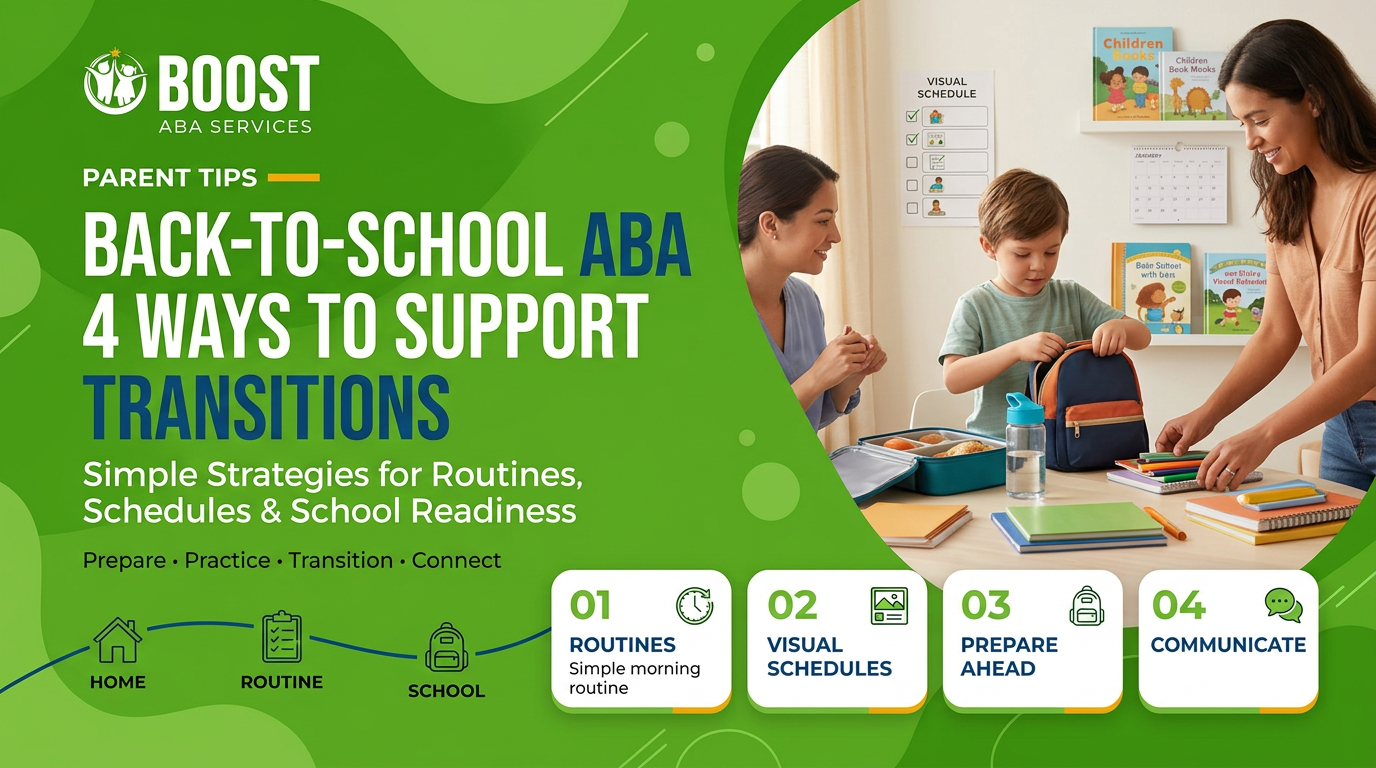
A new school year can bring exciting changes, but it can also mean new routines, new expectations, different schedules, and transitions between familiar activities.
For children who benefit from additional support with routines or transitions, preparing ahead of time can make the change easier to understand.
These back-to-school ABA tips focus on four practical areas parents can consider: creating predictable routines, using visual schedules, preparing materials ahead of time, and communicating with teachers.
At Boost ABA Services, we provide individualized home-based ABA therapy for children and families across New York, Texas, and Arizona. Because our services take place in the home, appropriate school-transition goals can sometimes be connected with the routines children practice before and after school.
Why Can Back-to-School Transitions Be Challenging?
Going back to school can involve many changes at once.
A child may need to:
- Wake up at a different time
- Follow a new morning routine
- Get dressed earlier
- Eat breakfast on a schedule
- Pack a backpack
- Leave the house at a specific time
- Enter a new classroom
- Meet new teachers
- Follow different expectations
- Transition between activities
- Adjust to a new school schedule
For some children, these changes may require additional preparation.
However, every child is different. A strategy that works well for one child may not work the same way for another.
The goal isn’t to make every transition perfect.
Instead, parents can focus on making upcoming changes clear, predictable, and manageable while considering their child’s individual needs.
1. Rebuild the School Routine Before School Starts
One of the most practical back-to-school tips for children with autism is to gradually reintroduce the school-day routine.
If summer has meant later bedtimes, later mornings, or a flexible schedule, suddenly changing everything on the first day can be a significant adjustment.
Instead, when appropriate, families can begin practicing parts of the school routine before the first day.
For example:
Wake up → Get dressed → Breakfast → Brush teeth → Backpack → Shoes → Leave
You don’t necessarily need to practice the entire routine every day.
Start with the parts that are most important or most challenging for your child.
Practice the Morning Routine
Try practicing the order of familiar activities.
For example:
1. Wake up
2. Get dressed
3. Eat breakfast
4. Brush teeth
5. Pack backpack
6. Put on shoes
7. Leave home
Over time, this sequence can become more familiar.
If your child needs additional support with certain steps, those steps can be addressed individually.
Practice the Night-Before Routine
Back-to-school preparation doesn’t only happen in the morning.
The evening routine can also help prepare for the next day.
Consider practicing:
- Choosing clothes
- Packing the backpack
- Preparing school materials
- Setting out shoes
- Reviewing the next day’s schedule
- Following the bedtime routine
Preparing some items the night before may reduce the number of decisions required during a busy morning.
2. Use a Visual Schedule
Another helpful ABA transition strategy is a visual schedule.
A visual schedule gives a child a way to see what is happening now and what comes next.
Depending on the child’s needs, it might use:
- Pictures
- Photographs
- Symbols
- Written words
- A checklist
- Objects representing activities
For example:
WAKE UP
↓
GET DRESSED
↓
BREAKFAST
↓
BRUSH TEETH
↓
BACKPACK
↓
SHOES
↓
SCHOOL
A visual schedule can make a routine easier to follow because the information remains visible instead of relying entirely on verbal reminders.
Keep the Visual Schedule Simple
A schedule doesn’t need to contain every detail of the day.
Start with the most important steps.
For a younger child, pictures may be easier to understand than a long written list.
For an older child, written words or a combination of words and visuals may be more appropriate.
The format should match the individual child’s communication and learning needs.
Use a First-Then Strategy
A first-then schedule can also be useful for certain transitions.
For example:
FIRST: GET DRESSED
THEN: BREAKFAST
Or:
FIRST: BACKPACK
THEN: FAVORITE ACTIVITY
This can help make the sequence clear.
However, the strategy should be used appropriately for the individual child rather than assuming it will work in every situation.
3. Prepare School Materials Ahead of Time
The first day of school can involve a lot of new information.
Preparing materials ahead of time can help reduce last-minute decisions.
Depending on your child’s age and school requirements, consider organizing:
- Backpack
- School supplies
- Lunch or snack items
- Water bottle
- Extra clothing if needed
- Communication supports
- Visual schedule
- Comfort or regulation tools if appropriate
- Any school-required materials
Let your child participate in preparation when appropriate.
For example, they might:
- Choose between two appropriate backpack options
- Help place supplies into the backpack
- Select clothes
- Put their water bottle in the bag
- Check items off a simple list
Participation can turn preparation into an opportunity to practice everyday skills.
Create a Simple School Checklist
A checklist might look like:
BACKPACK ✓
LUNCH ✓
WATER ✓
SHOES ✓
JACKET ✓
VISUAL SUPPORT ✓
Keep the checklist appropriate for your child’s age and abilities.
The goal isn’t to create another complicated task.
Instead, it can provide a simple reminder of what needs to happen before leaving home.
4. Communicate With Teachers and School Staff
Parents aren’t the only people helping a child transition back to school.
Teachers and school staff can also benefit from understanding relevant information about the child’s routines, communication, strengths, and support needs.
When appropriate, consider sharing information such as:
- How your child communicates
- What types of visual supports are useful
- Important routines
- Preferred ways of receiving instructions
- Relevant transition strategies
- How your child indicates they need help
- Important family priorities
You don’t need to send an overwhelming amount of information.
Instead, focus on information that can help school staff understand your child’s individual needs.
Ask Questions Before the First Day
If possible, parents may want to ask:
- What will the daily schedule look like?
- How will transitions be handled?
- Who should we contact with questions?
- What communication supports can be used at school?
- Are there visual schedules available?
- What should we send from home?
- What happens if the routine changes?
Knowing what to expect can help parents prepare their child for the new school environment.
How Home-Based ABA Can Support School Transitions
At Boost ABA Services, we provide home-based ABA therapy.
Because therapy takes place in the child’s familiar home environment, appropriate goals related to school preparation may sometimes be incorporated into existing routines when they align with the child’s individualized treatment plan.
For example, a child may work on:
Morning Routines
Practicing appropriate steps involved in getting ready for school.
Communication
Practicing ways to request help, make choices, or communicate needs.
Transitions
Working on appropriate strategies for moving from one activity to another.
Independence
Participating in age-appropriate routines such as preparing a backpack.
Following Schedules
Using visual supports to understand a sequence of activities.
These are examples only. Each child’s treatment goals should be individualized.
What If Your Child Has Difficulty With the New Routine?
Even with preparation, the first weeks of school may not go exactly as planned.
A child may have difficulty with:
- Earlier wake-up times
- Leaving home
- New teachers
- New classrooms
- Changes in routine
- School transportation
- Transitions
- Unfamiliar activities
Try to look at the specific situation rather than assuming the child is simply refusing.
Ask:
What changed?
Does my child understand what comes next?
What support might make the next step clearer?
Understanding the situation can help parents and professionals identify appropriate next steps.
Practice Transitions Before the First Day
You don’t necessarily need to wait until school starts to practice school-related transitions.
If appropriate, consider practicing:
Bedroom → Bathroom
Bathroom → Getting Dressed
Getting Dressed → Breakfast
Breakfast → Backpack
Backpack → Shoes
Shoes → Door
These are small transitions, but together they form the larger school-morning routine.
Similarly, if the child will be attending a new school, families may benefit from becoming familiar with the route or school environment when opportunities are available.
Use Clear and Predictable Language
Long explanations can sometimes make a transition more complicated.
Instead, use simple language that matches the child’s communication needs.
For example:
“First shoes, then car.”
“First backpack, then breakfast.”
“School is tomorrow.”
“Two more minutes, then cleanup.”
The goal is not to talk less in every situation.
Rather, during a transition, clear language can help make the next step easier to understand.
Reinforce Participation
When a child participates appropriately in a routine, specific positive feedback can help recognize that participation.
Instead of only saying:
“Good job.”
Try something more specific:
“Nice job putting your backpack away.”
Or:
“You got your shoes ready.”
Depending on the child’s individualized needs and treatment plan, reinforcement may take different forms.
What is meaningful for one child may not be meaningful for another.
Therefore, reinforcement strategies should be individualized.
Don’t Expect the First Week to Be Perfect
The first days of school can involve a lot of adjustment.
Even a routine that seemed easy during practice may feel different when the real school day begins.
There may be unexpected schedule changes.
The bus may arrive late.
A teacher may introduce a new activity.
A favorite activity may not be available.
The child may simply have a difficult day.
That’s okay.
The purpose of preparation isn’t to eliminate every unexpected situation.
Instead, preparation can help give children familiar tools and routines to work from.
Back-to-School Tips for Parents
Here is a simple checklist to save:
Before School Starts
✓ Create a simple visual schedule.
✓ Practice relevant transitions.
During the First Weeks
✓ Use clear language.
✓ Communicate with teachers.
Every Child’s School Routine Will Look Different
There is no perfect back-to-school routine for every child.
Some children may need visual schedules.
Others may benefit from verbal reminders.
Some may need more time to transition.
Others may need opportunities to make choices.
The most useful support is the support that is appropriate for the individual child.
This is also why individualized ABA therapy matters.
ABA services should be based on the child’s strengths, needs, goals, and circumstances rather than applying exactly the same strategy to every child.
Family Involvement Matters
Parents and caregivers can provide valuable information about what happens before and after school.
They know:
- What mornings look like
- Which routines are difficult
- How their child communicates
- What activities their child enjoys
- What supports have been useful
- What changes may affect the routine
At Boost ABA Services, our family-centered approach recognizes that parents are important members of the support team.
Home-based services can provide opportunities to work on appropriate goals within the environment where many school-preparation routines naturally occur.
Home-Based ABA Therapy in New York, Texas & Arizona
Boost ABA Services provides home-based ABA therapy in New York, Texas, and Arizona.
Our individualized approach can support meaningful skills connected to everyday life, depending on each child’s treatment plan.
Potential areas may include:
Communication • Daily Living Skills • Routines • Transitions • Play • Social Interaction • Independence
Service availability may vary by location.
New York
Families looking for home-based ABA therapy in New York can contact Boost ABA Services to learn about services and availability in their area.
Texas
Parents searching for home-based ABA therapy in Texas can contact our team to learn more about our approach and getting started.
Arizona
Families looking for home-based ABA therapy in Arizona can reach out to learn more about our individualized ABA services.
Start the School Year One Step at a Time
Back-to-school preparation doesn’t have to mean changing everything at once.
Start with one routine.
One visual schedule.
One transition.
One backpack.
One conversation with the teacher.
Small preparations can help create a clearer starting point for the school year.
At Boost ABA Services, we believe every child has their own strengths, needs, and path.
Big Progress Starts With Small Steps.
Learn More About Home-Based ABA Therapy
If you’re exploring home-based ABA therapy for your child, Boost ABA Services can help you learn more about our approach, services, insurance verification, and the process of getting started.
Boost ABA Services
Home-Based ABA Therapy | NY • TX • AZ
📞 845-377-0024
Open Monday – Friday
