
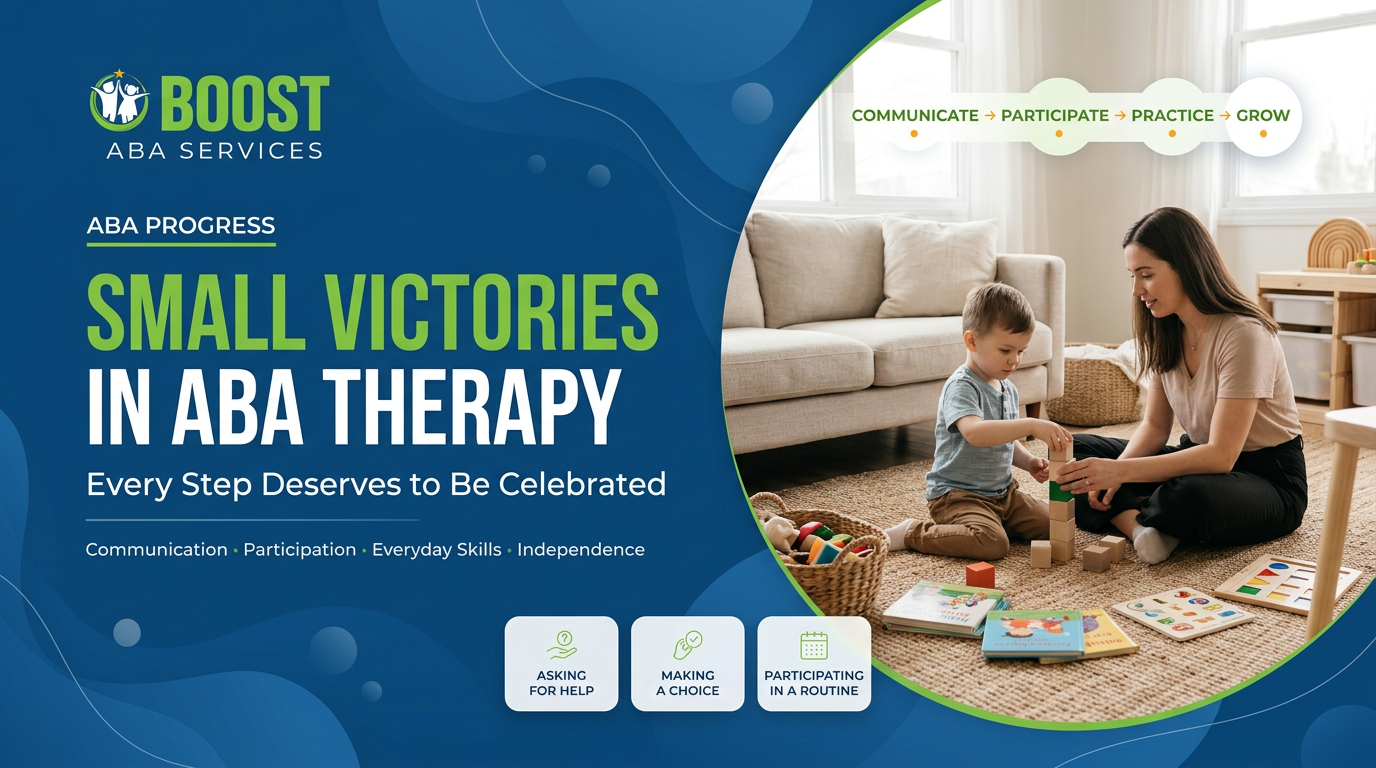
Sometimes the moments that matter most are the moments other people barely notice.
To someone else, these moments might look small. To a family, they can feel meaningful.
At Boost ABA Services, we provide individualized home-based ABA therapy for children and families across New York, Texas, and Arizona. Our approach recognizes that every child has different strengths, needs, communication styles, interests, and goals.
That’s why small victories in ABA therapy can look different for every child.
What Does Progress Look Like in ABA Therapy?
There isn’t one definition of progress that applies to every child.
Depending on a child’s individualized treatment plan, ABA therapy may support skills related to:
- Communication
- Daily living skills
- Social interaction
- Play
- Everyday routines
- Transitions
- Learning
- Making choices
- Asking for help
- Greater independence
For one child, progress might involve communicating a request.
For another, it could mean participating in one additional step of a daily routine.
Another child may be working toward using a new communication method.
In other words, progress should be considered in the context of the individual child rather than through comparison with other children.
1. Requesting Help
One of the small moments parents may notice is a child finding a meaningful way to ask for help.
Imagine a child struggling to open a container.
Instead of giving up or becoming frustrated, the child communicates:
“Help.”
That communication might happen through speech, a gesture, pointing, a picture, signs, or AAC.
The specific communication method is less important than giving the child a meaningful way to express what they need.
Why This Can Matter
Asking for help is a functional skill that children may use throughout everyday life.
They may need help:
- Opening something
- Reaching an item
- Completing an activity
- Getting dressed
- Understanding an instruction
- Navigating a routine
Depending on the child’s individualized goals, ABA therapy for communication skills may provide opportunities to practice appropriate ways to request assistance.
2. Participating in a Routine
Another small victory may be participating in part of an everyday routine.
Getting dressed, brushing teeth, cleaning up, or preparing for school can involve multiple steps.
A child may not complete the entire routine independently.
However, they may participate in one more step than they did previously.
For example:
Pick up shirt → Put arm through sleeve → Pull shirt down
A parent may notice that their child is now participating in another part of the process.
That can be meaningful.
Home-Based ABA and Daily Routines
Because Boost ABA Services provides home-based ABA therapy, appropriate daily living goals can sometimes be practiced within the routines where they naturally occur.
The goal isn’t to turn every household activity into therapy.
Instead, familiar routines can provide opportunities to practice appropriate individualized skills.
3. Communicating a Need
Communication isn’t limited to asking for an object.
Children may need to communicate:
“I’m finished.”
“I don’t want that.”
“I need a break.”
“More.”
“Help.”
“I want this.”
Depending on the child, these messages may be communicated through speech, gestures, pictures, AAC, signs, or other methods.
Being able to communicate needs in a meaningful way can be an important individualized goal.
Communication Looks Different for Every Child
There isn’t one communication method that every child should use.
Some children communicate primarily through spoken language.
Others use multiple communication methods.
An individualized approach considers what is appropriate and meaningful for that particular child.
4. Trying Something New
Sometimes progress looks like trying.
A child may explore a new activity.
Touch a new material.
Try a different food when appropriate and supported by the appropriate professionals.
Participate in an unfamiliar game.
Enter a new environment.
Or simply stay engaged with an activity a little longer.
These moments don’t need to be dramatic to matter.
Small steps can represent meaningful participation.
At the same time, children should not be pressured into activities simply to create a “success story.”
Support should respect the child’s individual needs, preferences, communication, and comfort.
5. Making a Choice
Choice-making is another everyday skill.
A parent might ask:
“Blue shirt or green shirt?”
The child points to one.
Or:
“Blocks or puzzle?”
The child selects an activity.
Making choices can provide opportunities for children to communicate preferences and participate in everyday decisions.
Depending on the child’s treatment plan, choice-making may be an appropriate skill to practice across different routines.
6. Participating in Play
Play can provide many natural opportunities for learning.
A child might:
- Take a turn
- Choose a toy
- Request another item
- Follow a simple direction
- Participate in a shared activity
- Communicate with a parent or therapist
- Play independently for a period of time
The specific goals will vary by child.
However, play can be a meaningful context for practicing appropriate communication, social, and learning skills.
7. Completing One More Step Independently
Independence is often built gradually.
A child may need assistance with a task at first.
Over time, they may participate in another step with less support when appropriate.
For example:
Parent helps → Child participates → Child completes a step → Child practices independently
This doesn’t mean every skill should be completed independently.
Asking for help is also an important skill.
The goal is to support an appropriate level of independence based on the individual child’s needs and goals.
Why Small Victories Matter to Families
Parents see the full picture.
They remember what a routine looked like yesterday, last month, or earlier in their child’s development.
They notice subtle changes that someone else might overlook.
These moments can carry meaning because they happen within real family life.
Home-Based ABA Therapy Makes Everyday Moments Relevant
At Boost ABA Services, our ABA services are home-based.
That means appropriate therapy can take place within the child’s familiar environment.
Home is where many everyday skills naturally happen.
Morning routines.
Mealtimes.
Play.
Getting dressed.
Personal care.
Cleanup.
Family activities.
Transitions.
Depending on the child’s individualized treatment plan, these activities may provide opportunities to practice meaningful skills.
This is one reason some families choose in-home ABA therapy.
The focus can connect with the child’s actual routines rather than treating everyday life as something completely separate from therapy.
Progress Doesn’t Have to Be Dramatic
Social media often highlights major milestones.
But real development isn’t always dramatic.
Sometimes progress is quiet.
These moments may not make a dramatic video.
Nevertheless, they can be meaningful to the people who experience them every day.
Parents Don’t Need to Compare
It’s natural for parents to compare.
You may see another child’s progress and wonder:
“Should my child be doing that?”
However, another child’s development isn’t a measurement of yours.
Children have different:
- Starting points
- Strengths
- Needs
- Interests
- Communication styles
- Family environments
- Goals
Therefore, individualized ABA therapy should focus on the individual child.
The question isn’t necessarily:
“Is my child doing what another child is doing?”
Instead, consider:
“What meaningful skills are appropriate for my child right now?”
What Parents Can Look For
If you’re wondering what progress may look like during your child’s ABA journey, pay attention to small changes in everyday life.
You might notice:
Communication
Your child finds a new way to express a need or preference.
Participation
Your child becomes involved in another part of a familiar activity.
Choice-Making
Your child communicates a preference between appropriate options.
Daily Living
Your child participates in another step of an age-appropriate routine.
Transitions
Your child practices moving between activities using appropriate supports.
Independence
Your child completes an appropriate step with less assistance.
These examples are not universal milestones.
Instead, they illustrate how progress can look different from one child to another.
Celebrating Progress Without Pressure
Celebrating small victories doesn’t mean turning every moment into a performance.
Children don’t need to achieve something simply so adults can celebrate it.
Instead, families can recognize meaningful participation and skill development while respecting the child’s individuality.
Sometimes, recognition can be quiet.
What matters is that the child feels supported rather than pressured.
How ABA Professionals Support Individualized Progress
Depending on the child’s treatment plan, an ABA professional may:
- Break larger skills into smaller steps
- Create appropriate opportunities for practice
- Use individualized reinforcement
- Provide prompts when appropriate
- Gradually reduce assistance when appropriate
- Observe the child’s responses
- Track relevant progress
- Communicate with caregivers
- Adjust strategies under appropriate clinical supervision
The exact approach depends on the individual child and their treatment goals.
A BCBA may oversee the treatment plan and review relevant progress with the clinical team.
Parents Are Important Observers
Parents may notice changes that happen outside scheduled therapy sessions.
They may notice:
“My child asked for help during breakfast.”
Or:
“They participated in getting dressed today.”
Or:
“They chose which activity they wanted.”
These observations can be valuable information for the child’s ABA team.
That’s why communication between families and clinical professionals matters.
Parents aren’t expected to collect formal clinical data.
However, sharing everyday observations can help the team understand how skills are showing up outside of therapy sessions.
Every Child Has Their Own Path
There is no single timeline for progress.
One child may develop a particular skill quickly.
That’s okay.
Individualized ABA therapy means recognizing those differences rather than expecting every child to follow the same path.
At Boost ABA Services, we focus on meaningful goals that are appropriate for the individual child and family.
Home-Based ABA Therapy in New York, Texas & Arizona
Boost ABA Services provides home-based ABA therapy in New York, Texas, and Arizona.
Our approach brings appropriate ABA support into familiar home environments, where children naturally participate in many everyday activities.
Depending on each child’s individualized treatment plan, services may support:
- Communication
- Daily living skills
- Everyday routines
- Social interaction
- Play
- Transitions
- Learning
- Independence
Service availability may vary by location.
ABA Therapy in New York
Families looking for home-based ABA therapy in New York can contact Boost ABA Services to learn about services and availability in their area.
ABA Therapy in Texas
Parents searching for home-based ABA therapy in Texas can contact our team to learn more about our approach and available services.
ABA Therapy in Arizona
Families looking for home-based ABA therapy in Arizona can reach out to learn more about our individualized ABA services.
Every Step Matters
A small moment can carry a lot of meaning.
A child asking for help.
A new way to communicate.
Another step in getting dressed.
A choice between two activities.
Participation in a family routine.
Trying something new.
These moments don’t look the same for every child.
And they don’t need to.
At Boost ABA Services, we believe meaningful support begins with understanding the individual child and creating opportunities to build skills that connect with everyday life.
Every step matters.
Learn More About Home-Based ABA Therapy
If you’re exploring home-based ABA therapy for your child, you don’t need to have everything figured out before reaching out.
The Boost ABA Services team can help you learn more about our individualized approach, available services, insurance verification, and the process of getting started.
Boost ABA Services
Home-Based ABA Therapy | NY • TX • AZ
📞 845-377-0024
Open Monday – Friday
Big Progress Starts With Small Steps.
