
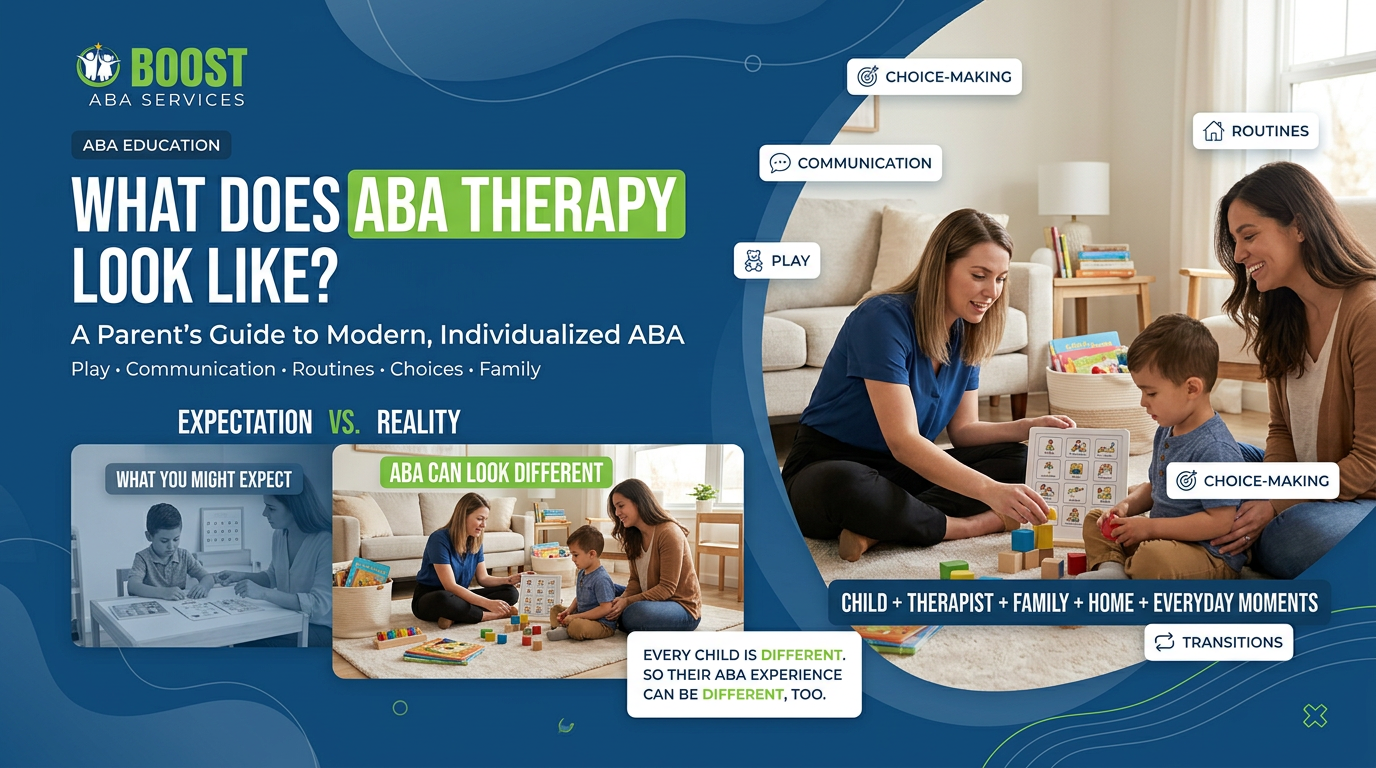
For this article, I recommend targeting “what does ABA therapy look like” as the primary focus keyphrase. It directly matches the Reel hook and the search intent of parents who are trying to understand what ABA actually involves.
What Does ABA Therapy Look Like? A Parent’s Guide to Modern, Individualized ABA
If you’ve searched for what ABA therapy looks like, you may have a very specific picture in your mind.
Maybe you imagine a child sitting at a table while a therapist presents flashcards or structured activities.
That can be one type of learning activity. However, ABA therapy can look much broader than that, particularly when services are individualized and delivered in a child’s familiar home environment.
At Boost ABA Services, we provide individualized home-based ABA therapy for children and families in New York, Texas, and Arizona. Depending on each child’s treatment plan, therapy can incorporate play, communication, everyday routines, choices, transitions, and family collaboration.
The important thing to remember is simple:
ABA doesn’t have to look the same for every child.
What Does ABA Therapy Look Like?
ABA stands for Applied Behavior Analysis.
ABA is an evidence-based approach based on principles of learning and behavior. Depending on the child’s individualized treatment plan, ABA therapy may support skills related to:
- Communication
- Daily living skills
- Social interaction
- Play
- Everyday routines
- Transitions
- Learning
- Choice-making
- Asking for help
- Independence
Because children have different needs and goals, their therapy sessions can look very different.
One child may spend part of a session practicing communication through play.
Therefore, there isn’t one universal picture of what ABA therapy should look like.
The Stereotype: ABA Is Only Table Work
One common image of ABA therapy is a child sitting across from a therapist at a table.
Structured table activities can be appropriate for certain individualized goals.
For example, a therapist may use a structured activity to practice:
- Matching
- Following directions
- Identifying items
- Communication
- Learning a specific skill
- Other appropriate treatment goals
1. ABA Can Look Like Play
Play is a natural part of childhood.
A therapist and child might:
- Build with blocks
- Complete a puzzle
- Read a book
- Play with toy cars
- Play an age-appropriate game
- Participate in pretend play
Depending on the child’s individualized goals, play may provide opportunities to practice:
Communication
Requesting a toy or asking for help.
Choice-making
Choosing which activity or item to use.
Turn-taking
Participating in an activity with another person.
Following directions
Completing an appropriate step in a game or activity.
Social interaction
Engaging with a parent, therapist, sibling, or another person.
The difference is that the therapist may identify appropriate opportunities within that activity that connect with the child’s treatment goals.
2. ABA Can Look Like Communication
Communication happens throughout everyday life.
A child may communicate when they want:
Help
More
A break
A toy
A snack
A different activity
Communication can happen through many methods.
Depending on the individual child, communication may involve:
- Spoken words
- Gestures
- Pointing
- Pictures
- Signs
- AAC
- Other appropriate communication methods
The goal is not to make every child communicate in exactly the same way.
Communication Doesn’t Have to Happen at a Table
Imagine a child is playing with a favorite toy and needs help opening something.
That moment may create an appropriate opportunity to practice communicating:
“Help.”
The learning opportunity happens within a real situation.
3. ABA Can Look Like Getting Dressed
Getting dressed may seem like a simple routine.
For example:
Choose clothes
→
Find shirt
→
Put shirt on
→
Put on pants
→
Find socks
→
Put on shoes
Depending on a child’s individualized goals, therapy may support appropriate participation in parts of this routine.
The goal isn’t necessarily for the child to complete every step independently.
4. ABA Can Look Like Breakfast
Depending on the child’s goals, a therapist may support appropriate skills involving:
- Making choices
- Communicating preferences
- Requesting help
- Participating in age-appropriate tasks
- Cleaning up
That moment can involve:
Choice-making + Communication
Again, the goal isn’t to turn breakfast into a therapy exercise.
5. ABA Can Look Like Transitions
Transitions happen all day.
A child moves from:
Play → Cleanup
Breakfast → Getting dressed
Screen time → Another activity
Home → School
Activity → Bedtime
For some children, transitions may require additional support.
Depending on the child’s individualized plan, strategies may include:
- Visual schedules
- Clear language
- Countdown warnings
- First-then language
- Appropriate choices
- Reinforcement
The appropriate approach depends on the individual child and situation.
Why Are Transitions Important?
They can involve:
- Communication
- Flexibility
- Understanding expectations
- Self-regulation
- Independence
That’s why transitions may be relevant to individualized treatment goals for some children.
6. ABA Can Look Like Making Choices
A parent might ask:
“Blocks or puzzle?”
The child points to the blocks.
Or:
“Blue shirt or green shirt?”
The child chooses one.
These moments can provide opportunities to communicate preferences.
- Play
- Meals
- Getting dressed
- Daily routines
- Activities
- Community experiences
7. ABA Can Look Like Family Involvement
ABA therapy isn’t necessarily just a therapist and child working together.
Parents and caregivers can be important members of the team.
Parents know:
- Their child’s routines
- Communication style
- Interests
- Strengths
- Preferences
- Areas where support may be helpful
- Family priorities
That information can be valuable to the clinical team.
Depending on the treatment plan, caregivers may participate through:
- Sharing observations
- Discussing goals
- Participating in caregiver training
- Learning appropriate strategies
- Communicating with the clinical team
Parents don’t need to become therapists.
Why Home-Based ABA Can Look Different
At Boost ABA Services, our services are home-based.
That means appropriate ABA therapy takes place within the child’s familiar home environment.
The home naturally contains many activities that are relevant to everyday life.
For example:
Living room: Play and communication
Kitchen: Mealtime and choices
Bedroom: Getting dressed and routines
Bathroom: Appropriate personal-care routines
Throughout the home: Transitions and everyday communication
Because the environment is familiar, appropriate treatment goals may be connected with activities the child already experiences.
Does Home-Based ABA Mean Therapy All Day?
No.
Home-based ABA therapy does not mean that every moment of a child’s day becomes therapy.
Instead, services take place during scheduled sessions and focus on the child’s individualized treatment goals.
The therapist may use activities within the home environment when they are relevant to those goals.
The rest of the child’s day remains family life.
The home is the setting, not the entire purpose of the therapy.
Is ABA Therapy Always Play-Based?
Not necessarily.
Some goals may be best addressed through structured activities.
Other goals may fit naturally into play or everyday routines.
Therefore, the type of activity should depend on:
- The child’s goals
- Current skills
- Individual needs
- Learning preferences
- Treatment plan
- Clinical guidance
A strong individualized approach doesn’t require every session to look identical.
What Does an Individualized ABA Session Look Like?
There isn’t one standard session that applies to every child.
However, a home-based session might include several different types of activities.
Preparation
The therapist reviews appropriate goals and prepares relevant materials.
Connection
The therapist engages with the child and establishes a comfortable working relationship.
Learning
The therapist creates appropriate opportunities to practice individualized skills.
Play
Play may provide natural opportunities for communication, interaction, and learning.
Everyday Routines
Appropriate goals may be practiced during relevant daily activities.
Observation
The therapist observes how the child responds to different situations and strategies.
Documentation
Relevant information from the session is documented according to the service model and treatment plan.
Collaboration
The therapist communicates with caregivers and the clinical team as appropriate.
What Does the BCBA Do?
A Board Certified Behavior Analyst (BCBA) may have several responsibilities within an ABA program.
Depending on the child’s service model and applicable requirements, a BCBA may:
- Assess relevant needs
- Develop individualized treatment goals
- Design appropriate interventions
- Review relevant data
- Monitor progress
- Supervise ABA team members
- Communicate with caregivers
- Adjust treatment strategies when appropriate
Parents should feel comfortable asking:
“How involved will the BCBA be in my child’s treatment?”
Understanding the clinical structure can help families know who is responsible for different aspects of care.
What Does an RBT Do?
An RBT, or Registered Behavior Technician, may work directly with a child while implementing appropriate treatment strategies under supervision.
Depending on the child’s individualized plan, the RBT may work on:
- Communication
- Play
- Daily living skills
- Learning
- Social interaction
- Routines
- Transitions
The exact responsibilities can vary based on the treatment plan and service structure.
What Parents Should Look For
If you’re researching what ABA therapy looks like, don’t focus only on the activities you see in a video or photograph.
Instead, ask:
Are the goals individualized?
Does the treatment plan reflect my child’s needs?
These questions can tell you much more about a provider’s approach than a single therapy activity.
ABA Shouldn’t Be About Making Every Child the Same
One of the most important ideas for parents to understand is that individualized ABA isn’t about making every child follow the same path.
Children have different:
- Strengths
- Needs
- Interests
- Communication styles
- Learning preferences
- Goals
Therefore, their therapy can look different.
One child may spend more time playing.
Different children can have different goals while receiving individualized ABA support.
Progress Can Look Different Too
The same principle applies to progress.
For one child, a meaningful step may involve communicating a need.
For another, it may involve participating in a routine.
Another child may be working on making choices.
Another may be practicing an age-appropriate daily living skill.
These examples are not universal milestones.
Instead, they illustrate why progress should be considered in relation to the individual child’s goals.
A More Complete Picture of ABA
So, what does ABA therapy actually look like?
It can look like:
🧸 Play
💬 Communication
🍳 Everyday routines
👕 Getting dressed
🔄 Transitions
🎯 Choice-making
👨👩👧 Family collaboration
📚 Structured learning
🏠 Home-based support
The exact combination depends on the child.
That’s the point.
Individualized ABA should look different when individual children have different needs.
Home-Based ABA Therapy in New York, Texas & Arizona
Boost ABA Services provides home-based ABA therapy in New York, Texas, and Arizona.
Our approach focuses on individualized support and meaningful skills that connect with everyday life.
Depending on each child’s treatment plan, services may support:
- Communication
- Daily living skills
- Everyday routines
- Social interaction
- Play
- Transitions
- Learning
- Independence
Service availability may vary by location.
Home-Based ABA Therapy in New York
Families looking for ABA therapy in New York can contact Boost ABA Services to learn more about home-based services and availability in their area.
Home-Based ABA Therapy in Texas
Parents searching for ABA therapy in Texas can contact our team to learn more about our individualized approach.
Home-Based ABA Therapy in Arizona
Families looking for ABA therapy in Arizona can reach out to learn more about our home-based services and next steps.
Have Questions About What ABA Looks Like?
If you’ve seen different opinions about ABA online, you’re not alone.
The best way to understand a provider’s approach is to ask questions.
Most importantly, ask how the provider will individualize support for your child.
Learn More About Home-Based ABA Therapy
If you’re exploring home-based ABA therapy for your child, Boost ABA Services is here to help you understand your options.
Our team can answer questions about our individualized approach, home-based services, insurance verification, service availability, and the process of getting started.
Boost ABA Services
Individualized Home-Based ABA Therapy
📍 New York • Texas • Arizona
📞 845-377-0024
Open Monday – Friday
