
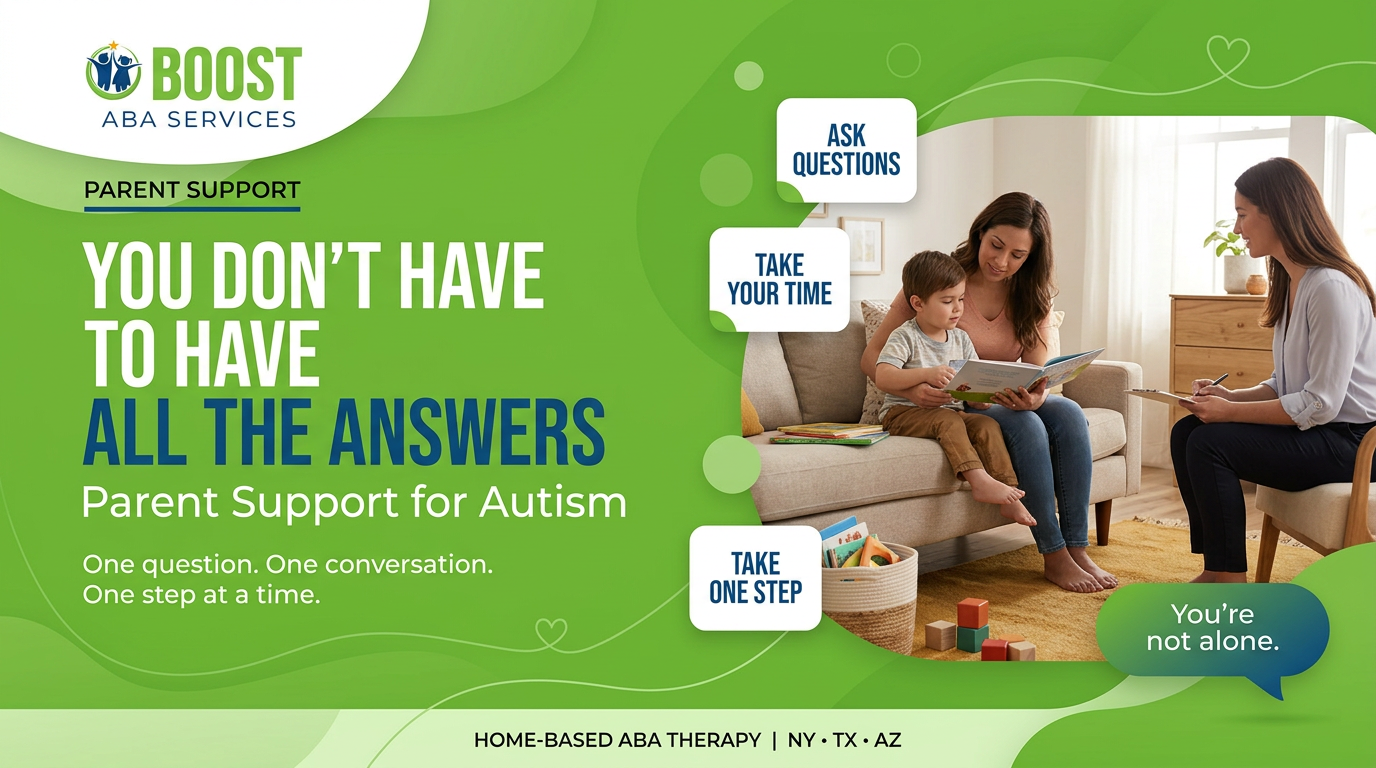
You Don’t Have to Have All the Answers: A Parent’s Guide to Navigating ABA Support
If you’re exploring ABA therapy for your child, you may feel like you should already know what to do, what questions to ask, and which services to choose.
Most importantly, you can focus on your child as an individual rather than comparing your family’s journey with someone else’s.
At Boost ABA Services, we provide individualized home-based ABA therapy for children and families across New York, Texas, and Arizona. Our family-centered approach recognizes that every child has different strengths, needs, interests, and goals.
This guide is a reminder that seeking support is a process, and you don’t have to navigate every step at once.
You Can Ask Questions
When families first begin learning about ABA, they may hear unfamiliar terms and encounter many different opinions.
You might wonder:
- What is ABA therapy?
- Is ABA appropriate for my child?
- What happens during an ABA assessment?
- What does a typical session look like?
- How involved are parents?
- Who supervises the therapy?
- Does insurance cover ABA?
- Can ABA happen at home?
- How are treatment goals chosen?
These are all reasonable questions.
In fact, asking questions can help you understand what a provider offers and whether its approach aligns with your family’s needs.
You don’t need to be an expert before making your first call.
You Can Take Your Time
An autism diagnosis or a recommendation for additional support can bring a lot of information at once.
Therefore, it can be helpful to take the process one step at a time.
Start by learning.
Then ask questions.
Next, explore your options.
After that, consider which services may be appropriate for your child.
You don’t have to make every decision on the same day.
Understanding your options is part of the journey.
Your Child Is Unique
Every child has their own personality, strengths, communication style, interests, needs, and preferences.
As a result, two children receiving ABA therapy may have completely different goals.
One child may be working on communication.
This is why individualized ABA therapy matters.
The goal isn’t to make every child follow the same path.
Instead, appropriate support should be based on the individual child.
Your Family Matters Too
Parents and caregivers bring valuable knowledge to the support team.
You know your child’s:
- Favorite activities
- Communication style
- Daily routines
- Strengths
- Preferences
- Challenges
- Interests
You also know what matters most to your family.
For example, maybe your biggest priority is making the morning routine easier.
These priorities can help guide conversations with qualified professionals.
At Boost ABA Services, we believe parents and caregivers are important members of the team.
What Does Individualized ABA Therapy Mean?
The phrase individualized ABA therapy means that treatment isn’t simply copied from one child to another.
Instead, the clinical team considers relevant information about the individual child when developing appropriate goals and strategies.
Depending on the child, goals may involve:
Communication
Finding meaningful ways to express needs, preferences, requests, or choices.
Daily Living Skills
Participating in age-appropriate activities such as dressing, personal care, or cleanup.
Routines
Participating in familiar sequences of everyday activities.
Transitions
Developing appropriate strategies for moving between activities.
Play
Building appropriate opportunities for communication, interaction, and learning through play.
Independence
Participating more independently in appropriate everyday activities when that is an individualized goal.
The exact goals depend on the child.
Small Steps Count
Parents sometimes look for major milestones.
However, meaningful progress isn’t always dramatic.
It can look like:
Asking for help.
Making a choice.
Communicating a need.
Participating in part of a routine.
Trying something new.
Moving between activities with appropriate support.
Completing another step independently.
These examples aren’t universal milestones.
Instead, they demonstrate why progress can look different for every child.
A small step that seems ordinary to someone else may feel significant to a family.
Home-Based ABA Therapy Can Connect With Everyday Life
At Boost ABA Services, we provide home-based ABA therapy.
Home is where many everyday routines naturally take place.
Getting dressed.
Eating breakfast.
Playing.
Cleaning up.
Asking for help.
Moving from one activity to another.
Preparing for school.
Getting ready for bed.
Depending on the child’s individualized treatment plan, appropriate therapy goals may sometimes be practiced within these familiar activities.
The goal isn’t to turn your home into a clinic.
Instead, home-based ABA therapy can connect appropriate skill development with the environment where everyday life happens.
Why Do Some Families Choose Home-Based ABA?
There are many reasons families may consider in-home ABA therapy.
For some, a familiar environment may be helpful.
For others, home-based services can provide opportunities to connect appropriate goals with daily routines.
There may also be practical considerations involving scheduling, transportation, and family routines.
However, home-based ABA isn’t automatically right for every child.
Whether it is appropriate depends on the child’s needs, treatment goals, family circumstances, professional recommendations, service availability, and other relevant factors.
Parents Don’t Have to Become Therapists
Parents sometimes worry that choosing ABA means they need to learn everything about behavior analysis.
That’s not the expectation.
The clinical team brings professional knowledge and experience.
Parents bring their knowledge of their child and family.
Together, those perspectives can support collaboration.
Depending on the treatment plan, caregiver involvement may include:
- Sharing observations
- Discussing family priorities
- Participating in caregiver training
- Learning about appropriate strategies
- Supporting relevant skills during everyday routines
- Communicating with the clinical team
You don’t have to do everything yourself.
You Can Ask for Help
Asking for support doesn’t mean you’re doing something wrong.
In fact, seeking information can be one of the most useful things you can do when you’re trying to understand your child’s needs.
You can ask your child’s professionals:
“What are you noticing?”
“Why is this goal important?”
“How will we measure progress?”
“How can I support this skill at home?”
“What should I expect from therapy?”
You can also ask an ABA provider:
“Can you explain that in simpler terms?”
You deserve to understand the services being considered for your child.
You Don’t Have to Compare Your Child
Comparison can be difficult.
You may see another child communicating differently or participating in a routine and wonder whether your child should be doing the same thing.
However, every child starts from a different place.
Every family has different circumstances.
Every treatment plan has different goals.
Therefore, another child’s journey isn’t a measurement of your child’s progress.
Instead of asking:
“Why isn’t my child doing what that child is doing?”
consider asking:
“What skills are meaningful and appropriate for my child right now?”
Progress Isn’t Always a Straight Line
Development and learning don’t necessarily happen in a perfectly predictable direction.
A skill may be easier in one environment than another.
A child may participate more on one day and need more support on another.
A routine may go smoothly one morning and be difficult the next.
That’s okay.
Individualized support allows the team to consider the child and the circumstances rather than expecting identical performance every time.
What Should You Look for in an ABA Provider?
If you’re researching ABA therapy for your child, consider asking providers about:
Individualized Goals
How are goals selected for my child?
Clinical Supervision
Who oversees the treatment plan?
Family Involvement
How are parents and caregivers included?
Communication
How will the team communicate with our family?
Progress Monitoring
How will progress be measured and discussed?
Home-Based Services
What does home-based ABA look like?
Insurance
How does the insurance verification process work?
These questions can help you understand the provider’s approach before beginning services.
Insurance Doesn’t Have to Be the First Answer You Figure Out
Insurance can be complicated.
Coverage depends on the individual insurance plan and applicable requirements.
You may need to understand:
- Whether ABA is included
- Network requirements
- Prior authorization
- Documentation requirements
- Deductibles
- Copays or coinsurance
- Applicable limitations
Because plans vary, it’s important to verify your specific benefits.
At Boost ABA Services, our team can help families understand the insurance verification process and discuss applicable next steps.
What Happens After You Contact an ABA Provider?
If you’re wondering where to begin, the process doesn’t have to feel complicated.
Generally, you can expect a conversation about:
Your child
Relevant strengths, needs, routines, and areas where support may be helpful.
Your family
Your questions, priorities, schedule, and preferences.
Services
What the provider offers and whether services are available in your area.
Insurance
The process for verifying applicable benefits and requirements.
Next steps
What may happen if services are appropriate and available.
The exact process varies by provider and individual circumstances.
A Simple Reminder for Parents
When everything feels like a lot, come back to these six reminders:
Your Child Is Unique.
Their strengths, needs, communication, and goals are their own.
Your Family Matters.
Your priorities and knowledge of your child are valuable.
Small Steps Count.
Meaningful progress doesn’t have to look dramatic.
Support Can Be Individualized.
Your child’s support should reflect their individual needs.
What We Want Every Parent to Hear
And you don’t have to figure everything out today.
You can start with one question.
Then another.
One conversation.
One decision.
One step.
Big progress can start with small steps.
Home-Based ABA Therapy in New York, Texas & Arizona
Boost ABA Services provides individualized home-based ABA therapy in New York, Texas, and Arizona.
Depending on each child’s individualized treatment plan, services may support:
- Communication
- Daily living skills
- Everyday routines
- Social interaction
- Play
- Transitions
- Learning
- Independence
Our approach is centered around the individual child and collaboration with families.
Service availability may vary by location.
New York
Families searching for home-based ABA therapy in New York can contact Boost ABA Services to learn more about available services.
Texas
Parents looking for home-based ABA therapy in Texas can contact our team to learn more about our approach and service availability.
Arizona
Families searching for home-based ABA therapy in Arizona can reach out to learn more about our individualized services.
You’re Not Alone
If you’re at the beginning of your child’s support journey, it’s okay to feel like you have questions.
That’s where learning begins.
Ask.
Listen.
Explore.
Take your time.
Find professionals who are willing to explain the process and collaborate with your family.
Most importantly, remember that your child is more than a diagnosis, and your family’s journey doesn’t have to look like anyone else’s.
Learn More About Home-Based ABA Therapy
If you’re exploring home-based ABA therapy for your child, Boost ABA Services is here to help you understand your options.
Our team can answer questions about our individualized approach, home-based services, insurance verification, service availability, and getting started.
Boost ABA Services
Individualized Home-Based ABA Therapy
📍 New York • Texas • Arizona
📞 845-377-0024
Open Monday – Friday
