
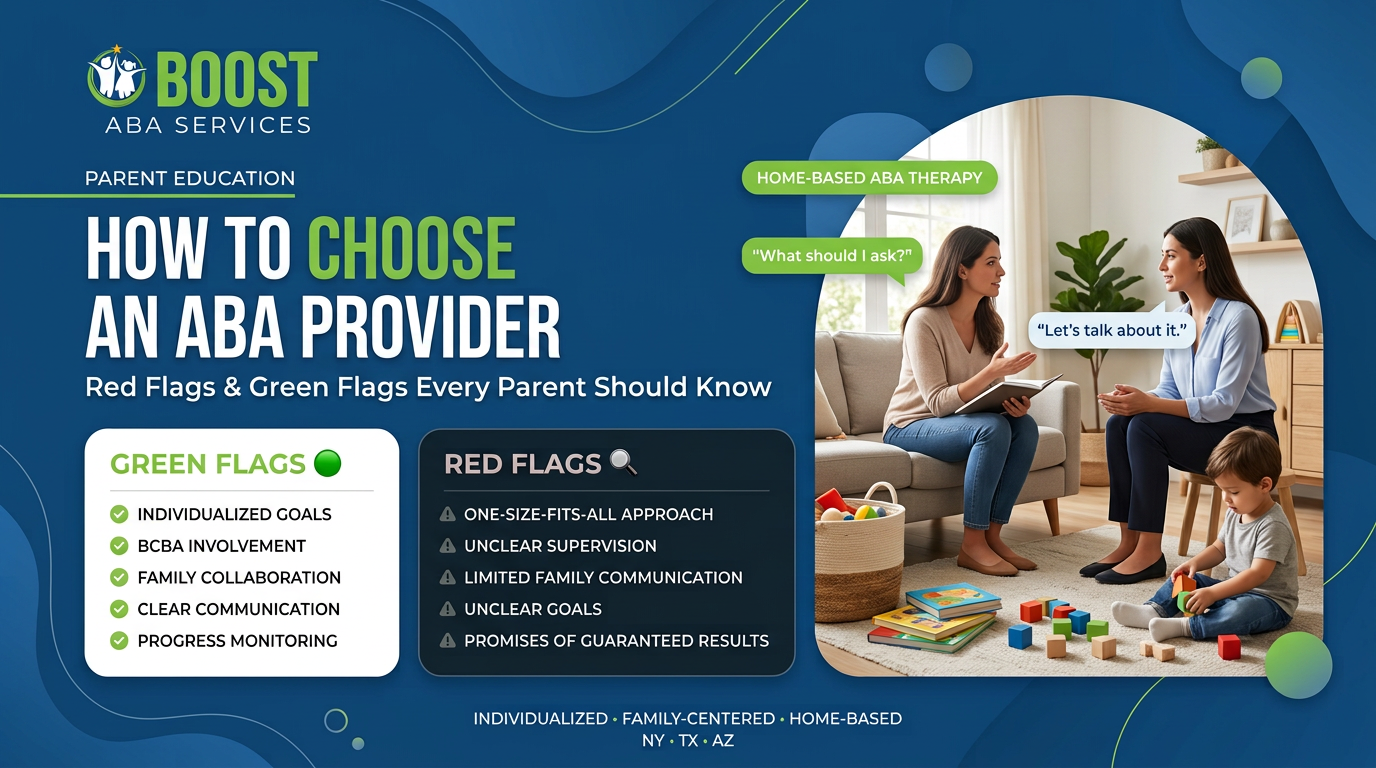
Choosing an ABA provider is an important decision for any family.
A helpful starting point is to ask questions about the provider’s approach, communication, clinical supervision, family involvement, and how individualized your child’s treatment will be.
At Boost ABA Services, we provide individualized home-based ABA therapy for children and families in New York, Texas, and Arizona. We believe parents should feel comfortable asking questions and understanding how a provider approaches their child’s support.
What Should Parents Look for in an ABA Provider?
There isn’t one perfect checklist for choosing an ABA provider.
Every family has different priorities, and every child has different needs.
- Individualized treatment goals
- Clinical supervision
- Parent and caregiver involvement
- Communication
- Progress monitoring
- Home-based services
- Insurance and service availability
- How the provider responds to family concerns
The goal isn’t to judge a provider based on one answer.
Green Flag #1: Individualized Goals
Every child has different:
- Strengths
- Needs
- Interests
- Communication styles
- Current skills
- Routines
- Family priorities
Green Flag #2: Clear BCBA Supervision
Parents should understand who oversees their child’s ABA treatment.
A Board Certified Behavior Analyst (BCBA) may assess needs, develop treatment goals, oversee treatment, monitor progress, and supervise members of the ABA team, depending on the service model and applicable requirements.
Questions to Ask
“Who oversees my child’s treatment plan?”
“How involved will the BCBA be?”
“How often will the clinical team review my child’s progress?”
Green Flag
The provider clearly explains the clinical structure and who is responsible for different parts of your child’s treatment.
Potential Red Flag
A lack of clarity about who supervises treatment or how parents can communicate with the clinical team may be a reason to ask additional questions.
Green Flag #3: Parents Are Included
They know:
- What their child enjoys
- How their child communicates
- Which routines are difficult
- What activities are motivating
- What their child does well
- Which skills matter most to the family
Questions to Ask
“How will parents be involved?”
“Do you provide caregiver training?”
“How will you communicate with our family?”
“Can we share observations and concerns?”
Green Flag
The provider welcomes family input and explains how caregivers can participate appropriately.
Potential Red Flag
Green Flag #4: Clear Communication
Good communication matters in any service involving your child.
Clear communication can include:
- Explaining treatment goals
- Answering parent questions
- Sharing relevant updates
- Explaining changes
- Discussing concerns
- Communicating with caregivers appropriately
Questions to Ask
“How will you keep us updated?”
“Who is our primary contact?”
“How can we communicate concerns?”
“How will changes to the treatment plan be explained?”
Green Flag #5: Progress Is Monitored
Depending on the treatment plan, the ABA team may collect and review relevant information about specific skills or behaviors.
Progress measurements can vary based on the individual goal.
Questions to Ask
“What are you measuring?”
“How will progress be explained to me?”
“How often are goals reviewed?”
Green Flag
The provider can explain how progress is monitored and how information is used to make appropriate treatment decisions.
Potential Red Flag
Be cautious about providers who focus heavily on promising outcomes without explaining how goals are measured or reviewed.
Green Flag #6: The Provider Can Explain What Home-Based ABA Looks Like
Home-based ABA doesn’t necessarily mean sitting at a table throughout the entire session.
Depending on a child’s individualized goals, therapy may involve:
- Play
- Communication
- Daily living skills
- Everyday routines
- Transitions
- Choice-making
- Social interaction
- Age-appropriate activities
Questions to Ask
“What does a typical home-based session look like?”
“How will therapy fit into our family routine?”
Green Flag
The provider can clearly explain how appropriate treatment goals may connect with the child’s everyday environment.
Potential Red Flag: A One-Size-Fits-All Approach
One of the biggest concerns parents may encounter is the idea that every child should receive the same program.
Children are individuals.
One child may be working on communication.
Individualization should be part of the conversation from the beginning.
Potential Red Flag: Promises of Guaranteed Results
Parents naturally want to know what they can expect.
A responsible provider should be careful about promising specific outcomes or timelines for every child.
“What are the goals for my child?”
Potential Red Flag: The Provider Doesn’t Welcome Questions
And you don’t need to worry about asking something that seems basic.
A good conversation might include questions about:
- Goals
- Supervision
- Communication
- Family involvement
- Progress
- Insurance
- Scheduling
- Home-based services
Understanding your child’s support is important.
Potential Red Flag: Parents Are Treated Like Outsiders
Parents can provide important information about:
- Everyday routines
- Communication
- Interests
- Strengths
- Challenges
- Family priorities
Potential Red Flag: The Provider Can’t Explain the Process
Ask:
What happens after I contact you?
What information do you need?
How does insurance verification work?
Clear answers can make the process easier to understand.
Green Flags vs. Red Flags: Quick Parent Checklist
| Area | Green Flag 🟢 | Question to Investigate 🔎 |
|---|---|---|
| Goals | Goals are individualized | Same goals for every child |
| BCBA | Clear clinical supervision | Unclear supervision structure |
| Family | Parents are welcomed as partners | Parents feel disconnected |
| Communication | Questions are answered clearly | Communication is consistently unclear |
| Progress | Progress is monitored and discussed | Outcomes are promised without clear measurement |
| Home-Based Care | Therapy can connect with appropriate everyday routines | Provider can’t clearly explain the home model |
| Treatment | Approach is based on the individual child | One-size-fits-all approach |
| Questions | Parents are encouraged to ask questions | Parents feel discouraged from asking |
Questions to Ask Before Choosing an ABA Provider
- How will you learn about my child’s strengths and needs?
- How are treatment goals selected?
- How will my child’s interests be incorporated?
- Who will supervise my child’s treatment?
- How involved will the BCBA be?
- Who will work directly with my child?
- How will parents and caregivers participate?
- Do you provide caregiver training?
- How will we communicate with the team?
- How will progress be measured?
- How often are goals reviewed?
- How will changes to the treatment plan be explained?
- What does a typical home-based ABA session look like?
- How will therapy fit into our everyday routines?
- What areas do you serve?
- Do you help with insurance verification?
- What requirements may apply?
- Who can help us understand the next steps?
What Makes a Good ABA Provider?
There isn’t one characteristic that automatically makes an ABA provider the right choice for every family.
Important areas include:
Individualized care
Your child’s goals should be based on their individual needs.
Clinical oversight
You should understand who supervises treatment.
Family collaboration
Parents should have an opportunity to share relevant information and ask questions.
Clear communication
The provider should communicate in language families can understand.
Progress monitoring
The team should have a way to evaluate relevant treatment goals.
Why Home-Based ABA May Be the Right Fit for Some Families
Home is where many everyday activities naturally happen.
Depending on the individualized treatment plan, these everyday moments may provide opportunities to practice meaningful skills.
At Boost ABA Services, our home-based model is designed around this connection between individualized goals and everyday life.
Home-Based ABA Therapy in New York, Texas & Arizona
Boost ABA Services provides home-based ABA therapy in New York, Texas, and Arizona.
- Communication
- Daily living skills
- Everyday routines
- Social interaction
- Play
- Transitions
- Learning
- Independence
Service availability may vary by location.
New York
Families searching for home-based ABA therapy in New York can contact Boost ABA Services to learn about available services in their area.
Texas
Parents looking for home-based ABA therapy in Texas can contact our team to learn more about our approach and service availability.
Arizona
Families searching for home-based ABA therapy in Arizona can reach out to learn more about individualized ABA services.
Choosing an ABA Provider: Trust the Questions You Ask
And ask how the provider communicates with your family.
Most importantly, remember that your child is an individual.
Learn More About Home-Based ABA Therapy
Boost ABA Services
Individualized Home-Based ABA Therapy
📍 New York • Texas • Arizona
📞 845-377-0024
Open Monday – Friday
