
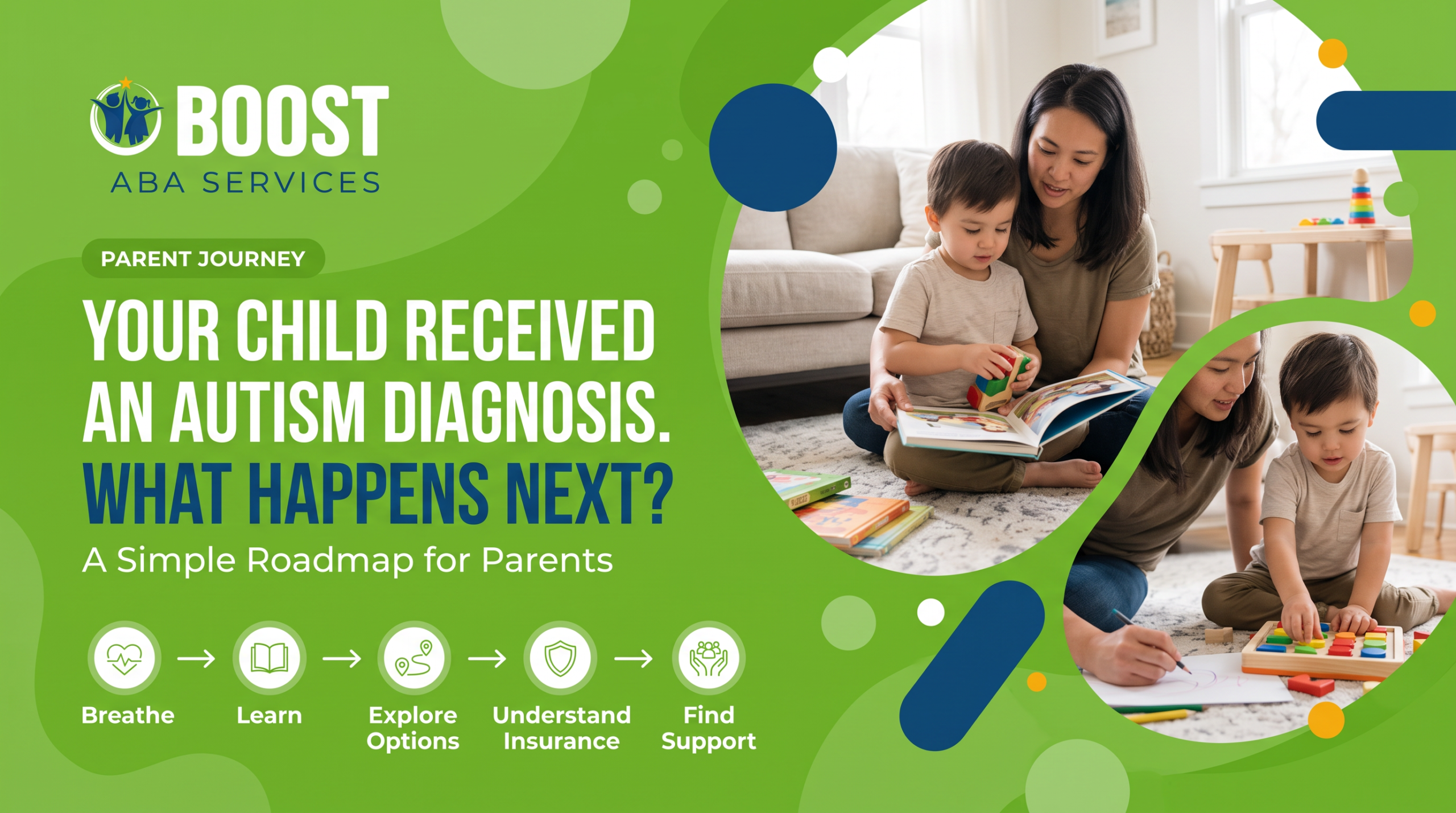
Receiving an autism diagnosis for your child can bring many questions at once. You may be wondering what to do after an autism diagnosis, which services to explore, how insurance works, or how to determine what type of support may be appropriate for your child.
You do not need to make every decision immediately.
A helpful starting point is to move through the process one step at a time: breathe, learn, evaluate your options, understand your insurance, and find appropriate support for your child.
At Boost ABA Services, we provide individualized, home-based ABA therapy for children and families.
Step 1: Breathe and Give Yourself Time
After your child receives an autism diagnosis, you may receive a lot of new information in a very short period of time.
There may be recommendations, terminology, paperwork, insurance questions, and decisions about services.
You don’t have to understand everything today.
Start by organizing the information you’ve received and writing down the questions you want to discuss with your child’s healthcare or developmental professionals.
Questions might include:
- What does my child’s evaluation tell us?
- What are my child’s current strengths?
- Which areas may benefit from additional support?
- Which recommendations should we prioritize?
- Who should we speak with next?
- What resources are available for our family?
An autism diagnosis can provide information that helps families and professionals better understand a child’s needs. It does not change who your child is.
Step 2: Learn About Autism and Your Child’s Individual Needs
The next step after an autism diagnosis is learning.
Autism is a spectrum, which means autistic children can have very different strengths, needs, communication styles, preferences, and support requirements.
Rather than trying to learn everything about autism at once, focus first on understanding your child.
Consider areas such as:
Communication
How does your child currently communicate?
Communication may involve spoken words, gestures, pointing, pictures, signs, facial expressions, or Augmentative and Alternative Communication (AAC).
Daily Living Skills
Does your child need additional support with dressing, hygiene, mealtime routines, or other age-appropriate everyday activities?
Social Interaction
What kinds of interactions does your child enjoy? Are there particular social situations where additional support could be useful?
Routines and Transitions
How does your child respond when moving between activities or when a familiar routine changes?
Independence
Are there everyday skills your child could work toward completing with greater independence?
Understanding these areas can make conversations with professionals more productive and help you evaluate different support options.
Step 3: Evaluate Your Child’s Support Options
One of the most common questions parents have is:
“What services does my child need after an autism diagnosis?”
There isn’t one answer that applies to every child.
Depending on your child’s individual needs and recommendations from qualified professionals, support options may include different healthcare, developmental, educational, behavioral, communication, or family services.
The appropriate combination of services will vary.
When evaluating any provider or service, ask questions.
Consider asking:
- What is the goal of this service?
- How will it address my child’s individual needs?
- How are parents and caregivers involved?
- Who will provide and supervise services?
- What does a typical session look like?
- Where will services take place?
You should feel comfortable asking a provider to explain their approach in language you understand.
Step 4: Learn About ABA Therapy
ABA is an evidence-based approach that applies principles of learning and behavior to help develop meaningful skills.
Depending on a child’s individual treatment plan, ABA therapy may focus on areas such as:
- Functional communication
- Daily living skills
- Everyday routines
- Social interaction
- Play skills
- Transitions
- Learning skills
- Increasing independence
- Developing helpful alternatives to challenging behaviors
Two children with the same diagnosis may have completely different goals because their strengths, needs, environments, and family priorities are different.
A Simple Guide for Parents resource.
INTERNAL LINK: Link the article title above to the Boost ABA Services home-based ABA article.
Step 5: Understand Home-Based ABA Therapy
Boost ABA Services specializes in home-based ABA therapy, also known as in-home ABA therapy.
Home-based services bring appropriate ABA support into the child’s familiar home environment.
For example, depending on a child’s goals:
Playtime may provide opportunities for communication and interaction.
Cleaning up may become part of practicing an everyday routine.
Asking for help may provide an opportunity to practice functional communication.
Moving from one activity to another may provide an opportunity to work on transitions.
Step 6: Understand Your Insurance Coverage
For many families, one of the biggest questions after an autism diagnosis is:
“Will my insurance cover ABA therapy?”
Insurance coverage can vary based on the family’s plan, state, provider network, medical necessity requirements, authorizations, and other factors.
Before beginning services, families may need to understand:
- Whether the provider is in-network
- Deductible requirements
- Copays or coinsurance
- Prior authorization requirements
- Documentation requirements
- Applicable coverage limitations
Insurance terminology can feel complicated, especially when you’re already navigating a new diagnosis.
That’s why verifying benefits can be an important early step.
Boost ABA Services can help families understand the process of insurance verification for ABA therapy and determine the applicable next steps for services.
INTERNAL LINK: Link “insurance verification for ABA therapy” to the Insurance & Coverage or Verify Insurance page.
Step 7: Find Appropriate Support for Your Child
Finding support isn’t about choosing the first provider you find.
It’s about finding services that are appropriate for your child’s individual needs.
When considering an ABA provider, ask about:
- Individualized treatment planning
- BCBA involvement and supervision
- Therapist qualifications
- Parent and caregiver involvement
- Where therapy takes place
- Communication with families
- Insurance and authorization processes
What Does the ABA Process Usually Look Like?
The exact process can vary based on the child, provider, insurance plan, and other circumstances, but families exploring ABA may generally encounter steps such as:
1. Initial Contact
The family contacts an ABA provider and shares basic information about the child and the services they are exploring.
2. Insurance Verification
Applicable insurance benefits and requirements may be reviewed.
3. Assessment
When appropriate and authorized, a qualified professional evaluates relevant needs, strengths, skills, and goals.
4. Individualized Treatment Planning
If ABA services are appropriate, treatment goals and strategies are developed around the individual child.
5. Begin Services
Therapy begins according to the child’s individualized plan and applicable authorization.
6. Monitor Progress
The clinical team reviews progress and adjusts goals or strategies when appropriate.
Families should ask their provider about their specific process because these steps and requirements can differ.
Parents and Caregivers Are Important Partners
Parents don’t need to become therapists.
But parents and caregivers can provide valuable information about their child’s routines, communication, strengths, preferences, and challenges.
With home-based ABA therapy, collaboration can be particularly relevant because therapy takes place within the environment where the family spends much of its everyday life.
Depending on the treatment plan, parent and caregiver training may help families understand:
- Their child’s individualized goals
- Strategies used during sessions
- Ways to support appropriate skills during everyday routines
- How to create opportunities for practice
- How to communicate observations to the clinical team
The goal is collaboration, not perfection.
Questions to Ask an ABA Provider
Before choosing an ABA provider, consider keeping this checklist available:
- Who will oversee my child’s treatment?
- Will a BCBA develop and monitor the treatment plan?
- How are treatment goals selected?
- How will my child’s strengths be incorporated?
- How will my child’s communication style be respected?
- What does a typical session look like?
- How will parents and caregivers be involved?
- How will progress be measured?
- How frequently will goals be reviewed?
- How does home-based ABA work?
- How does insurance verification work?
- Who can I contact when I have questions?
A provider’s answers can help you better understand whether their approach aligns with your family’s needs.
Remember: Every Child’s Journey Is Different
It’s easy to compare your child’s development with another child’s, especially when you’re researching autism online.
But an autism diagnosis doesn’t create a single roadmap that every family must follow.
Your child’s path should reflect their individual strengths, communication, needs, preferences, family circumstances, and professional recommendations.
Progress should be meaningful to the individual child rather than based on comparison with someone else’s journey.
Home-Based ABA Services From Boost ABA Services
At Boost ABA Services, we provide individualized home-based ABA therapy for children and families.
Our approach focuses on understanding each child’s needs and developing meaningful goals that can be practiced within familiar everyday environments.
We work collaboratively with families and clinical professionals to support skills that may include communication, daily living, routines, social interaction, play, learning, and independence based on each child’s individualized treatment plan.
Boost ABA Services currently supports families across New York, Texas, and Arizona.
Your Child Received an Autism Diagnosis. What Happens Next?
If you’re still wondering what to do after an autism diagnosis, remember this simple roadmap:
BREATHE
You don’t need every answer today.
LEARN
Learn about your child’s individual strengths, needs, and recommendations.
EVALUATE YOUR OPTIONS
Explore the services and resources that may be appropriate for your child.
UNDERSTAND YOUR INSURANCE
Learn about your benefits, authorization requirements, and coverage options.
FIND APPROPRIATE SUPPORT
Ask questions and look for providers whose services align with your child’s individual needs.
You don’t need to navigate every step at once.
We’re Here to Help You Understand Your Options
If you’re exploring home-based ABA therapy after your child’s autism diagnosis, the Boost ABA Services team can answer questions about our services, insurance verification, availability, and getting started.
Boost ABA Services
Serving families across New York, Texas, and Arizona
Phone: 845-377-0024
Email: info@boostabaservices.com
Open: Monday – Friday
Big Progress Starts With Small Steps.
