Every child develops differently, but parents sometimes notice areas where their child seems to need more help than expected. Recognizing signs your child may need extra support does not mean something is necessarily wrong, and it does not provide a diagnosis. It can simply be a reason to pay closer attention, ask questions, and speak with a qualified professional.
At Boost ABA Services, we provide individualized, home-based ABA therapy for children and families. We understand that parents may have questions about communication, routines, social interaction, behavior, or everyday skills before they know what type of support, if any, may be appropriate.
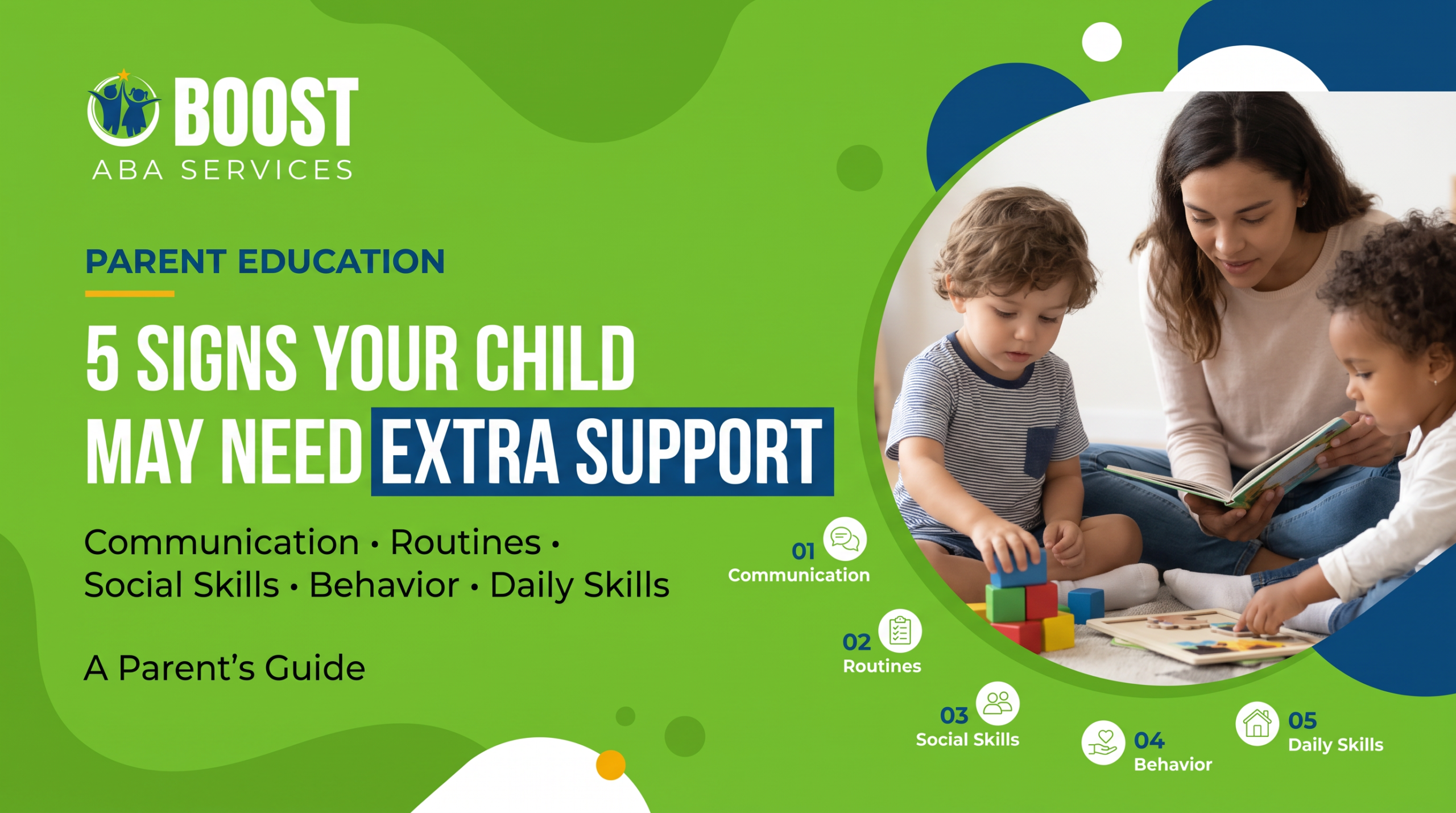
Here are five areas parents can observe when considering whether to speak with a qualified healthcare or developmental professional.
1. Communication Seems Difficult
Communication develops differently from child to child.
Some children primarily communicate with spoken language, while others may use gestures, pointing, pictures, signs, facial expressions, or Augmentative and Alternative Communication (AAC).
You may notice that your child has difficulty expressing what they want or need, communicating when they need help, understanding certain directions, or participating in back-and-forth communication.
For example, a child may become frustrated when others don’t understand what they are trying to communicate.
These observations alone do not tell you why a communication difficulty is happening or whether your child needs ABA therapy.
If you have concerns about your child’s communication development, discussing them with an appropriate qualified professional can help you better understand what may be happening and what next steps may be appropriate.
2. Everyday Routines Are Consistently Challenging
Daily routines are a big part of childhood.
Getting dressed, brushing teeth, preparing to leave the house, sitting down for a meal, getting ready for bed, or moving between activities can involve many individual skills.
Some children may need additional support learning or completing these routines.
Parents may notice difficulties with:
- Getting ready in the morning
- Brushing teeth or other hygiene routines
- Getting dressed
- Mealtime routines
- Cleaning up
- Moving from one activity to another
- Following a sequence of everyday tasks
- Bedtime routines
Every child can have difficult mornings or resist certain routines occasionally. The important question is whether the difficulty is persistent and meaningfully affecting the child or family’s everyday life.
For children receiving home-based ABA therapy, everyday routines can sometimes provide natural opportunities to practice appropriate skills directly within the environment where those skills are needed.
3. Social Interaction May Require Additional Support
Social development can look different for every child.
Some children naturally seek frequent interaction, while others prefer more independent activities. Personality differences alone do not indicate a developmental condition or mean a child needs therapy.
However, parents may have questions if their child consistently has difficulty with social skills that are important to their daily life.
Depending on the child’s age and development, this might involve challenges with:
- Taking turns
- Participating in shared activities
- Joining play
- Communicating with peers
- Asking others for help
- Responding during interactions
- Understanding certain social situations
- Participating in age-appropriate group activities
The goal should not be to make every child behave socially in exactly the same way.
Instead, appropriate support can focus on helping a child develop meaningful social and communication skills based on their individual needs.
4. Certain Behaviors Are Making Everyday Life More Difficult
All children experience frustration and difficult moments.
Behavior is also a form of communication and can occur for many different reasons.
A child might be tired, overwhelmed, trying to access something, attempting to avoid an uncomfortable situation, having difficulty communicating, responding to changes in routine, or experiencing something else entirely.
Parents may consider seeking professional guidance when certain behaviors are frequent, intense, unsafe, or significantly interfere with the child’s ability to participate in everyday activities.
Rather than simply asking:
“How do we stop this behavior?”
It can be more helpful to ask:
“What might my child be communicating, and what skills or support could help?”
Applied Behavior Analysis can involve understanding what happens before and after a behavior and using that information to develop individualized strategies and teach helpful alternative skills.
The goal should be to understand the individual child, not simply eliminate behavior without considering its purpose.
5. Daily Living Skills Require More Support
Developing independence is a gradual process.
Depending on a child’s age and abilities, daily living skills may include:
- Dressing
- Personal hygiene
- Eating routines
- Putting belongings away
- Following simple household routines
- Asking for assistance
- Making appropriate choices
- Completing age-appropriate tasks
Some children may learn these skills quickly, while others benefit from additional instruction, repetition, visual supports, or breaking larger tasks into smaller steps.
If your child consistently struggles with age-appropriate everyday skills, it may be worth discussing those concerns with a qualified professional.
For children who receive in-home ABA therapy, working on appropriate daily living goals within the home can provide opportunities to practice skills in the same environment where the child may eventually use them more independently.
One Sign Does Not Equal a Diagnosis
This is one of the most important things for parents to understand.
Noticing communication challenges, difficulties with routines, differences in social interaction, challenging behaviors, or delays in daily living skills does not automatically mean your child has autism or another developmental condition.
It also does not automatically mean your child needs ABA therapy.
There can be many reasons a child experiences difficulty in one or more developmental areas.
An online article, checklist, Reel, or social media post cannot evaluate or diagnose your child.
If you’re concerned about your child’s development, talk with an appropriate qualified healthcare or developmental professional who can consider your child’s individual history, development, needs, and circumstances.
When Should Parents Consider Talking to a Professional?
You know your child’s everyday routines and behaviors better than anyone else.
If you notice persistent challenges, have concerns about your child’s development, or simply feel that you need professional guidance, you don’t have to wait until you have all the answers before asking questions.
Consider discussing your observations with your child’s pediatrician or another appropriate developmental professional.
It can be useful to write down specific examples before your conversation.
Instead of saying:
“My child struggles with routines.”
You might note:
“Getting dressed before school regularly takes 45 minutes, and my child needs help completing each step.”
Specific observations can give professionals more useful information when discussing your concerns.
Parents can also review developmental milestone information provided by the Centers for Disease Control and Prevention (CDC) as an educational resource. Developmental milestone information is not a substitute for professional evaluation.
How Can Home-Based ABA Therapy Support Everyday Skills?
If a qualified professional recommends ABA and your child is appropriate for services, home-based ABA therapy can provide opportunities to work on individualized goals within the child’s familiar environment.
At Boost ABA Services, therapy is designed around each child’s individual treatment plan rather than a standard checklist.
Depending on the child’s needs, goals may involve:
Communication
Supporting meaningful ways to request, make choices, ask for help, and communicate with others.
Everyday Routines
Practicing appropriate skills during real routines such as getting dressed, cleaning up, or preparing for activities.
Social Skills
Creating opportunities to practice interaction, play, communication, and other individualized social goals.
Daily Living Skills
Breaking everyday tasks into manageable steps and supporting increasing independence when appropriate.
Helpful Alternative Skills
Understanding challenging situations and teaching appropriate skills that may help a child communicate or navigate those situations more effectively.
Because Boost provides ABA therapy in the home, appropriate skills can be practiced within many of the everyday situations where families actually experience challenges.
Why Individualized Support Matters
Two children experiencing a similar challenge may need completely different approaches.
For example, two children may both have difficulty transitioning from playtime to bedtime.
One child may benefit from clearer expectations and a visual routine. Another child’s difficulty may be connected to communication, environmental factors, or something entirely different.
That’s why effective support begins with understanding the individual child.
At Boost ABA Services, our home-based approach focuses on each child’s strengths, needs, family priorities, and individualized goals.
Progress shouldn’t be measured by comparing one child with another.
It should be meaningful to the child and family.
Parents and Caregivers Are Part of the Process
One advantage of providing ABA services at home is the opportunity for professionals to understand the child’s everyday environment and routines.
Parents and caregivers can also be important members of the child’s support team.
Depending on the treatment plan, parent and caregiver training may help families understand strategies used during therapy, recognize opportunities to practice skills, and support appropriate goals throughout everyday life.
Collaboration can help connect what a child practices during an ABA session with situations that happen outside of therapy.
What Should I Do If I Think My Child Needs Extra Support?
If you’ve noticed signs your child may need extra support, you don’t need to diagnose the cause yourself.
Start with three simple steps:
1. Observe
Pay attention to the specific situations where your child appears to have difficulty.
2. Write Down Your Questions
Document specific examples involving communication, routines, social interaction, behavior, or daily living skills.
3. Talk With a Qualified Professional
Discuss your observations with your child’s pediatrician or another appropriate healthcare or developmental professional.
If ABA therapy is recommended or you’re exploring ABA services after receiving professional guidance, you can then learn about different providers and approaches.
Home-Based ABA Services From Boost ABA Services
Boost ABA Services provides individualized home-based ABA therapy designed around the needs and goals of each child.
Our team works with children and families to support meaningful skills within familiar everyday environments.
If you’re exploring ABA therapy following professional guidance, our team can answer questions about our services, the intake process, insurance verification, and what home-based ABA may look like for your family.
We currently support families across New York, Texas, and Arizona.
Have Questions About ABA Therapy?
You don’t need to have everything figured out before reaching out.
Learn more about Home-Based ABA Therapy, explore What ABA Therapy Is, or contact our team to ask about the process of getting started.
Boost ABA Services
Phone: 845-377-0024
Email: info@boostabaservices.com
Open: Monday – Friday
Serving families across New York, Texas, and Arizona.
Big Progress Starts With Small Steps.