
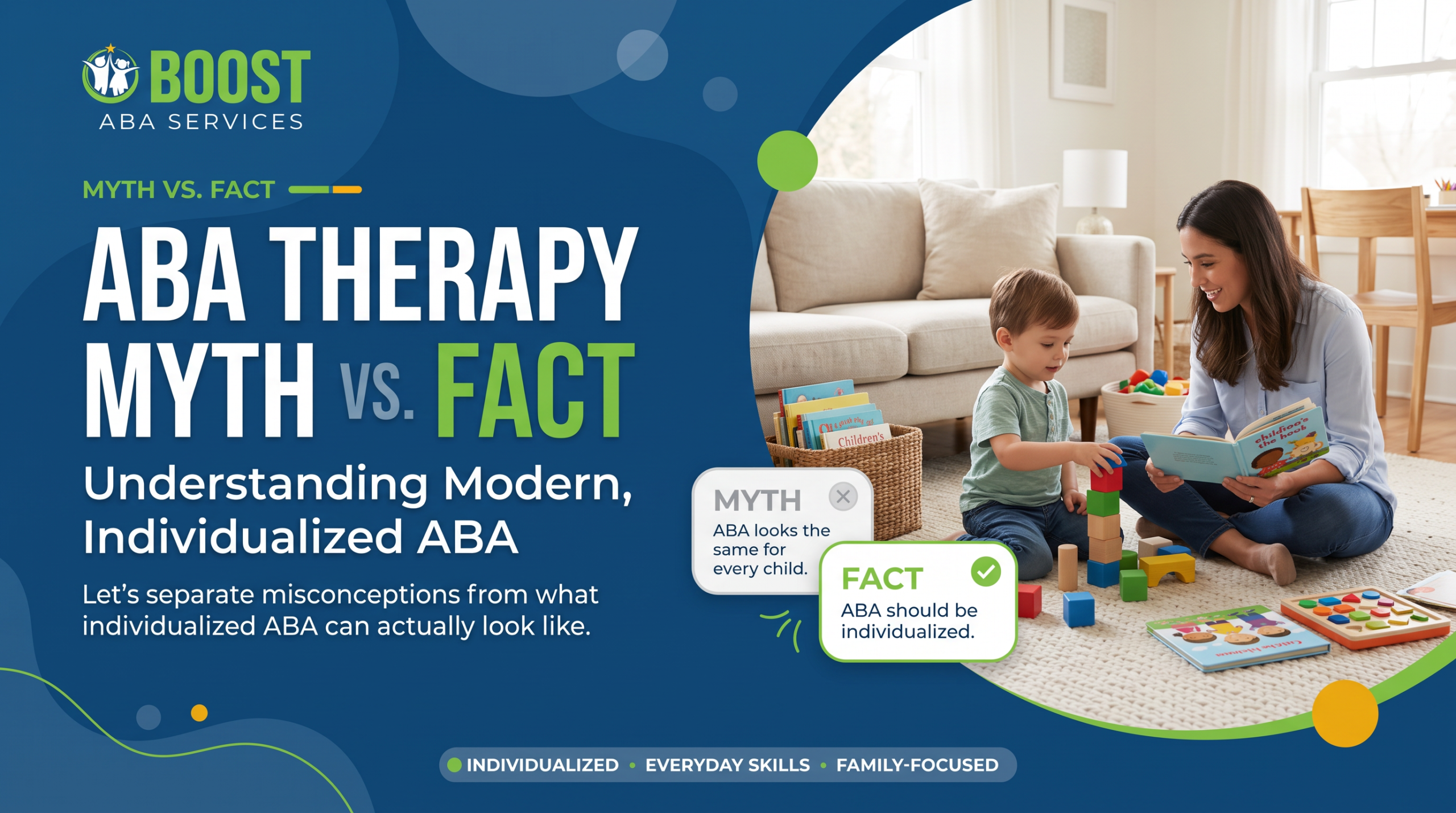
Some descriptions of ABA are based on misconceptions, outdated approaches, or the assumption that every ABA program looks the same.
Modern individualized ABA therapy should begin with something much simpler: understanding the individual child.
At Boost ABA Services, we provide individualized home-based ABA therapy designed around each child’s strengths, needs, communication, everyday routines, and meaningful goals.
Let’s look at some common ABA therapy myths and facts and explain ABA in clear, parent-friendly language.
Myth #1: ABA Therapy Is the Same for Every Child
FACT: ABA Therapy Should Be Individualized
Children have different:
- Strengths
- Needs
- Interests
- Communication styles
- Daily routines
- Learning preferences
- Family environments
- Areas where additional support may be helpful
One child may be working on functional communication.
Myth #2: ABA Is Just Sitting at a Table Doing Repetitive Tasks
FACT: ABA Can Happen During Everyday Activities
Especially with home-based ABA therapy, appropriate learning opportunities can occur throughout everyday life.
For example:
Playtime can create opportunities for communication and interaction.
Mealtime may provide opportunities for making choices or requesting help.
Cleaning up may become part of practicing a familiar routine.
Myth #3: ABA Is Only About Changing Behavior
FACT: ABA Can Focus on Building Meaningful Skills
The word “behavior” can make ABA sound like it is simply about stopping unwanted actions.
That’s an incomplete picture.
Depending on the child’s individualized treatment plan, goals may involve:
- Functional communication
- Daily living skills
- Play skills
- Social interaction
- Making choices
- Asking for help
- Transitions
- Learning skills
- Greater independence
- Helpful alternatives to challenging behaviors
A major question should not simply be:
“How do we stop this behavior?”
A more useful question may be:
“What does this child need, and what meaningful skills can we help them develop?”
Myth #4: ABA Is About Making Every Child Act the Same
FACT: Individualized ABA Should Respect Differences
Every child is different, and support should reflect those differences.
That might mean helping a child communicate a need.
It might mean learning to ask for a break.
It might mean practicing a new daily living skill.
Myth #5: Communication Means Spoken Words
FACT: Communication Can Take Many Forms
Children may communicate using:
- Spoken language
- Gestures
- Pointing
- Pictures
- Signs
- Facial expressions
- Augmentative and Alternative Communication (AAC)
- Other individualized communication methods
A meaningful communication goal might involve asking for help, making a choice, requesting something, communicating discomfort, or expressing that a child needs a break.
The goal shouldn’t be to force every child to communicate in exactly the same way.
The goal is to support functional, meaningful communication based on the individual child’s needs.
Myth #6: Parents Aren’t Part of ABA Therapy
FACT: Parents and Caregivers Can Be Important Partners
Parents and caregivers know their child’s everyday life in ways a therapist cannot learn from a treatment plan alone.
Families understand their child’s:
- Favorite activities
- Daily routines
- Communication
- Strengths
- Challenges
- Home environment
- Important family priorities
The goal isn’t to turn parents into therapists.
It’s to create collaboration between families and the clinical team.
Myth #7: ABA Only Happens During Therapy Sessions
Children don’t only communicate during therapy.
They don’t only use daily living skills during therapy either.
This is one reason ABA therapy at home can be relevant for some families.
Myth #8: ABA Should Look the Same Every Day
FACT: ABA Should Respond to the Child’s Progress and Needs
Children learn and develop over time.
Qualified professionals may collect and review appropriate information to understand whether a child is making progress toward individualized goals.
A strategy may need modification.
Individualized ABA should be responsive rather than static.
What Does Modern Home-Based ABA Therapy Look Like?
Depending on the individual child’s goals, you might see an ABA professional:
- Playing with the child
- Practicing communication
- Working through an everyday routine
- Using visual supports
- Creating opportunities for the child to make choices
- Practicing transitions
- Breaking a complex skill into smaller steps
- Using appropriate reinforcement
- Observing progress
- Collaborating with parents and caregivers
Others may happen naturally during everyday activities.
What matters is that the approach connects to the child’s individualized treatment plan.
Why Home-Based ABA Can Be Different
The home naturally contains many meaningful learning opportunities.
Morning Routines
Getting dressed, brushing teeth, preparing belongings, and getting ready for the day.
Communication
Asking for help, making choices, requesting preferred items, or communicating the need for a break.
Play
Practicing individualized communication, interaction, choice-making, or play skills.
Transitions
Moving from one familiar activity to another.
Daily Living Skills
Participating in age-appropriate household and personal routines.
The goal is not to turn every moment at home into therapy.
What Should Parents Look for in an ABA Provider?
If you’re considering ABA services, asking questions can help you better understand a provider’s approach.
Consider asking:
- How will my child’s goals be individualized?
- Who develops the treatment plan?
- How is a BCBA involved?
- How will my child’s strengths and interests be considered?
- How will my child’s communication style be supported?
- How are parents and caregivers involved?
- How will progress be evaluated?
- What does a typical home-based ABA session look like?
- How are treatment goals reviewed and adjusted?
ABA Therapy Myth vs. Fact: The Biggest Takeaway
Perhaps the biggest misconception about ABA is that ABA is one specific activity or one standardized program.
ABA is a field based on principles of learning and behavior.
How those principles are applied matters.
Quality ABA services should consider the individual child, meaningful goals, appropriate professional oversight, progress, communication, family involvement, and the environment where skills will be used.
At Boost ABA Services, our approach to individualized home-based ABA therapy focuses on supporting meaningful skills within familiar everyday environments.
Learn More About Home-Based ABA Therapy
At Boost ABA Services, we provide individualized home-based ABA services for children and families across New York, Texas, and Arizona.
Our team can help you learn more about our approach, available services, insurance verification, and the process of getting started.
Boost ABA Services
Phone: 845-377-0024
Email: info@boostabaservices.com
Open: Monday – Friday
Serving families across New York, Texas, and Arizona.
Big Progress Starts With Small Steps.
