
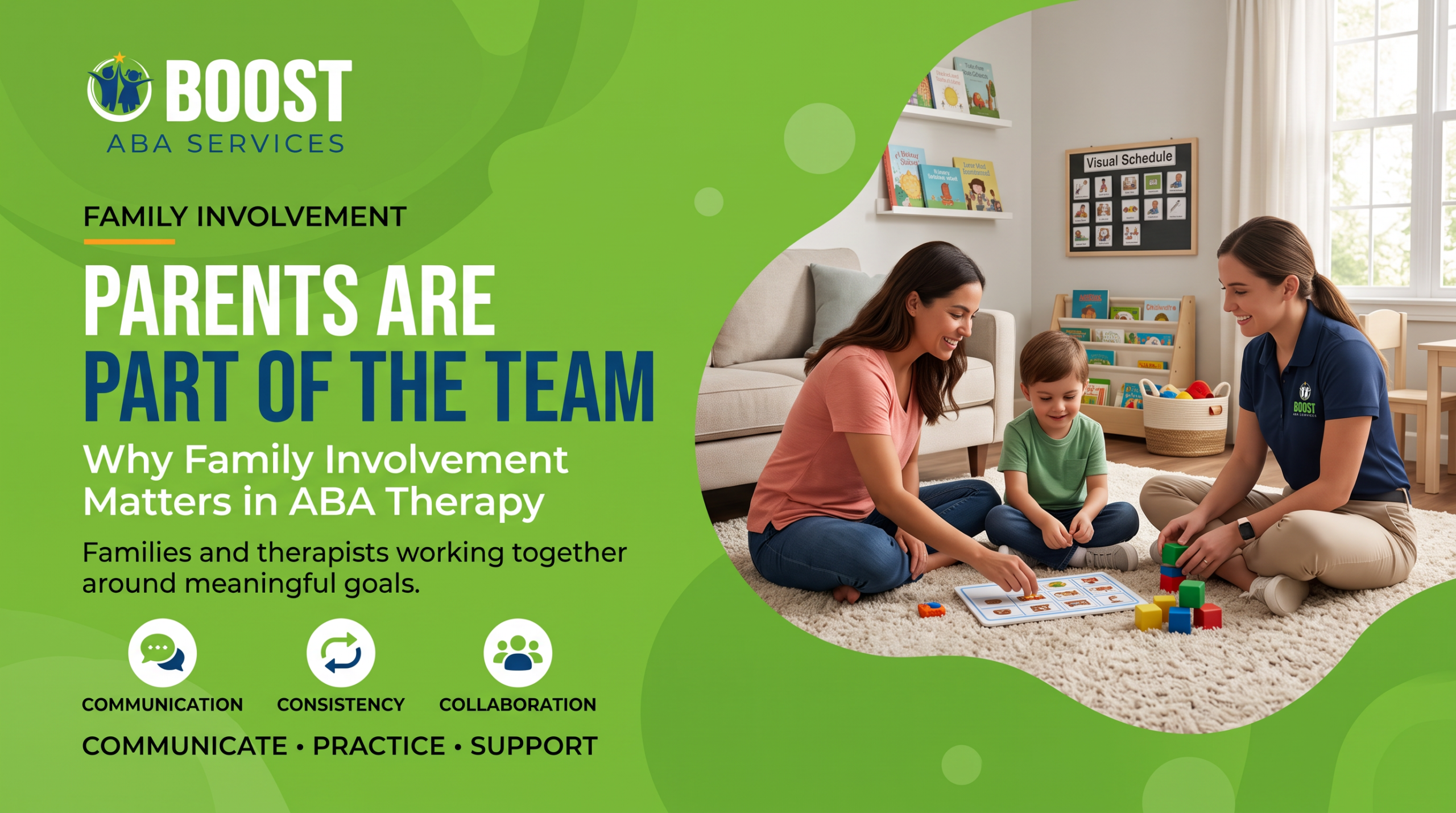
ABA therapy doesn’t happen in isolation.
Children spend much of their everyday lives with parents, caregivers, siblings, and other important people. That’s why parent involvement in ABA therapy can be an important part of helping children practice meaningful skills beyond individual therapy sessions.
At Boost ABA Services, we provide individualized home-based ABA therapy with a family-centered approach. Our clinical team works alongside parents and caregivers so families can understand their child’s goals, ask questions, share what they observe at home, and learn appropriate ways to support skills during everyday routines.
Parents don’t need to become therapists.
They are already something equally important: a meaningful part of their child’s support team.
What Does Parent Involvement in ABA Therapy Mean?
Parent involvement doesn’t mean turning every interaction with your child into a therapy session.
It means creating collaboration between the family and the child’s ABA team.
Depending on the child’s individualized treatment plan, caregiver involvement may include:
- Sharing information about everyday routines
- Discussing family priorities
- Understanding treatment goals
- Learning why certain strategies are being used
- Participating in caregiver training
- Practicing appropriate strategies during everyday situations
- Sharing observations with the clinical team
- Asking questions
- Discussing what’s working and what remains challenging
Parents have information that can be incredibly valuable to the clinical team because they see their child across many different situations.
Why Are Parents Important Members of the ABA Team?
An ABA professional may spend scheduled therapy time with a child, but families experience many more parts of the child’s everyday life.
Parents may see what happens:
First thing in the morning.
While getting dressed.
During mealtime.
When it’s time to leave home.
During play with siblings.
When plans unexpectedly change.
During the bedtime routine.
These observations can help the ABA team better understand which skills may be meaningful for the child and family.
Family feedback helps connect therapy with everyday life.
Home-Based ABA Makes Family Collaboration Natural
At Boost ABA Services, we provide ABA therapy in the home.
This creates opportunities for appropriate therapy goals to connect directly with the routines and environments children experience every day.
Depending on the child’s treatment plan, this could involve routines such as:
- Getting dressed
- Brushing teeth
- Preparing for school
- Asking for help
- Making choices
- Mealtime
- Cleaning up
- Playing
- Moving between activities
- Preparing for bedtime
The home itself can provide meaningful context for individualized learning.
Consistency Can Help Children Practice Skills
Children may need repeated opportunities to practice new skills.
If a child practices a skill only during ABA sessions but encounters completely different expectations during the rest of the week, using that skill in other situations may be more difficult.
This is where appropriate consistency can matter.
For example, imagine a child is learning to ask for help.
During ABA sessions, the child practices an individualized communication method when assistance is needed.
If parents understand the child’s communication goal, they may also be able to recognize appropriate opportunities for the child to practice asking for help during everyday routines.
That might happen when:
- A container is difficult to open
- A toy is out of reach
- The child needs assistance getting dressed
- Something isn’t working
- The child needs support completing an activity
The goal isn’t constant practice.
It’s providing appropriate opportunities for meaningful skills to be used in everyday situations.
Caregiver Training Is More Than Receiving Instructions
Parent and caregiver training in ABA should involve collaboration and understanding.
Families should have opportunities to ask questions such as:
- Why are we working on this goal?
- What does this strategy mean?
- How should we respond in this situation?
- What should we do if the strategy isn’t working?
- How can we support this skill during our normal routine?
- How will we know if progress is occurring?
Caregiver training may also help families understand concepts such as:
- Reinforcement
- Visual supports
- Functional communication
- Prompting
- Daily routines
- Transitions
- Skill building
- Understanding patterns surrounding behavior
The purpose is not simply to give parents a list of rules.
It is to help families understand the child’s individualized goals and how appropriate strategies connect with everyday life.
Parents Help Identify Meaningful Goals
Clinical expertise is important, but families can provide important context about what matters in the child’s everyday life.
Suppose a child can complete an activity during therapy but mornings remain extremely difficult for the family.
That information matters.
Or perhaps communication during mealtime is currently a bigger family priority than another skill being considered.
That matters too.
Family-centered ABA should consider meaningful questions such as:
Which routines are important to this family?
These conversations can help ensure that appropriate treatment goals remain relevant to the individual child and family.
Families Know Their Child
Parents and caregivers bring valuable knowledge to the ABA team.
They may know:
- What their child enjoys
- What motivates their child
- How their child communicates
- Which routines are easy
- Which routines are difficult
- What situations tend to be challenging
- What helps their child feel comfortable
- Which skills would make everyday life more manageable
ABA professionals bring clinical training and expertise.
Parents bring deep knowledge of their child’s everyday experiences.
A family-centered ABA approach brings those perspectives together.
Parent Involvement Can Support Communication Skills
Communication happens throughout everyday life.
Children communicate when they:
- Want something
- Don’t want something
- Need help
- Need a break
- Want attention
- Make choices
- Want to continue an activity
- Want an activity to stop
Depending on the child, communication might involve spoken language, gestures, pointing, signs, pictures, AAC, or another individualized method.
When parents understand the communication skills their child is working on, they may be better equipped to recognize appropriate opportunities for those skills to be used naturally.
Family Involvement Can Support Daily Living Skills
Many daily living skills naturally happen at home.
This can make caregiver involvement particularly relevant to home-based ABA.
For example, an individualized treatment plan may include appropriate goals involving:
Getting Dressed
Parents can understand which steps the child is currently practicing and what level of assistance may be appropriate.
Personal Care
Visual routines or other individualized strategies may support activities such as brushing teeth or washing hands.
Cleaning Up
A familiar cleanup routine may provide opportunities to practice following steps and increasing independence.
Asking for Help
Everyday challenges can provide natural opportunities for functional communication.
Transitions
Families can learn appropriate strategies that may help make changes between activities more predictable.
These are real skills being practiced in the environments where children may actually need to use them.
Family Involvement Can Help Skills Carry Into Everyday Life
A child learning a skill in one situation doesn’t automatically mean they will use that skill everywhere.
For example, a child may learn to request help from their therapist but not yet request help from a parent.
Or they may follow a visual schedule during therapy but not yet use one during their morning routine.
ABA professionals may work on helping skills become useful across appropriate people, settings, activities, and situations.
Family involvement can support this process by creating opportunities for skills to be practiced naturally outside of direct therapy sessions.
What Does Family-Centered ABA Look Like?
A family-centered ABA therapy approach recognizes that treatment exists within a child’s larger everyday life.
It may include:
Listening to Families
Parents should have opportunities to discuss priorities, concerns, and observations.
Individualizing Goals
Treatment should be based on the child’s individual strengths, needs, and circumstances.
Explaining Strategies Clearly
Families should understand what the clinical team is doing and why.
Providing Caregiver Training
Parents can learn appropriate ways to support individualized skills during everyday routines.
Reviewing Progress
Families and clinicians can discuss progress and areas that may require adjustment.
Maintaining Communication
Questions and observations should be welcomed throughout the treatment process.
Family-centered care should feel collaborative.
Parents Don’t Have to Be Perfect
Consistency matters, but consistency does not mean perfection.
Families are busy.
There will be difficult mornings, unexpected schedule changes, travel, siblings who need attention, stressful days, and routines that simply don’t go according to plan.
Parent involvement in ABA shouldn’t become another source of pressure.
The goal is to help caregivers understand useful strategies and incorporate them into everyday life when appropriate.
Even small opportunities can matter.
A child asking for help during breakfast.
Completing another step of the dressing routine.
Using a visual before leaving home.
Making a choice during play.
Moving to the next activity with additional support.
These everyday moments can provide meaningful opportunities for practice.
Questions Parents Can Ask Their ABA Team
Being involved also means feeling comfortable asking questions.
Consider asking your child’s ABA team:
- What skills are we currently working on?
- Why were these goals selected?
- How can we appropriately support these skills at home?
- What should we look for when monitoring progress?
- Which strategies should we use consistently?
- What should we do when something isn’t working?
- How can we make routines more predictable?
- How can we support our child’s communication?
- When will goals be reviewed?
- How can we share concerns or observations?
Parents shouldn’t feel that they need to understand ABA terminology before asking questions.
Your ABA team should be able to explain treatment in clear, understandable language.
Parents Are Part of the Team
ABA professionals bring clinical knowledge.
Parents and caregivers bring knowledge of their child’s everyday life.
Children bring their own strengths, preferences, communication, interests, and individual needs.
When those perspectives come together, treatment can be more closely connected to what matters in everyday life.
At Boost ABA Services, our family-centered approach recognizes parents and caregivers as important collaborators throughout the ABA journey.
Family-Centered, Home-Based ABA Therapy at Boost ABA Services
Boost ABA Services provides individualized home-based ABA therapy for children across New York, Texas, and Arizona.
Our approach brings appropriate ABA support into the child’s familiar environment, creating opportunities for families and clinical professionals to collaborate around meaningful everyday skills.
Depending on the child’s individualized treatment plan, services may support areas such as:
- Communication
- Daily living skills
- Everyday routines
- Transitions
- Play
- Social interaction
- Learning
- Greater independence
Families are encouraged to ask questions, understand their child’s goals, and participate in the process in ways that are appropriate for their family.
Learn About Our Family-Centered Approach
If you’re considering home-based ABA therapy for your child, we’re here to help you understand what services can look like and how parents and caregivers can be involved.
Boost ABA Services
Serving families across New York, Texas, and Arizona
Phone: 845-377-0024
Email: info@boostabaservices.com
Open: Monday – Friday
Big Progress Starts With Small Steps.
