
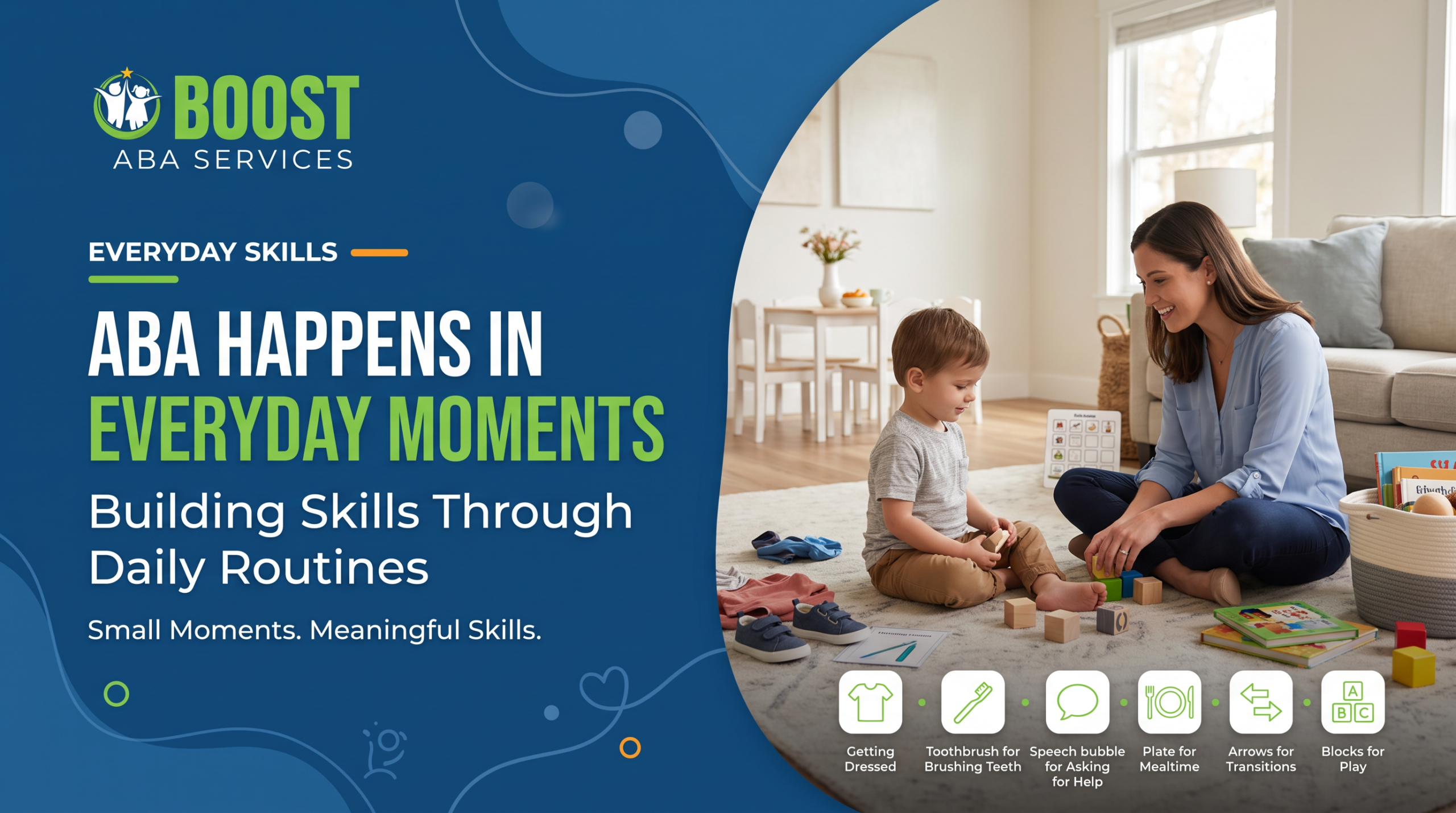
ABA therapy doesn’t always look like sitting at a table completing structured activities. For many children, meaningful learning opportunities can happen during the routines they experience every day.
Getting dressed. Brushing teeth. Asking for help. Sitting down for mealtime. Moving from one activity to another. Playing with a favorite toy.
These everyday moments can provide opportunities to practice communication, independence, daily living skills, and other individualized goals.
At Boost ABA Services, we provide individualized home-based ABA therapy, allowing appropriate skills to be practiced within the familiar environment where many everyday routines actually happen.
What Is ABA Therapy for Everyday Skills?
Applied Behavior Analysis, commonly known as ABA therapy, uses principles of learning and behavior to help children develop meaningful skills.
Depending on a child’s individual needs and treatment plan, ABA therapy for everyday skills may focus on areas such as:
- Communication
- Daily living skills
- Following routines
- Asking for help
- Making choices
- Play skills
- Social interaction
- Transitions
- Increasing independence
- Developing helpful alternatives to challenging behaviors
ABA therapy should be individualized. Not every child needs to work on the same skills, and the same strategy will not be appropriate for every child.
For children receiving home-based ABA therapy, many appropriate learning opportunities can be incorporated into natural routines and activities at home.
Why Everyday Moments Matter in ABA Therapy
Children use important skills throughout their entire day, not only during a therapy session.
A child may need to communicate when they want a snack.
Practicing appropriate skills within everyday situations can help connect learning with the situations where those skills may actually be useful.
This is one reason in-home ABA therapy can be valuable for some children and families.
1. Getting Dressed
Getting dressed may seem like one simple activity, but it actually involves many smaller skills.
Depending on a child’s age, abilities, and individualized goals, getting dressed may involve:
- Choosing appropriate clothing
- Finding clothing items
- Putting clothes on in sequence
- Using buttons or zippers
- Following directions
- Asking for assistance
- Completing multiple steps
- Increasing independence
If completing the entire routine is difficult, an ABA professional may break the activity into smaller, manageable steps when appropriate.
For example, instead of expecting a child to independently complete the entire dressing routine immediately, support may focus on one part of the routine at a time.
Small steps can gradually build toward larger skills.
2. Brushing Teeth and Personal Care
Personal care routines can provide another opportunity to develop daily living skills for children.
Brushing teeth, washing hands, combing hair, and other hygiene activities often involve a sequence of steps.
Depending on the child’s treatment goals, ABA strategies may help make these routines clearer and more predictable.
This could involve tools such as:
- Visual schedules
- Step-by-step instructions
- Modeling
- Practice
- Positive reinforcement
- Breaking a routine into smaller parts
The specific approach should always be based on the individual child.
Because these activities normally happen at home, home-based ABA services can provide opportunities to practice appropriate personal care skills within the child’s actual routine and environment.
3. Asking for Help
Knowing how to ask for help is an important functional communication skill.
Imagine a child wants a toy but cannot reach it, cannot open a container, or doesn’t know how to complete part of an activity.
These moments can become opportunities to practice communication.
Depending on how the child communicates, asking for help might involve:
- Spoken words
- Gestures
- Pointing
- Pictures
- Signs
- An AAC device
- Another appropriate communication method
Communication does not have to look the same for every child.
An individualized ABA program may support a child’s ability to communicate needs in a way that is appropriate and meaningful for them.
4. Mealtime
Mealtime is another everyday routine that can involve many different skills.
Depending on a child’s individual goals, appropriate learning opportunities during mealtime might involve:
- Making choices
- Requesting an item
- Asking for help
- Following a familiar routine
- Participating in age-appropriate meal activities
- Cleaning up afterward
- Practicing appropriate independence
Not every mealtime challenge is behavioral, and feeding concerns can involve medical, sensory, oral-motor, nutritional, or other factors requiring appropriately qualified professionals.
ABA providers should work within their professional scope and the child’s individualized treatment plan.
5. Transitions Between Activities
Transitions happen constantly.
A child may need to move from:
Playtime → Mealtime
Home → School
Screen time → Bedtime routine
Indoor activity → Leaving the house
One toy → Another activity
For some children, transitions can be difficult.
When transition goals are appropriate for the child, ABA strategies may help make changes more predictable.
This could involve:
- Visual schedules
- Clear expectations
- Advance notice
- First-then language
- Consistent routines
- Appropriate choices
- Reinforcement
The goal isn’t necessarily to make every transition perfect.
Instead, support can focus on helping the individual child develop skills that make everyday routines more manageable and understandable.
6. Learning Through Play
Play can be an important part of childhood and can also create natural opportunities for learning.
During play, children may have opportunities to practice:
- Making choices
- Requesting
- Taking turns
- Sharing attention
- Following directions
- Problem-solving
- Communication
- Interaction
- Independent play skills
ABA therapy does not always need to look formal.
Depending on the child’s goals, learning may happen while building blocks, playing with toy cars, reading books, completing puzzles, drawing, or participating in other preferred activities.
A skilled ABA professional can identify appropriate opportunities to practice individualized skills while keeping the activity meaningful to the child.
Home-Based ABA Brings Learning Into Everyday Life
This is where home-based ABA therapy can be particularly relevant.
The home already contains many of the routines, activities, people, and environments that are part of a child’s everyday life.
Rather than practicing every skill in an unfamiliar environment and then trying to use it somewhere else, appropriate goals can sometimes be addressed directly within the environment where the child needs them.
For example:
Morning routine: Getting dressed and preparing for the day.
Bathroom: Personal hygiene routines.
Kitchen: Making choices, requesting, or participating in appropriate mealtime routines.
Living room: Play, communication, and interaction.
Bedroom: Cleaning up, organizing belongings, or bedtime routines.
Front door: Preparing to leave the house and transitioning between activities.
This is an important part of the philosophy behind individualized ABA therapy at home.
Everyday Skills Can Support Greater Independence
One potential goal of ABA therapy is helping children develop skills that support greater independence when appropriate.
Independence does not mean a child should never need assistance.
Everyone asks for help.
Instead, increasing independence can mean helping a child develop more ways to participate in everyday life.
Depending on the child’s age and individualized goals, that might include:
- Getting dressed with less assistance
- Communicating when help is needed
- Following parts of a familiar routine
- Making choices
- Putting belongings away
- Participating in personal care
- Moving between activities
- Completing age-appropriate household tasks
A seemingly small skill can make a meaningful difference in a child’s everyday experience.
Communication Is Part of Everyday Life
Communication doesn’t only happen during a communication exercise.
It happens throughout the day.
A child might communicate:
“I want that.”
“Help me.”
“I’m finished.”
“I need a break.”
“I don’t want that.”
“Can we play?”
And communication doesn’t have to involve spoken words.
Children may communicate using speech, gestures, signs, pictures, pointing, facial expressions, AAC, or other methods.
Supporting functional communication can therefore be incorporated into many appropriate everyday situations.
What Does an ABA Therapist Do During Everyday Routines?
During in-home ABA therapy, an ABA professional isn’t simply completing activities for the child.
Depending on the treatment plan, the professional may:
- Observe how the child currently completes a skill
- Identify areas where support may be useful
- Break complex skills into smaller steps
- Create appropriate opportunities for practice
- Use reinforcement
- Model skills
- Provide prompts when appropriate
- Gradually adjust support
- Track progress
- Collaborate with parents and caregivers
A BCBA may oversee the child’s individualized treatment plan and monitor whether strategies and goals remain appropriate.
Parents and Caregivers Are Important Partners
Home-based ABA also creates opportunities for collaboration with parents and caregivers.
Families know their child’s routines, preferences, strengths, and everyday challenges.
Depending on the treatment plan, parent and caregiver training may help families better understand the strategies being used during ABA sessions and how appropriate skills can be supported throughout everyday life.
For example, a parent may learn how to create opportunities for their child to request help during a familiar routine or how to use an appropriate visual support for a transition.
The goal is not to turn parents into therapists.
The goal is to help families understand and support skills that are meaningful in their child’s everyday life.
Small Moments Can Create Meaningful Opportunities
Meaningful progress isn’t always dramatic.
And sometimes it’s simply practicing a skill again.
Each child’s progress will look different.
That’s why ABA goals should focus on the individual child rather than comparing one child’s development with another.
Learn About Home-Based ABA Therapy
At Boost ABA Services, we provide individualized home-based ABA therapy for children, bringing appropriate support into the familiar environments where everyday life happens.
Depending on each child’s individualized treatment plan, our team may support goals involving communication, daily living skills, routines, play, social interaction, transitions, learning, and independence.
By working within the home environment, appropriate skills can be practiced during real-life activities and routines that are meaningful to the child and family.
ABA Happens in Everyday Moments
Getting dressed.
Brushing teeth.
Asking for help.
Sitting down for mealtime.
Moving between activities.
Playing.
These may seem like ordinary parts of the day, but they can provide meaningful opportunities for children to practice important skills.
ABA can happen in everyday moments because everyday moments are where children use many of the skills they’re learning.
At Boost ABA Services, our home-based approach is designed to connect individualized support with the child’s everyday environment.
Ready to Learn More About ABA?
If you’re exploring home-based ABA therapy for your child, the Boost ABA Services team can help you understand our services, insurance verification, and the process of getting started.
Boost ABA Services
Serving families across New York, Texas, and Arizona
Phone: 845-377-0024
Email: info@boostabaservices.com
Open: Monday – Friday
Big Progress Starts With Small Steps.
