
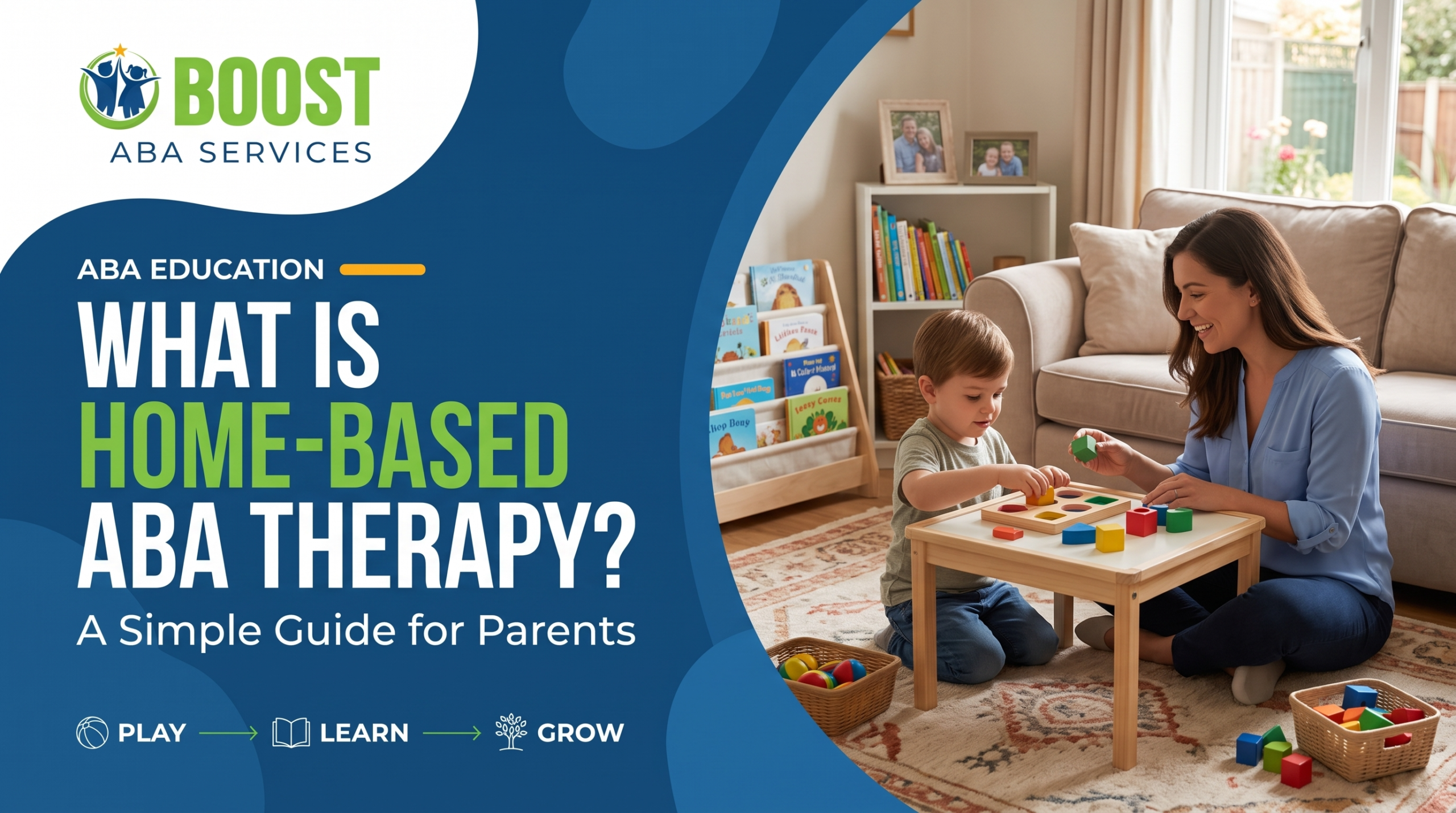
If you’ve heard about home-based ABA therapy but aren’t exactly sure what it means, you’re not alone. For many parents, Applied Behavior Analysis can initially sound complicated or overly clinical. In practice, ABA therapy can focus on something much easier to understand: helping children learn meaningful skills that can support their everyday lives.
At Boost ABA Services, we provide individualized ABA services in the home, allowing children to learn and practice skills in a familiar environment. Our approach is child-centered, family-focused, and built around each child’s individual strengths, needs, and goals.
This guide explains what ABA therapy is, how in-home ABA works, and what families can expect without all the clinical jargon.
What Exactly Is ABA Therapy?
ABA stands for Applied Behavior Analysis.
ABA is an evidence-based approach that uses principles of learning and behavior to understand how skills develop and how the environment can influence behavior.
But what does that actually mean for a parent?
In simple terms, ABA therapy can help children learn, practice, and strengthen useful skills by breaking larger goals into manageable steps.
Depending on a child’s individual needs and treatment plan, ABA therapy may focus on areas such as:
- Communication
- Daily living skills
- Social interaction
- Play skills
- Following everyday routines
- Transitions between activities
- Learning and readiness skills
- Increasing independence
- Developing helpful alternatives to challenging behaviors
There isn’t one universal ABA program that looks the same for every child. Goals and strategies should be individualized based on the child.
What Is Home-Based ABA Therapy?
Home-based ABA therapy, also called in-home ABA therapy, brings ABA services into the child’s natural home environment.
Instead of traveling to a center for every session, appropriate therapy activities and learning opportunities can take place where many of the child’s everyday routines already happen.
This can create opportunities to work on meaningful skills within real-life situations.
For example, a child may practice:
Getting dressed as part of building independence.
Asking for a preferred item as part of developing functional communication.
Cleaning up toys as part of learning an everyday routine.
Taking turns with a sibling or caregiver as part of practicing social interaction.
Moving from playtime to another activity as part of practicing transitions.
Home-based ABA is not simply taking a clinic session and moving it into someone’s house. The home environment itself can become part of the learning process.
What Does Home-Based ABA Therapy Look Like?
A home-based ABA session may look more natural than parents expect.
You might see an ABA professional:
- Playing with toys alongside your child
- Practicing communication during everyday activities
- Using positive reinforcement when teaching skills
- Breaking a difficult task into smaller steps
- Practicing routines in the places where they normally occur
- Helping a child work toward individualized goals
- Collecting appropriate data to monitor progress
- Collaborating with parents and caregivers
Some activities may be structured, while others may happen naturally through play and everyday routines.
The specific session should depend on the child’s treatment plan and goals.
ABA Can Happen During Everyday Moments
One of the benefits of in-home ABA therapy is the opportunity to practice appropriate skills within the child’s everyday environment.
Learning opportunities can exist throughout a normal day.
During Play
Play can create opportunities to practice requesting, sharing, taking turns, following directions, and interacting with others.
During Mealtime
Depending on a child’s goals, everyday mealtime routines may provide opportunities to practice communication, following routines, making choices, or age-appropriate independence.
During Morning and Evening Routines
Getting dressed, brushing teeth, putting belongings away, and completing other daily activities may provide opportunities to build daily living skills.
During Transitions
Moving from one activity to another can sometimes be difficult. When appropriate to the child’s goals, ABA strategies may be used to help make routines and transitions more predictable.
These examples help explain why home-based ABA therapy for children can be closely connected to real-life skills.
Every Child’s ABA Therapy Should Be Individualized
Every child is different.
A strategy that is useful for one child may not be appropriate for another.
That’s why individualized care is such an important part of ABA.
Before developing a treatment plan, qualified professionals consider factors such as the child’s current abilities, areas of need, family priorities, environment, and meaningful goals.
One child’s goals might focus heavily on communication.
Another child may be working toward greater independence with daily routines.
Another may need support developing play or social skills.
ABA should not be about comparing one child to another. The focus should be on meaningful progress for the individual child.
Communication Is More Than Spoken Words
Communication is an important area of development, but communicating doesn’t always mean speaking.
Children may communicate through:
- Spoken words
- Gestures
- Pointing
- Pictures
- Signs
- Facial expressions
- Augmentative and Alternative Communication (AAC)
ABA goals can support functional communication based on the child’s individual needs and communication methods.
The purpose is not to force every child to communicate in the same way. The goal is to support meaningful ways for children to express needs, make choices, participate in interactions, and be understood.
What Role Do Parents Have in Home-Based ABA?
Parents and caregivers can play an important role in home-based ABA services.
ABA professionals may spend several hours working with a child, but families are present throughout many more everyday situations.
Parent and caregiver involvement can help connect appropriate therapy strategies with everyday routines.
Depending on the child’s treatment plan, parent and caregiver training may help families:
- Better understand their child’s goals
- Learn strategies being used during ABA sessions
- Support appropriate skills during everyday routines
- Recognize opportunities for practice
- Communicate with the clinical team about progress and challenges
At Boost ABA Services, we believe collaboration with families is an important part of individualized care.
Who Provides ABA Therapy?
ABA services may involve several professionals depending on the child’s needs and treatment plan.
A Board Certified Behavior Analyst (BCBA) may assess needs, develop treatment goals, oversee programming, analyze progress, and supervise other members of the therapy team.
A Registered Behavior Technician (RBT) or Behavior Technician may work directly with the child while implementing treatment strategies under appropriate supervision.
Parents and caregivers may also collaborate with the clinical team to help support consistency across everyday environments.
What Are the Potential Benefits of Home-Based ABA Therapy?
The goals and outcomes of ABA therapy vary by child, so families should be cautious of anyone promising specific results.
Depending on an individual child’s needs, home-based ABA therapy may provide opportunities to work toward goals involving:
- Functional communication
- Social skills
- Daily living skills
- Independence
- Play and leisure skills
- Everyday routines
- Transitions
- Learning skills
- Helpful alternatives to challenging behaviors
An important advantage of providing ABA in the home is that certain skills can be practiced within the environment where the child may actually need to use them.
Is Home-Based ABA Therapy Right for My Child?
There isn’t a single answer that applies to every family.
Whether ABA therapy is appropriate should depend on the individual child’s needs and recommendations from qualified professionals.
Parents considering ABA can ask questions such as:
- What skills does my child currently need support with?
- What would the treatment goals be?
- How will those goals be individualized?
- How will progress be measured?
- How will parents and caregivers be involved?
- Who will supervise my child’s treatment?
- How will therapy connect to our child’s everyday routines?
- What will a typical home-based session look like?
A quality ABA provider should be willing to discuss these questions with families.
Why Families Choose Home-Based ABA Services
For some families, receiving ABA therapy at home can provide a familiar setting for learning.
Children have access to their normal toys, routines, family environment, and everyday activities. This can provide natural opportunities to practice appropriate skills in situations where they may eventually need to use those skills independently.
Home-based services can also give ABA professionals greater insight into certain routines and challenges families experience in everyday life.
The goal is not simply to learn a skill during a therapy session. When appropriate, the goal is for meaningful skills to become useful beyond therapy.
Home-Based ABA Therapy With Boost ABA Services
At Boost ABA Services, we provide individualized, home-based ABA therapy designed around each child’s unique needs and goals.
Our clinical professionals work with children and families to support meaningful development while incorporating learning opportunities into familiar routines and environments.
Depending on the individual treatment plan, support may focus on communication, social interaction, daily living skills, routines, learning, independence, and other meaningful areas of development.
We believe meaningful progress doesn’t have to happen all at once.
A request for help.
Another step completed independently.
A new way to communicate.
A smoother everyday routine.
Each can represent meaningful progress for an individual child.
Big Progress Starts With Small Steps.
Learn More About Home-Based ABA Therapy
If you’re exploring ABA services for your child, you don’t need to understand everything before reaching out.
The Boost ABA Services team can answer questions about home-based ABA therapy, our approach, service availability, insurance verification, and the process of getting started.
Boost ABA Services
Serving families across New York, Texas, and Arizona
Phone: 845-377-0024
Email: info@boostabaservices.com
