
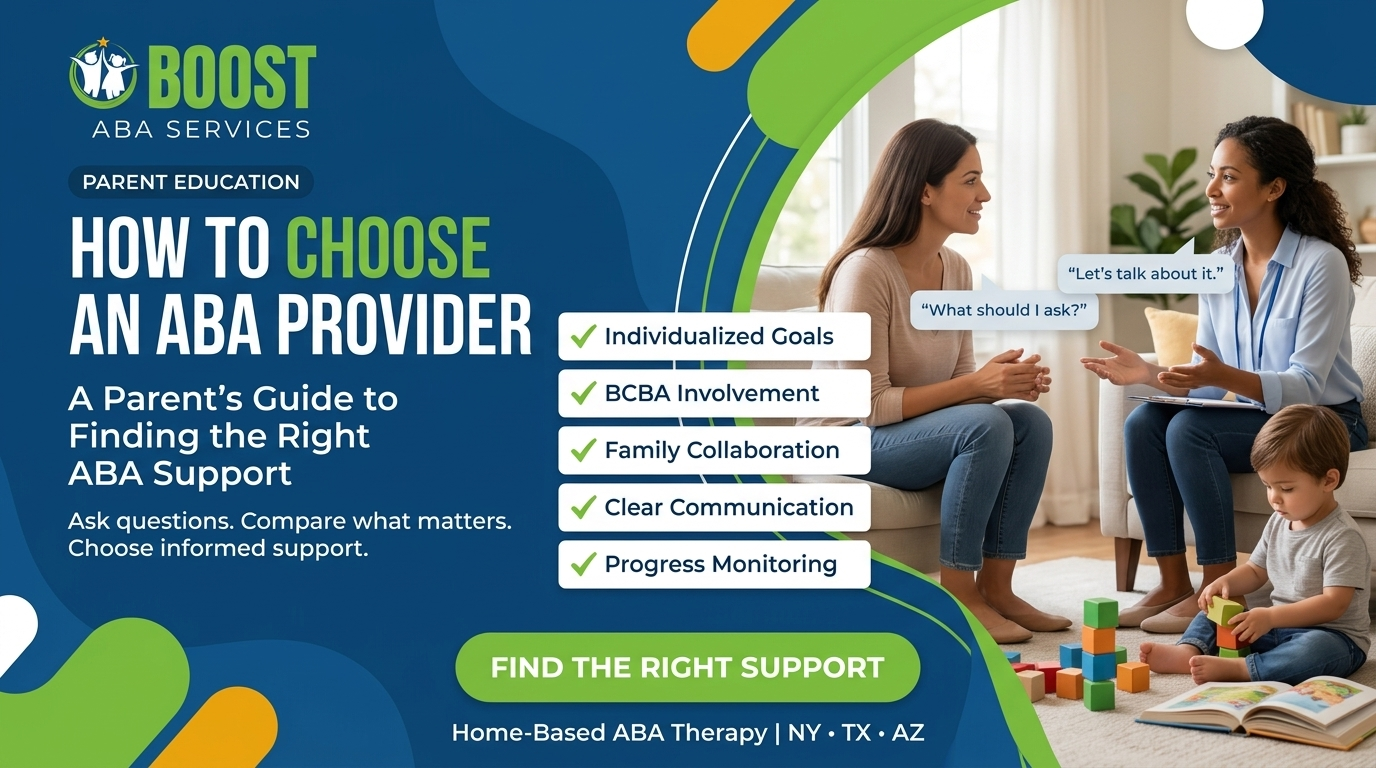
If you’ve spent hours searching for ABA therapy for your child, you’re not alone.
“ABA therapy near me.”
“Best ABA therapy provider.”
“Home-based ABA therapy.”
“ABA therapy in my area.”
And somehow, after all that research, you may still be asking:
“How do I know which provider is right for my family?”
Finding ABA support can feel overwhelming, especially when every provider seems to describe their services differently.
The good news is that you don’t have to compare everything.
Instead, focus on a few questions that can help you understand a provider’s approach and whether it may fit your child’s needs.
At Boost ABA Services, we provide individualized home-based ABA therapy for children and families in New York, Texas, and Arizona. Our goal is to make the process easier to understand so families can take the next step with confidence.
First: You Don’t Need to Find the “Perfect” Provider
Parents sometimes feel pressure to find the perfect ABA provider immediately.
However, choosing a provider doesn’t have to mean knowing everything about ABA.
You can start by asking:
What services do you provide?
Do you serve my area?
How are goals individualized?
How are parents involved?
Who supervises treatment?
How is progress monitored?
How does insurance verification work?
These questions can help you move from endless searching toward a more focused conversation.
What Should You Look for in an ABA Provider?
When comparing ABA therapy providers, focus on the areas that matter most to your family.
Individualized Treatment Goals
Every child has different strengths, needs, interests, communication styles, and priorities.
Therefore, ask:
“How will you determine my child’s goals?”
One child may have goals related to communication.
Another may focus on daily living skills.
Another may work on transitions, play, social interaction, or independence.
A provider should be able to explain how treatment is individualized rather than simply applying the same goals to every child.
BCBA Involvement
Ask:
“Who oversees my child’s treatment?”
A BCBA may assess needs, develop treatment goals, oversee treatment, monitor progress, and supervise members of the ABA team, depending on the service model and applicable requirements.
You should understand:
- Who your clinical contact is
- How the BCBA is involved
- How the treatment team communicates
- Who you contact with concerns
Family Collaboration
Parents know their child’s everyday life.
You know:
- What your child enjoys
- How your child communicates
- Which routines are difficult
- What motivates your child
- What your family prioritizes
Ask:
“How will parents be involved?”
A family-centered approach should make room for parent questions, observations, and priorities.
Clear Communication
You shouldn’t need a clinical background to understand your child’s services.
Ask:
“How will you keep our family updated?”
“Who should we contact with questions?”
“How will treatment changes be explained?”
Clear communication can make the ABA experience easier to navigate.
Progress Monitoring
Ask:
“How will you measure my child’s progress?”
Depending on the treatment plan, the clinical team may collect and review relevant information about specific skills or behaviors.
The important thing is that the provider can explain what is being measured and how information is used to inform treatment.
If You’re Looking for Home-Based ABA, Ask This
If your goal is home-based ABA therapy, don’t assume that every provider offers the same model.
Ask:
“What does a typical home-based ABA session look like?”
Home-based ABA can look different depending on the child’s individualized goals.
Depending on the treatment plan, a session may involve:
- Play
- Communication
- Daily living skills
- Everyday routines
- Transitions
- Choice-making
- Learning
- Family collaboration
The home is the setting for services.
It doesn’t mean every part of family life becomes therapy.
Instead, appropriate treatment goals may sometimes be connected with familiar activities and routines.
Why Some Families Choose Home-Based ABA
Home is where many everyday skills naturally happen.
A child may practice communication during breakfast.
Depending on the child’s individualized treatment plan, these routines may provide meaningful opportunities for skill development.
At Boost ABA Services, our home-based ABA therapy approach is designed around this connection between individualized goals and everyday life.
Don’t Choose a Provider Based on Location Alone
Searching “ABA therapy near me” is a good starting point.
However, proximity shouldn’t be the only factor.
You should also consider:
Does the provider serve my specific location?
Do they offer home-based services?
A provider that is nearby isn’t necessarily the right fit for every family.
What About Insurance?
Insurance can make the search feel even more complicated.
Coverage depends on the individual insurance plan and applicable requirements.
Depending on your plan, you may need to understand:
- ABA benefits
- Network status
- Prior authorization
- Documentation requirements
- Deductibles
- Copays or coinsurance
- Coverage limitations
When comparing providers, ask:
“Can you help me understand the insurance verification process?”
At Boost ABA Services, our team can help families understand the insurance verification process and discuss applicable next steps.
However, insurance verification does not necessarily guarantee payment or coverage.
What If You’re Comparing Multiple Providers?
If you’ve already opened 20 tabs, try narrowing your search.
Create a simple comparison list:
| Question | Provider 1 | Provider 2 | Provider 3 |
|---|---|---|---|
| Home-based services? | |||
| Serves my location? | |||
| Individualized goals? | |||
| BCBA involvement? | |||
| Parent collaboration? | |||
| Progress monitoring? | |||
| Insurance verification? | |||
| Clear intake process? |
You don’t need to compare every sentence on every website.
Instead, focus on the information that matters most to your family.
What Are Some Green Flags?
When researching how to choose an ABA provider, look for providers that can clearly explain:
Individualized Goals
How treatment is built around the individual child.
Clinical Supervision
Who oversees the treatment plan.
Family Collaboration
How parents and caregivers participate.
Clear Communication
How the provider answers questions and shares relevant information.
Progress Monitoring
How relevant treatment goals are reviewed.
Transparent Intake
What happens after you contact the provider.
These aren’t guarantees that a provider is right for your family.
Rather, they’re useful areas to explore.
What Questions Should You Ask Before Choosing ABA?
Save this list for your next provider call.
About Your Child
How will you learn about my child’s strengths and needs?
How are goals selected?
About the Clinical Team
Who oversees treatment?
How involved is the BCBA?
About Family Involvement
How will parents participate?
Is caregiver training available?
About Home-Based ABA
What does a typical session look like?
How can therapy connect with everyday routines?
About Progress
How is progress monitored?
How often are goals reviewed?
About Insurance
How does insurance verification work?
About Getting Started
What happens after I submit an inquiry?
These questions can help you turn online research into a real conversation.
“Can you help me understand whether your services may be appropriate for my child?”
A conversation can help you learn more without requiring you to have all the answers.
What Happens When You Contact Boost ABA Services?
If you’re ready to stop searching and start asking questions, the first step can be simple.
Contact
Reach out by phone, email, or our website.
Share
Tell us about your child, your location, and what you’re looking for.
Review
Discuss available services and the home-based ABA model.
Verify
If applicable, discuss insurance information and the verification process.
Next Steps
If services are appropriate and available, we’ll explain what comes next.
The exact process can vary depending on your circumstances.
Home-Based ABA Therapy in New York, Texas & Arizona
Boost ABA Services provides home-based ABA therapy in New York, Texas, and Arizona.
Depending on the child’s individualized treatment plan, services may support:
- Communication
- Daily living skills
- Everyday routines
- Play
- Social interaction
- Transitions
- Learning
- Independence
Service availability may vary by specific location.
ABA Therapy in New York
Looking for home-based ABA therapy in New York? Contact Boost ABA Services to learn whether services are available in your area.
ABA Therapy in Texas
Searching for home-based ABA therapy in Texas? Our team can help you learn more about available services and next steps.
ABA Therapy in Arizona
Looking for home-based ABA therapy in Arizona? Contact Boost ABA Services to discuss your location and potential service availability.
You Can Close Some of Those Tabs
If you’ve been searching for ABA for weeks, you don’t need another 20 articles telling you what ABA is.
You need answers to the questions that matter to your family.
Does the provider serve your area?
Can they explain their home-based approach?
Are goals individualized?
Start there.
Ready to Take the Next Step?
At Boost ABA Services, we’re here to help families understand their options for individualized home-based ABA therapy.
Boost ABA Services
Individualized Home-Based ABA Therapy
📍 New York • Texas • Arizona
📞 845-377-0024
Open Monday – Friday
