
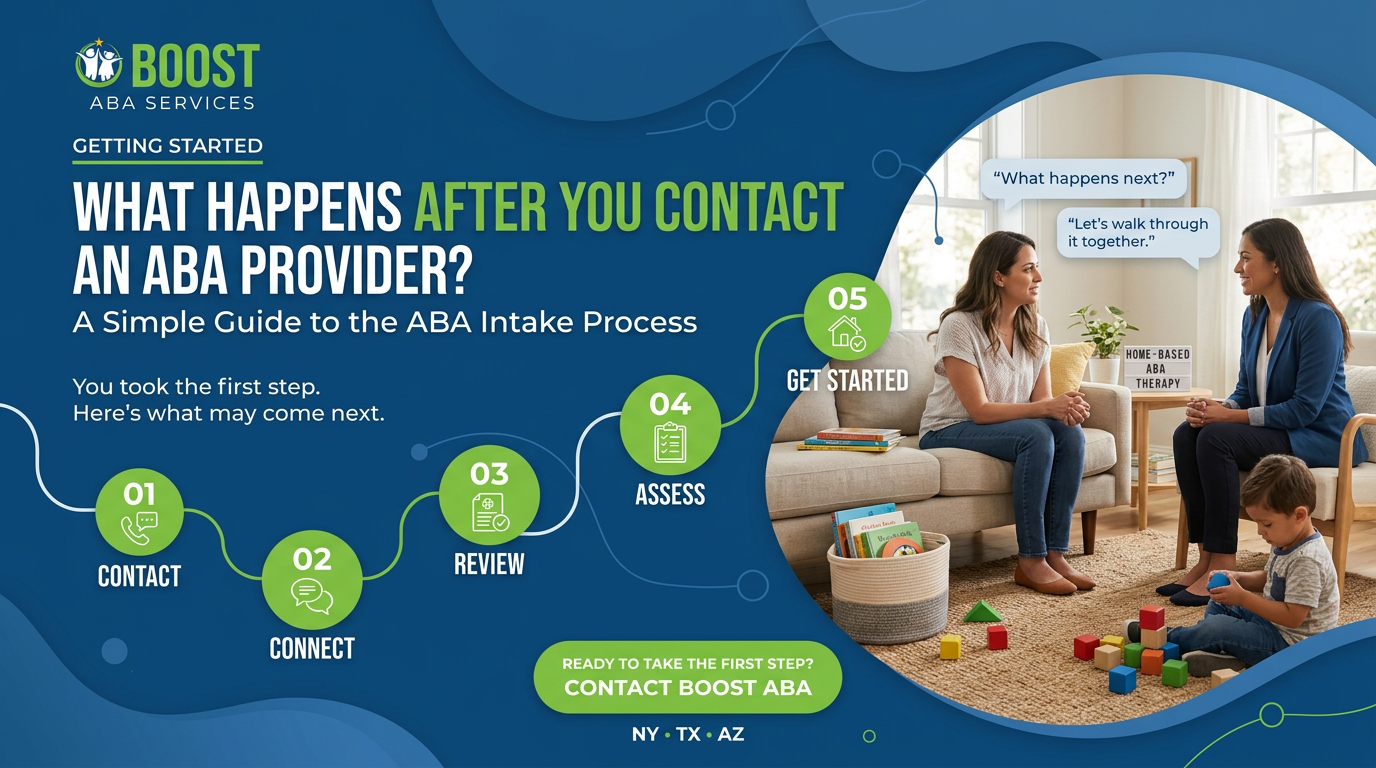
Submitting an ABA therapy inquiry can feel like a big step. You may wonder what happens after contacting an ABA provider and what to expect next in the process.
You may have filled out a contact form, sent an email, or made a phone call. Now you’re wondering:
“What happens next?”
“When will someone contact me?”
“What information will I need?”
“What happens with insurance?”
“Will my child need an assessment?”
“When can therapy begin?”
These are completely reasonable questions.
At Boost ABA Services, we provide individualized home-based ABA therapy for children and families in New York, Texas, and Arizona. We want families to understand what the process may look like after they reach out so that the next steps feel easier to navigate.
The exact intake process can vary based on individual circumstances, service availability, insurance requirements, and other factors. However, here’s a general look at what families can expect.
Step 1: You Contact Boost ABA Services
The process starts with a simple conversation.
“I’m interested in home-based ABA therapy for my child and would like to learn more.”
That’s enough to start.
What Information May Be Helpful?
When you contact an ABA provider, it can help to have basic information available, such as:
- Your child’s age
- Your city and state
- Your ZIP code
- Your main concerns
- Insurance information, if applicable
- Any relevant recommendations or documentation you already have
- Your questions about ABA therapy
You don’t need to explain everything using clinical terminology.
Simply describe what you’re experiencing in everyday language.
For example:
“My child has difficulty communicating when they need help.”
or:
“We’re looking for support with transitions and daily routines.”
Step 2: We Learn About What You’re Looking For
After your initial inquiry, the next step is understanding what you’re looking for and whether Boost ABA Services may be able to help.
This may involve discussing:
- Your child’s age
- Your location
- Areas where you’re seeking support
- Home-based ABA services
- Your family’s questions
- Insurance information
- Potential next steps
This conversation is an opportunity for you to ask questions too.
Questions You Can Ask
You may want to ask:
Do you provide home-based ABA therapy in my area?
What does a typical ABA session look like?
How are treatment goals individualized?
Who supervises the treatment?
How are parents involved?
How does insurance verification work?
What happens after the first call?
You don’t need to wait for the provider to ask everything.
Your questions matter.
Step 3: Confirm Your Location and Service Availability
Because Boost ABA Services provides home-based ABA therapy, your location is an important part of the intake process.
Boost focuses on services in:
New York
Texas
Arizona
However, being located in one of these states does not automatically mean services are available at every address.
Availability may depend on:
- Specific location
- Current provider availability
- Staffing
- Scheduling
- Service model
- Individual circumstances
Therefore, we encourage families to provide their city and ZIP code so service availability can be discussed.
Searching for ABA Therapy Near Me?
If you’ve been searching for:
“ABA therapy near me”
“home-based ABA therapy near me”
or
“ABA provider near me”
your location is one of the first things to confirm.
If you’re unsure whether Boost serves your area, simply ask.
Step 4: Review Insurance Information
Insurance is one of the most common questions parents have when starting ABA therapy.
If applicable, the team may need information from your insurance plan to begin the verification process.
You may be asked for:
- Insurance company
- Member ID
- Group number
- Policyholder information
- Insurance card
- Other applicable information
Does Insurance Cover ABA Therapy?
Coverage depends on the individual insurance plan and applicable requirements.
Depending on your plan, you may need to understand:
- ABA benefits
- Network requirements
- Prior authorization
- Documentation
- Deductibles
- Copays or coinsurance
- Coverage limitations
Because plans vary, you shouldn’t assume that another family’s insurance experience will be the same as yours.
What Is Insurance Verification?
Insurance verification involves reviewing applicable benefits and requirements to better understand what may be available under a specific plan.
However, verification does not necessarily guarantee payment or coverage.
If you have questions about your benefits, you can also contact your insurance company directly.
Step 5: Discuss the Assessment Process
Depending on the provider, service model, and individual circumstances, an assessment may be part of the process before ABA therapy begins.
An assessment can help the clinical team understand relevant information about your child.
This may include:
- Current skills
- Communication
- Strengths
- Areas where support may be helpful
- Daily routines
- Social interaction
- Learning
- Family priorities
The exact assessment process can vary.
What Is the Purpose of an ABA Assessment?
The purpose is to help the clinical team understand the individual child and identify appropriate treatment goals.
It isn’t simply about putting a label on a child.
Instead, relevant information can help guide an individualized treatment plan.
Parents should feel comfortable asking:
“What will the assessment involve?”
“What information are you looking for?”
“How will the assessment information be used?”
Step 6: Develop Individualized Treatment Goals
Once the clinical team has relevant information, appropriate treatment goals can be developed.
This is an important part of individualized ABA therapy.
Your child’s goals should reflect their individual needs rather than simply copying another child’s program.
For example, one child may have goals related to:
Communication
Another may focus on:
Daily living skills
Another may work on:
Transitions
Another may have goals related to:
Play or social interaction
The appropriate goals depend on the individual child.
Step 7: Understand What Home-Based ABA Will Look Like
At Boost ABA Services, our ABA services are home-based.
This means appropriate therapy takes place in the child’s familiar home environment.
Some parents picture ABA as sitting at a table for an entire session.
However, home-based ABA can involve many different activities depending on the child’s individualized treatment plan.
A session may include:
- Play
- Communication
- Daily living skills
- Everyday routines
- Transitions
- Choice-making
- Age-appropriate activities
- Family collaboration
For example, appropriate goals may sometimes connect with:
Getting dressed
Breakfast
Playing
Cleaning up
Asking for help
Moving between activities
The home is the setting for services. It doesn’t mean every moment of family life becomes therapy.
Step 8: Understand the Role of Parents
Parents and caregivers are important sources of information about a child’s everyday life.
You know:
- What your child enjoys
- How your child communicates
- Which routines are difficult
- What motivates your child
- What your child does well
- Which skills matter most to your family
Depending on the treatment plan, caregiver involvement may include:
- Sharing observations
- Discussing family priorities
- Participating in caregiver training
- Learning appropriate strategies
- Supporting relevant skills during everyday routines
- Communicating with the clinical team
You don’t need to become a therapist.
Instead, you can be a collaborative member of your child’s support team.
Step 9: Discuss What Happens Before Services Begin
Before services begin, there may be additional administrative, clinical, insurance, or scheduling steps.
These can vary depending on the individual situation.
You may need to discuss:
- Service availability
- Scheduling
- Insurance requirements
- Authorization
- Treatment planning
- Documentation
- Start-date considerations
Because every family is different, there isn’t one universal timeline for beginning ABA therapy.
How Long Does It Take to Start ABA?
There isn’t one guaranteed timeframe.
The process can depend on:
- Insurance requirements
- Authorization
- Assessment
- Service availability
- Staffing
- Scheduling
- Individual circumstances
Therefore, ask your provider about the current process and what steps remain for your specific situation.
Step 10: Begin Home-Based ABA Services
Once the appropriate steps have been completed and services are available, therapy can begin according to the individualized treatment plan.
Depending on the child’s goals, sessions may involve:
- Communication
- Play
- Daily living skills
- Routines
- Transitions
- Learning
- Social interaction
- Independence
The exact activities depend on the child.
That’s why two children receiving home-based ABA may have completely different therapy experiences.
What If I Have More Questions After Submitting the Form?
You can ask.
Submitting an inquiry doesn’t mean you’ve agreed to everything.
It simply opens a conversation.
You can continue asking about:
- Services
- Insurance
- Assessment
- Scheduling
- Home-based ABA
- Treatment goals
- Parent involvement
- Next steps
You should feel comfortable understanding the process before moving forward.
What Should Parents Have Ready?
If you’ve already submitted your inquiry or you’re preparing to contact Boost, keep these items nearby:
Child Information
Age and basic information about your child.
Location
City, state, and ZIP code.
Insurance
Insurance card and relevant plan information, if applicable.
Main Concerns
A few examples of what you’re looking for support with.
Questions
Write down anything you want to ask the team.
You don’t need a perfect list.
Even one question is a good place to start.
What Makes the Boost ABA Approach Different?
At Boost ABA Services, our focus is on individualized home-based ABA therapy.
We recognize that every child is different.
Therefore, our approach is centered around:
Individualized Goals
Support based on the child’s needs and treatment plan.
Home-Based Services
Appropriate therapy within the child’s familiar environment.
Family Collaboration
Parents and caregivers are important members of the support team.
Clinical Support
Appropriate clinical oversight and treatment planning.
Meaningful Everyday Skills
Connecting appropriate goals with real-life routines when relevant to the child’s treatment plan.
Home-Based ABA Therapy in New York, Texas & Arizona
Boost ABA Services provides home-based ABA therapy in New York, Texas, and Arizona.
Depending on the child’s individualized treatment plan, services may support:
- Communication
- Daily living skills
- Everyday routines
- Play
- Social interaction
- Transitions
- Learning
- Independence
Service availability may vary by specific location.
ABA Therapy in New York
If you’re looking for home-based ABA therapy in New York, contact Boost ABA Services to discuss service availability in your area.
ABA Therapy in Texas
If you’re searching for home-based ABA therapy in Texas, our team can help you learn more about our services and potential next steps.
ABA Therapy in Arizona
If you’re looking for home-based ABA therapy in Arizona, contact us to learn more about our individualized approach and available services.
Your First Step Can Be Simple
If you’ve already submitted an ABA inquiry, you may be wondering what happens next.
And throughout the process, you can ask questions.
You don’t have to have everything figured out before contacting an ABA provider.
Ready to Take the First Step?
If you’re looking for home-based ABA therapy for your child, Boost ABA Services is here to help you understand the process.
Whether you’re just beginning your search or you’ve already submitted an inquiry, our team can help you learn more about available services and potential next steps.
Boost ABA Services
Individualized Home-Based ABA Therapy
📍 New York • Texas • Arizona
📞 845-377-0024
Open Monday – Friday
