
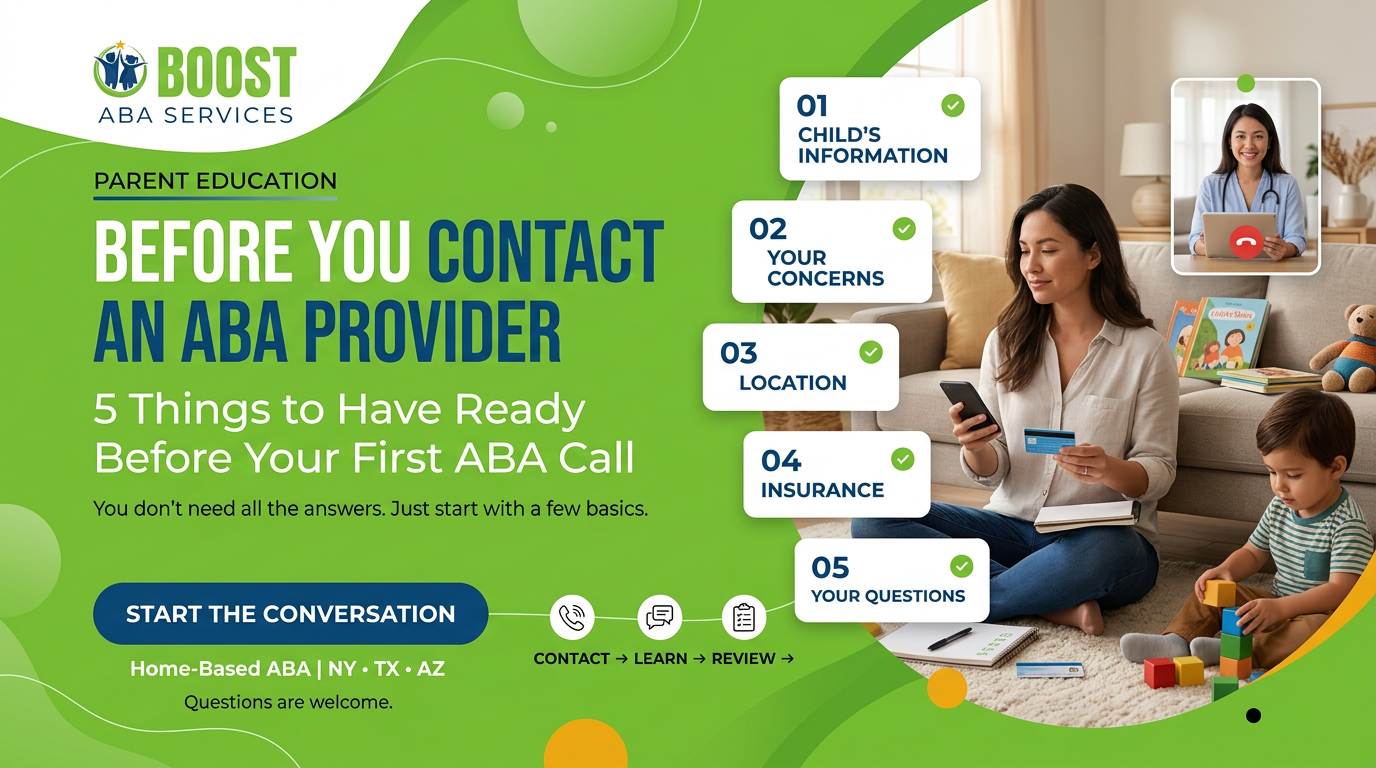
If you’re looking for ABA therapy for your child, making the first call to a provider can feel like a big step. You may wonder what information you need, what questions you’ll be asked, or what happens after you reach out.
Having a few basic details ready can simply make the conversation easier and help the provider understand what you’re looking for.
At Boost ABA Services, we provide individualized home-based ABA therapy for children and families in New York, Texas, and Arizona. Our team can help families learn about services, discuss their needs, understand the intake process, and explore potential next steps.
What Should You Have Ready Before Your First ABA Call?
- Basic information about your child
- Your main concerns and priorities
- Your location
- Your insurance information
- Your questions
You don’t need a detailed clinical report or a perfect explanation. Simply sharing what you’re experiencing can be a good place to start.
1. Basic Information About Your Child
The first thing a provider will likely want to understand is some basic information about your child.
You may want to have:
- Your child’s age
- Your child’s location
- How your child communicates
- Areas where you’re looking for support
- Relevant recommendations or documentation you already have
“My child is 5 years old, and we’re looking for home-based ABA therapy. We’re mainly looking for support with communication and daily routines.”
That’s enough to begin the conversation.
You Don’t Need to Know ABA Terminology
Parents sometimes worry that they need to describe their child’s needs using clinical language.
You don’t.
Instead of saying:
“My child has difficulty with functional communication.”
You can say:
“My child has difficulty communicating when they need help.”
Instead of:
“My child struggles with transitions.”
You can say:
“Moving from one activity to another is difficult for my child.”
Simple, everyday descriptions can help a provider understand what you’re looking for.
2. Your Main Concerns and Priorities
Maybe you’re concerned about:
- Communication
- Daily routines
- Transitions
- Play
- Social interaction
- Learning
- Independence
- Asking for help
- Other everyday skills
You don’t need to identify every concern.
What Is Most Important to Your Family?
For example:
“Mornings are very difficult.”
“My child has trouble communicating when they need help.”
“Transitions between activities are challenging.”
“We’re looking for support with daily routines.”
These real-life examples can help the provider better understand your family’s needs.
3. Your Location
If you’re looking for home-based ABA therapy near you, your location is especially important.
Boost ABA Services provides home-based ABA services in:
New York
Texas
Arizona
However, service availability can vary by specific location.
For that reason, have your:
- City
- State
- ZIP code
ready when you contact an ABA provider.
Why Does Location Matter?
Being located in one of the states a provider serves doesn’t necessarily mean services are available at every address.
Availability can depend on:
- Geographic service area
- Current provider availability
- Staffing
- Scheduling
- Service model
- Individual circumstances
Therefore, it’s always best to ask directly:
“Do you provide home-based ABA therapy in my area?”
4. Your Insurance Information
Insurance is one of the most common questions parents have when starting ABA therapy.
If you have insurance, keep your insurance card nearby when contacting a provider.
You may need:
- Insurance company name
- Member ID
- Group number
- Policyholder information
- Insurance card
Does Insurance Cover ABA Therapy?
Coverage depends on the individual insurance plan and applicable requirements.
Depending on the plan, families may need to understand:
- ABA benefits
- Network requirements
- Prior authorization
- Documentation requirements
- Deductibles
- Copays or coinsurance
- Coverage limitations
Because insurance plans vary, you shouldn’t assume that another family’s coverage will be the same as yours.
What Is Insurance Verification?
Insurance verification involves reviewing applicable benefits and requirements to better understand what may be available under a specific plan.
However, verification does not necessarily guarantee payment or coverage.
At Boost ABA Services, our team can help families understand the insurance verification process and discuss applicable next steps.
5. Your Questions
Don’t forget the most important thing:
Your questions.
You don’t need to know exactly what to ask. However, having a few questions written down can make your first conversation easier.
Questions About Your Child’s Goals
Questions About the BCBA
Who oversees my child’s treatment?
How involved will the BCBA be?
Who should I contact if I have concerns?
Questions About Home-Based ABA
What does a typical home-based ABA session look like?
How will therapy fit into our everyday routines?
How will parents be involved?
Questions About Progress
How will my child’s progress be measured?
How will progress be communicated to our family?
What happens if a goal needs to change?
Questions About Getting Started
What happens after I submit an inquiry?
Is an assessment required?
What information do you need from us?
How does insurance verification work?
What are the next steps?
What Happens After You Contact an ABA Provider?
Knowing what happens after your first call can make the process feel much easier.
While every provider’s process may differ, getting started with ABA therapy may generally involve:
Step 1: Contact the Provider
You can call, email, or submit an online inquiry.
Step 2: Share Basic Information
You’ll provide information about your child, your location, and the type of support you’re looking for.
Step 3: Review Available Services
The provider can explain its services and discuss whether home-based ABA may be available in your area.
Step 4: Discuss Insurance
If applicable, you’ll provide insurance information and discuss the verification process.
Step 5: Assessment
Depending on the provider and individual circumstances, an assessment may be part of the process.
Step 6: Individualized Planning
Relevant information can help the clinical team determine appropriate goals and treatment strategies.
Step 7: Getting Started
If services are appropriate and available, the provider can explain the next steps for beginning therapy.
The exact process and timeline can vary.
What Does Home-Based ABA Therapy Look Like?
At Boost ABA Services, we provide home-based ABA therapy.
This means appropriate ABA services take place within the child’s familiar home environment.
Some parents may picture ABA as a child sitting at a table for an entire session. However, home-based ABA can look different depending on the child’s individualized goals.
A session may involve:
- Play
- Communication
- Daily living skills
- Everyday routines
- Transitions
- Choice-making
- Social interaction
- Age-appropriate activities
For example, appropriate goals may sometimes be incorporated into:
Getting dressed
Breakfast
Playtime
Cleanup
Asking for help
Moving between activities
The goal isn’t to turn your home into a clinic.
Instead, appropriate treatment goals can connect with meaningful activities that naturally happen at home.
Why Individualized ABA Matters
Every child is different.
One child may have goals related to communication.
Therefore, individualized ABA therapy should consider the specific child rather than applying exactly the same goals to everyone.
When speaking with a provider, ask:
“How will you determine what is appropriate for my child?”
The answer can tell you a lot about the provider’s approach.
Parents Are Part of the Team
Parents and caregivers bring valuable information to the ABA process.
You know your child’s:
- Favorite activities
- Communication style
- Daily routines
- Strengths
- Preferences
- Challenges
- Family priorities
Depending on the treatment plan, caregiver involvement may include:
- Sharing observations
- Discussing priorities
- Participating in caregiver training
- Learning appropriate strategies
- Supporting relevant skills during everyday routines
- Communicating with the clinical team
You don’t need to become a therapist.
Instead, you can be an important partner in your child’s support.
What If You Don’t Know What Your Child Needs?
That’s okay.
You don’t need to diagnose your child or create a treatment plan before contacting an ABA provider.
You can simply say:
“I’m concerned about my child’s communication.”
Or:
“We’re having difficulty with transitions.”
Or:
“I’d like to learn more about home-based ABA.”
Or even:
“I’m not sure what services my child needs. Can you help me understand the options?”
A conversation can help you learn more about the possibilities.
What If You’re Nervous About Making the Call?
Calling an ABA provider about your child can feel intimidating.
But you don’t need perfect wording.
You don’t need every document.
You don’t need to know every ABA term.
And you don’t need to make a decision during your first conversation.
You can simply say:
“Hi, I’m interested in learning more about ABA therapy for my child.”
That’s enough to start.
Before Your First ABA Call: Quick Checklist
Save this checklist before contacting an ABA provider:
Have Ready
- Child’s age
- City and ZIP code
- Basic information about your child
- Your main concerns
- Insurance information, if applicable
- Your questions
Ask About
- Home-based services
- Individualized goals
- BCBA involvement
- Parent participation
- Progress monitoring
- Insurance verification
- Assessment
- Next steps
You don’t need every box checked.
The checklist is simply there to make your first conversation easier.
Home-Based ABA Therapy in New York, Texas & Arizona
Boost ABA Services provides individualized home-based ABA therapy in New York, Texas, and Arizona.
Depending on each child’s individualized treatment plan, services may support:
- Communication
- Daily living skills
- Everyday routines
- Play
- Social interaction
- Transitions
- Learning
- Independence
Service availability may vary by specific location.
ABA Therapy in New York
If you’re looking for home-based ABA therapy in New York, contact Boost ABA Services to learn about service availability in your area.
ABA Therapy in Texas
If you’re searching for home-based ABA therapy in Texas, our team can help you learn more about our services and the process of getting started.
ABA Therapy in Arizona
If you’re looking for home-based ABA therapy in Arizona, contact Boost ABA Services to learn more about our individualized approach and available services.
You Don’t Have to Have All the Answers
Starting ABA therapy can feel like a big decision.
But your first call doesn’t have to be complicated.
Have your child’s basic information.
Think about your main concerns.
Have your location ready.
Keep your insurance information nearby.
And most importantly, bring your questions.
You can start with one conversation.
Ready to Contact Boost ABA Services?
If you’re looking for home-based ABA therapy for your child, we’re here to help you understand the process.
You can ask questions, learn about our services, check availability in your area, and discuss potential next steps.
Boost ABA Services
Individualized Home-Based ABA Therapy
📍 New York • Texas • Arizona
📞 845-377-0024
Open Monday – Friday
