
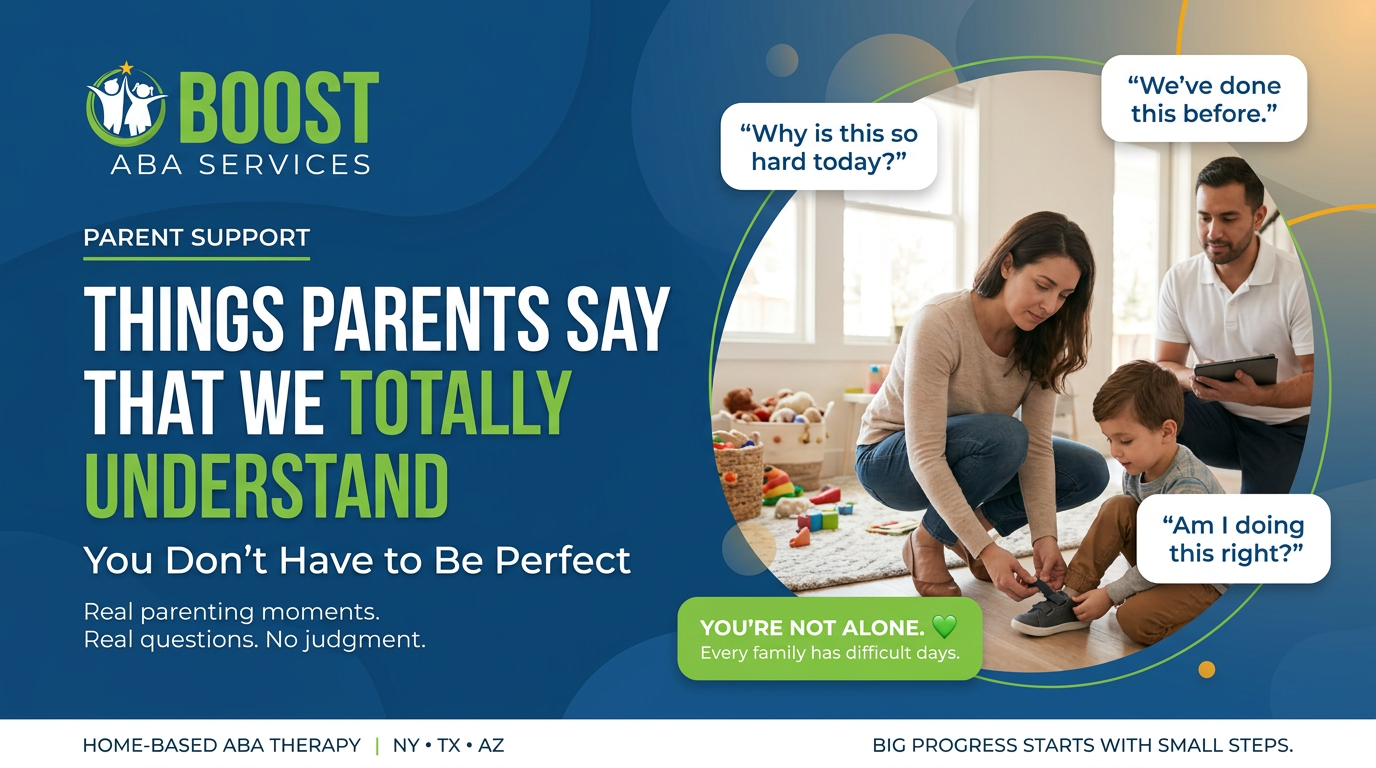
Things Parents Say That We Totally Understand: You Don’t Have to Be Perfect
“Why is this so hard today?” For many parents, parenting challenges autism brings are a daily reality.
If you’ve ever said that during a difficult morning, a challenging transition, or a routine that suddenly feels impossible, you’re not alone.
Parenting can come with moments that don’t go according to plan. A routine that worked yesterday may feel completely different today. A simple request can turn into a long conversation. A transition from one activity to another may take more time than expected. And sometimes, you may simply wonder:
“Am I doing this right?”
The answer is that you don’t have to be perfect.
At Boost ABA Services, we understand that every child and family is different. Our individualized home-based ABA therapy approach focuses on meaningful skills, everyday routines, and collaboration with parents and caregivers across New York, Texas, and Arizona.
This guide covers some of the everyday moments parents may recognize and a few ways to approach them with patience and understanding.
“Why Is This So Hard Today?”
Sometimes a routine that usually works suddenly doesn’t.
These moments can leave parents wondering what changed.
However, children can have different needs from one day to the next. Their energy, environment, schedule, communication, and circumstances can all be different.
Instead of assuming that something has gone wrong, it can help to pause and ask:
What is different today?
Is the routine clear?
Does my child understand what comes next?
Is there a communication barrier?
Does my child need additional support with this step?
These questions aren’t about blaming anyone.
They’re about understanding the situation.
“Mornings Shouldn’t Be This Hard.”
Morning routines can involve many transitions in a short period of time.
Wake up.
Get dressed.
Brush teeth.
Eat breakfast.
Pack a backpack.
Put on shoes.
Leave the house.
For some children, moving through all these steps can require additional support.
Try Making the Routine Predictable
A simple visual schedule can show what comes next:
WAKE UP → GET DRESSED → BREAKFAST → BRUSH TEETH → SHOES → SCHOOL
Depending on your child’s needs, a visual schedule could use pictures, photographs, symbols, written words, or a combination.
The goal isn’t to create a complicated system.
Instead, it can make the sequence easier to understand.
“We’ve Done This So Many Times. Why Is It Still Difficult?”
Parents may sometimes feel frustrated when a child continues to need support with a routine they’ve practiced many times.
However, learning isn’t always a straight line.
A child may be able to complete a skill in one situation but need more support in another.
For example, getting dressed may be easier on a relaxed weekend morning than on a rushed school morning.
Similarly, a child may communicate effectively during play but have difficulty communicating when they’re overwhelmed.
This is one reason individualized support matters.
The question isn’t necessarily:
“Why can’t my child do this yet?”
Instead, consider:
“What support does my child need in this situation?”
“Why Does My Child Keep Asking the Same Question?”
Repeated questions can sometimes be challenging for parents.
You may hear the same question again and again:
“When are we leaving?”
“Are we going to the park?”
“What’s for dinner?”
“When is bedtime?”
Instead of immediately assuming the child is simply being repetitive, consider what the repeated question may be communicating.
The appropriate response depends on the individual child and situation.
A visual schedule, clear answer, predictable routine, or other individualized support may be helpful in some circumstances.
“Transitions Are Taking Forever.”
Moving from one activity to another can be challenging for some children.
Going from:
Play → Cleanup
Screen time → Dinner
Home → School
Bath → Bedtime
can require a significant change in attention and expectations.
A Few Practical Ideas
Depending on your child’s needs, you might consider:
Visual schedules
Show what comes next.
Countdowns
Give an appropriate warning before an activity ends.
Clear language
Use simple, predictable directions.
First-Then language
For example:
“First shoes, then outside.”
Reinforcement
Recognize appropriate participation when it occurs.
These strategies aren’t guaranteed to work for every child.
Instead, they are examples of approaches that may be considered based on the individual child and circumstances.
“My Child Doesn’t Want to Try Anything New.”
Trying something unfamiliar can be difficult for some children.
A new food, activity, environment, person, or routine may feel very different from what they know.
Rather than turning every new experience into a battle, consider starting small when appropriate.
For example:
Look → Explore → Participate
Give the child opportunities to become familiar with something before expecting full participation.
At the same time, consider what the child may be communicating through their response.
Understanding the situation can help parents and professionals determine appropriate next steps.
“I Feel Like I’m Doing Everything Wrong.”
This may be one of the hardest thoughts parents experience.
When routines are difficult, it’s easy to blame yourself.
But parenting isn’t a test you either pass or fail.
That’s normal.
You don’t have to be perfect to support your child.
Your Child’s Behavior Isn’t the Whole Story
When a difficult moment happens, it can be tempting to focus only on what you see.
However, behavior happens within a larger context.
Parents and professionals may consider:
- What happened before the behavior
- What the child may be communicating
- What happened afterward
- Changes in the environment
- Communication needs
- Routines
- Other relevant circumstances
Understanding these factors can help the clinical team develop appropriate individualized support.
This doesn’t mean every behavior has one simple explanation.
Instead, it means looking at the whole situation rather than making assumptions.
Parents Know Their Children Best
Parents see things that professionals may not see during a scheduled session.
You know:
- Your child’s favorite activities
- Their daily routines
- How they communicate
- What they enjoy
- What tends to be difficult
- What helps them feel comfortable
- What matters most to your family
That knowledge is valuable.
At Boost ABA Services, we believe parents and caregivers are important members of the support team.
Our family-centered ABA approach encourages collaboration between families and clinical professionals.
Home-Based ABA Can Connect Support With Everyday Life
At Boost ABA Services, we provide home-based ABA therapy.
One reason some families choose in-home ABA is that many everyday routines naturally happen at home.
For example:
Morning
Getting dressed, brushing teeth, eating breakfast, and preparing to leave.
Afternoon
Playing, having a snack, completing activities, and transitioning between routines.
Evening
Mealtime, cleanup, personal care, and preparing for bedtime.
Depending on a child’s individualized treatment plan, these routines may provide appropriate opportunities to practice meaningful skills.
The goal isn’t to turn your home into a clinic.
Instead, appropriate therapy goals can connect with the environment where everyday life happens.
You Don’t Have to Handle Every Moment Perfectly
It’s easy to believe that good parenting means always knowing exactly what to do.
It doesn’t.
That’s okay.
Learning how to support your child is a process.
And asking for support is not a sign that you’re failing.
It’s a sign that you’re paying attention and looking for ways to help.
When Should Parents Ask for Professional Support?
If you have ongoing concerns about your child’s communication, daily routines, learning, social interaction, transitions, or behavior, consider discussing those concerns with an appropriately qualified professional.
You don’t need to wait until a situation becomes overwhelming.
You can bring specific examples and ask:
“How can we support this skill at home?”
The answers will depend on your child’s individual circumstances.
Small Changes Can Feel Big to Families
Sometimes parents notice small changes that others might overlook.
These moments don’t need to be dramatic to feel meaningful.
Every child has their own strengths, needs, and goals.
Therefore, meaningful progress can look different from one child to another.
What Parents Can Remember on Difficult Days
When a day feels particularly challenging, remember:
You don’t need every answer today.
Your child doesn’t need to follow someone else’s timeline.
Most importantly:
You don’t have to be perfect.
Home-Based ABA Therapy in New York, Texas & Arizona
Boost ABA Services provides individualized home-based ABA therapy in New York, Texas, and Arizona.
Depending on each child’s individualized treatment plan, services may support areas such as:
- Communication
- Daily living skills
- Everyday routines
- Social interaction
- Play
- Transitions
- Learning
- Independence
Our approach is family-centered and focused on meaningful skills that connect with everyday life.
Service availability may vary by location.
ABA Therapy in New York
Families looking for home-based ABA therapy in New York can contact Boost ABA Services to learn more about available services in their area.
ABA Therapy in Texas
If you’re searching for home-based ABA therapy in Texas, our team can help you learn more about our approach and the process of getting started.
ABA Therapy in Arizona
Families looking for home-based ABA therapy in Arizona can contact us to learn more about individualized services and availability.
You Are Not Alone
Parenting comes with moments that are joyful, exhausting, confusing, and everything in between.
If you’ve ever thought:
“Why is this so hard today?”
You’re not alone.
If you’ve ever repeated the same instruction ten times, you’re not alone.
If you’ve ever questioned whether you were doing enough, you’re not alone.
And if you’ve ever celebrated a tiny moment that nobody else seemed to notice, you’re definitely not alone.
Your child has their own journey.
Your family has its own story.
And you don’t have to navigate every step perfectly.
Learn More About Home-Based ABA Therapy
If you’re exploring home-based ABA therapy for your child, Boost ABA Services is here to help you understand your options.
Our team can answer questions about our individualized approach, family involvement, insurance verification, service availability, and getting started.
Boost ABA Services
Home-Based ABA Therapy | NY • TX • AZ
📞 845-377-0024
Open Monday – Friday
Big Progress Starts With Small Steps.
