
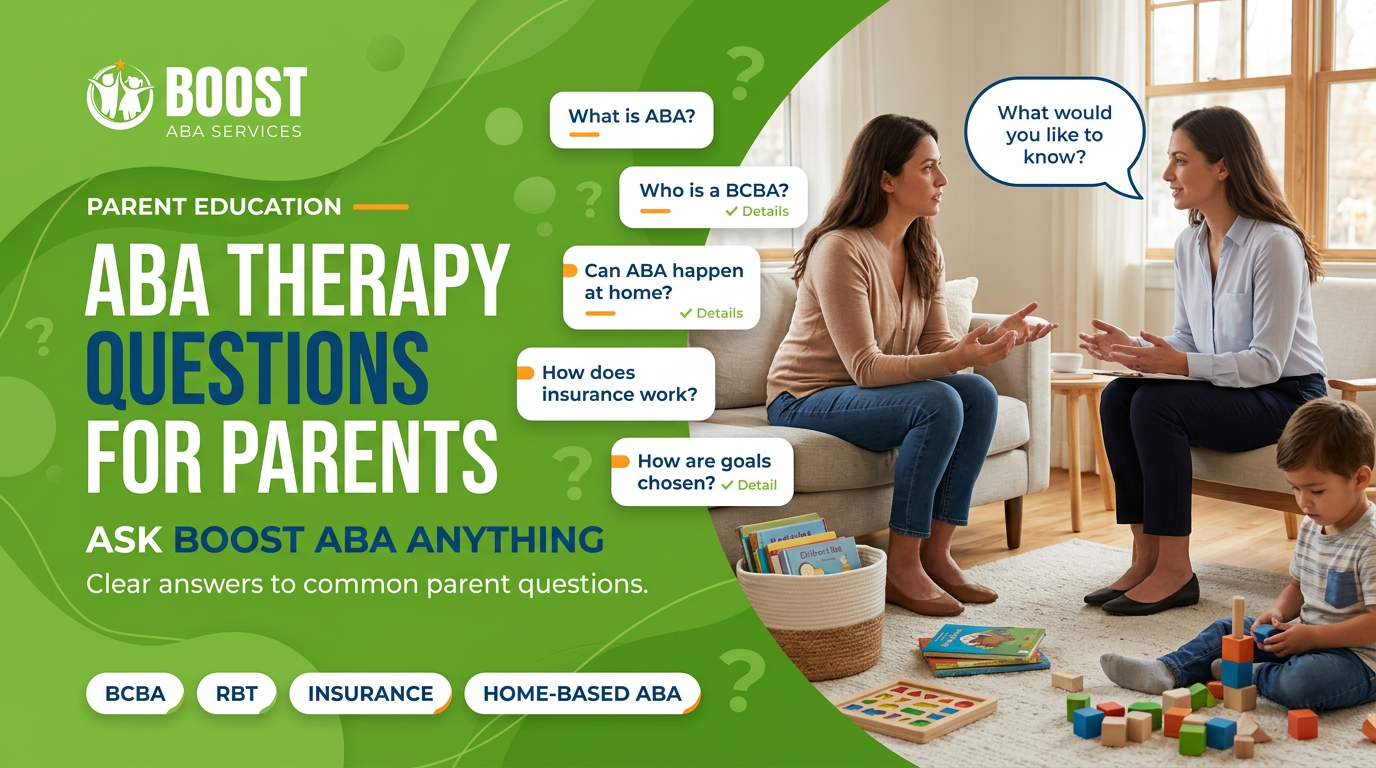
If you’re considering ABA therapy for your child, you probably have questions.
What exactly happens during ABA therapy?
Who provides the therapy?
How involved are parents?
Can ABA happen at home?
How are goals selected?
Does insurance cover ABA?
These are all reasonable questions.
In fact, asking questions is an important part of understanding any service you are considering for your child.
At Boost ABA Services, we provide individualized home-based ABA therapy for children and families across New York, Texas, and Arizona. Our goal is to make ABA easier to understand and help families feel comfortable learning about their options.
This guide answers some of the common ABA therapy questions for parents.
What Is ABA Therapy?
ABA stands for Applied Behavior Analysis.
ABA is an evidence-based approach that applies principles of learning and behavior to support meaningful skills.
Depending on a child’s individualized treatment plan, ABA therapy may focus on areas such as:
- Communication
- Daily living skills
- Social interaction
- Play
- Everyday routines
- Transitions
- Learning
- Making choices
- Asking for help
- Greater independence
ABA therapy should be individualized.
That means the goals and strategies used with one child may look very different from those used with another child.
1. Is ABA Therapy the Same for Every Child?
No.
One of the most important things parents should know is that ABA should not be a one-size-fits-all program.
Every child has different:
- Strengths
- Needs
- Interests
- Communication styles
- Learning preferences
- Routines
- Family priorities
For example, one child’s individualized goals may focus on functional communication.
Another child may be working on daily living skills.
Another may be practicing transitions or social interaction.
Therefore, parents should ask:
“How will my child’s ABA goals be individualized?”
2. What Does ABA Therapy Actually Look Like?
ABA therapy can look different depending on the child and their individualized treatment plan.
Some activities may be structured.
Others may happen naturally during play or everyday routines.
A home-based ABA session might include:
- Playing with blocks
- Reading a book
- Practicing communication
- Using a visual schedule
- Working through a morning routine
- Practicing transitions
- Completing an age-appropriate daily living activity
- Making choices
- Participating in a family routine
At Boost ABA Services, our home-based ABA therapy allows appropriate goals to be practiced within familiar surroundings.
3. Why Does ABA Happen at Home?
This is a common question for families considering home-based services.
The answer is simple:
Home is where many everyday skills naturally happen.
Getting dressed happens at home.
Brushing teeth happens at home.
Mealtimes happen at home.
Play happens at home.
Family communication happens at home.
Transitions happen throughout the home.
Depending on the child’s individualized treatment plan, these routines can provide meaningful opportunities to practice appropriate skills.
Home-based ABA doesn’t mean every moment becomes therapy.
Instead, appropriate learning opportunities can be connected with the environment where children naturally use many of their skills.
4. Who Provides ABA Therapy?
An ABA team can include different professionals.
A Board Certified Behavior Analyst (BCBA) may assess needs, develop treatment goals, oversee treatment, monitor progress, and supervise other members of the ABA team, depending on the service model and applicable requirements.
A Registered Behavior Technician (RBT) may work directly with the child while implementing appropriate strategies under supervision.
You may also hear the term Behavior Technician (BT), depending on the provider and position.
Parents should feel comfortable asking:
“Who will work directly with my child?”
and:
“Who supervises my child’s treatment?”
5. What Does a BCBA Do?
A BCBA can have several important responsibilities within an ABA program.
Depending on the child’s service model, the BCBA may:
- Assess relevant needs
- Develop individualized treatment goals
- Design appropriate interventions
- Review relevant data
- Monitor progress
- Supervise ABA team members
- Communicate with caregivers
- Adjust treatment strategies when appropriate
The BCBA’s exact responsibilities can vary depending on the child’s program and applicable requirements.
If you’re choosing an ABA provider, ask how frequently the BCBA will be involved and who you should contact with questions.
6. What Is an RBT?
RBT stands for Registered Behavior Technician.
An RBT is a paraprofessional who has met the requirements for RBT certification through the Behavior Analyst Certification Board.
RBTs may work directly with children while implementing appropriate treatment strategies under supervision.
Depending on the child’s treatment plan, their work may involve:
- Communication
- Play
- Daily living skills
- Learning
- Social interaction
- Routines
- Transitions
If your child will work with an RBT, ask the provider how supervision and communication with the BCBA are structured.
7. Are Parents Involved in ABA Therapy?
Yes, parents and caregivers can be important members of the team.
Parents know their child’s everyday life.
They know:
- What their child enjoys
- How their child communicates
- Which routines are easy
- Which routines are difficult
- What motivates their child
- Which skills are meaningful to the family
This information can be especially valuable with home-based ABA therapy.
Depending on the treatment plan, caregiver involvement may include:
- Sharing observations
- Discussing family priorities
- Participating in caregiver training
- Learning about appropriate strategies
- Supporting skills during everyday routines
- Communicating with the clinical team
Parents don’t need to become therapists.
Instead, they can collaborate with the professionals supporting their child.
8. How Does Home-Based ABA Work With Family Routines?
One advantage of home-based services is that therapy can take place within familiar routines.
For example, a child’s individualized goals might relate to:
Morning Routine
Getting dressed, brushing teeth, eating breakfast, or preparing to leave.
Play
Communicating, making choices, taking turns, or participating in an activity.
Mealtime
Communicating preferences, asking for assistance, or participating in appropriate routines.
Cleanup
Following steps and participating in putting belongings away.
Transitions
Moving from one activity to another using appropriate individualized supports.
Bedtime
Participating in appropriate steps of a familiar evening routine.
The exact goals depend on the child.
9. What Is Reinforcement in ABA?
Reinforcement is another term parents commonly hear.
In simple terms, reinforcement refers to what happens after a behavior that increases the likelihood of that behavior happening again.
For example, if a child appropriately asks for help and receives assistance, that response may function as reinforcement if it increases the child’s future use of that communication skill.
Reinforcement can look different for different children.
Depending on the child, it may involve:
- Specific praise
- Access to a preferred activity
- A favorite toy
- Choosing an activity
- Social interaction
- Another individualized reinforcer
Reinforcement should be based on the individual child and treatment plan.
10. What Is Prompting?
Prompting means providing assistance to help someone complete a skill.
For example, a therapist may provide a verbal, visual, gestural, or other appropriate prompt while a child is learning a new routine.
As the child develops the skill, the treatment team may work toward reducing assistance when appropriate.
Parents can ask:
“How will prompts be reduced as my child learns the skill?”
This can help families understand how the provider approaches developing greater independence.
11. What Is a Visual Schedule?
A visual schedule shows a child what activities are happening and what comes next.
It might use:
- Pictures
- Photographs
- Symbols
- Written words
- Checklists
- Objects
For example:
GET DRESSED → BREAKFAST → BRUSH TEETH → SHOES → SCHOOL
Visual schedules can be useful for some children because the information remains visible.
They may be used during morning routines, bedtime, transitions, school preparation, or other appropriate activities.
12. What Is AAC?
AAC stands for Augmentative and Alternative Communication.
AAC includes methods that supplement or provide an alternative to spoken communication.
Examples can include:
- Pictures
- Communication boards
- Signs
- Speech-generating devices
- Tablet-based communication systems
Communication doesn’t have to look the same for every child.
Depending on the child’s needs, AAC may be part of an individualized communication approach.
13. How Are ABA Goals Chosen?
Parents should understand why their child’s goals were selected.
Treatment planning may consider:
- Current skills
- Strengths
- Areas where support may be helpful
- Communication
- Interests
- Daily routines
- Family priorities
- Individualized treatment needs
Ask:
“Why is this goal important for my child?”
and:
“How does this goal connect with everyday life?”
These questions can help you understand the purpose behind the treatment plan.
14. How Is Progress Measured?
Another common ABA therapy question for parents is:
“How will we know if my child is making progress?”
Depending on the treatment plan, the clinical team may collect and review relevant information about specific skills or behaviors.
Measurements can vary depending on the goal.
The team may consider factors such as:
- Frequency
- Duration
- Accuracy
- Level of assistance
- Successful responses
- Other measurable aspects of the skill
Parents should be able to ask how progress will be explained to them.
15. Does ABA Therapy Guarantee Results?
No responsible provider should promise a specific outcome for every child.
Every child responds differently to services.
Progress can depend on many factors, including the child’s individual needs, treatment goals, environment, and other circumstances.
Instead of asking only:
“How fast will my child improve?”
parents may also want to ask:
“What are my child’s individualized goals?”
“How will progress be measured?”
“How will the treatment plan change if needed?”
16. Does Insurance Cover ABA Therapy?
Insurance coverage varies.
Whether ABA is covered depends on the individual insurance plan and applicable requirements.
Families may need to understand:
- Whether ABA is included in their benefits
- Network status
- Prior authorization
- Documentation requirements
- Deductibles
- Copays or coinsurance
- Applicable coverage limitations
Therefore, parents should verify their specific benefits rather than assuming coverage.
At Boost ABA Services, our team can help families understand the insurance verification process and discuss applicable next steps.
17. How Do I Choose an ABA Provider?
If you’re comparing ABA providers, consider asking:
How are treatment goals individualized?
Who supervises my child’s treatment?
How involved will the BCBA be?
How are parents and caregivers included?
What does a typical home-based session look like?
Do you provide services in my area?
The answers can help you understand how different providers approach care.
18. Is Home-Based ABA Right for Every Child?
Not necessarily.
Every child and family is different.
Whether home-based ABA is appropriate depends on factors such as:
- The child’s needs
- Treatment goals
- Family circumstances
- Professional recommendations
- Service availability
- Insurance requirements
- Provider capabilities
If you’re considering home-based services, discuss your child’s needs with qualified professionals and ask providers how their model works.
19. What Makes Boost ABA Services Different?
At Boost ABA Services, our services are home-based and individualized.
We provide ABA therapy within the child’s familiar home environment across New York, Texas, and Arizona.
Depending on the child’s individualized treatment plan, services may support:
- Communication
- Daily living skills
- Everyday routines
- Social interaction
- Play
- Transitions
- Learning
- Independence
Our approach also emphasizes family collaboration.
Parents and caregivers can share their observations, priorities, and questions as part of the child’s support team.
20. What Happens When I Contact Boost ABA Services?
If you’re interested in learning more about home-based ABA, you don’t need to know exactly what service you want before contacting us.
A conversation can help you understand the process.
Generally, the journey may include:
Contact
Reach out to our team and tell us what you’re looking for.
Learn
Share information about your child and your family’s questions.
Review
Discuss service availability and applicable insurance information.
Understand
Learn more about the home-based ABA process.
Next Steps
If services are appropriate and available, our team can explain what comes next.
The exact process can vary based on individual circumstances.
Ask Boost ABA Anything
Parents should never feel uncomfortable asking questions about their child’s services.
If you’re wondering:
“What happens during ABA?”
“How involved are parents?”
“Can ABA happen at home?”
“How does insurance work?”
“What does a BCBA do?”
“How are goals chosen?”
Ask.
Understanding your options is an important part of finding appropriate support.
Home-Based ABA Therapy in New York, Texas & Arizona
Boost ABA Services provides home-based ABA therapy in New York, Texas, and Arizona.
Our services are designed around each child’s individual needs and meaningful goals.
Depending on the treatment plan, support may involve communication, daily living skills, routines, transitions, play, social interaction, learning, and independence.
Service availability may vary by location.
New York
Looking for home-based ABA therapy in New York? Contact Boost ABA Services to learn about available services in your area.
Texas
Searching for home-based ABA therapy in Texas? Our team can help you understand our approach and the process of getting started.
Arizona
Looking for home-based ABA therapy in Arizona? Contact us to learn more about our individualized home-based services.
Send Us Your Questions
We’re continuing our Ask Boost ABA Anything series to answer common questions from parents and caregivers.
If there’s something about ABA therapy, home-based services, insurance, or the process of getting started that you’d like explained, send us your question.
Your question could become our next educational resource.
Boost ABA Services
Home-Based ABA Therapy | NY • TX • AZ
📞 845-377-0024
Open Monday – Friday
Big Progress Starts With Small Steps.
