
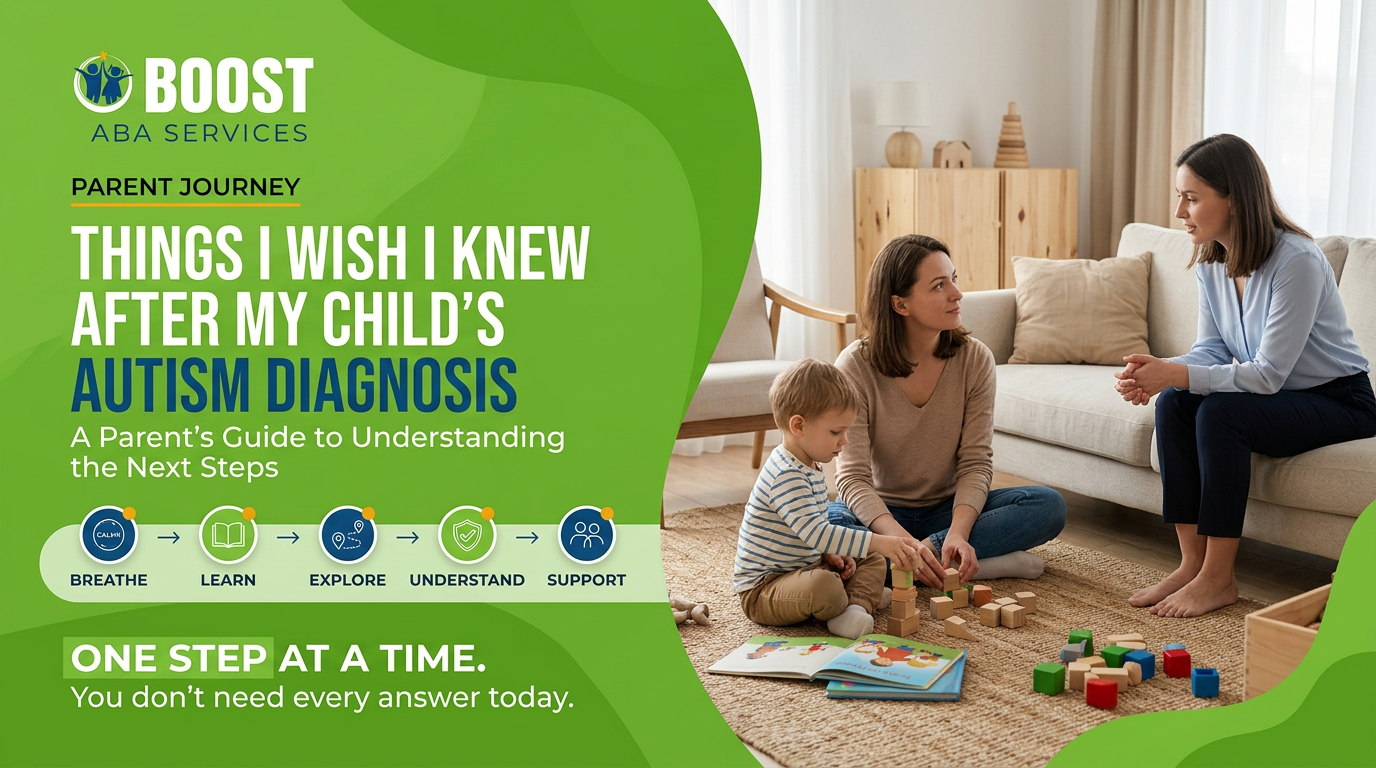
An autism diagnosis can bring many emotions and many questions.
You may be wondering:
What happens next?
What services should I consider?
Does my child need ABA therapy?
How does insurance work?
Where do I even begin?
There is no single roadmap that every family has to follow.
If you’re asking what to do after an autism diagnosis, start with one step at a time. Learn about your child’s individual needs, ask questions, explore appropriate support options, and give yourself time to understand the information you’re receiving.
At Boost ABA Services, we provide individualized home-based ABA therapy for children and families across New York, Texas, and Arizona.
You Don’t Have to Know Everything on Day One
One of the first things many parents learn after an autism diagnosis is just how much information there is to process.
You may hear terms you’ve never heard before.
BCBA.
ABA.
RBT.
AAC.
IEP.
Insurance authorization.
Assessments.
Treatment plans.
It can feel like a lot.
You don’t need to understand every term immediately.
Give yourself permission to learn gradually.
Start by writing down your questions and discussing them with your child’s pediatrician, developmental specialist, or other qualified professionals involved in your child’s care.
There is nothing wrong with saying:
“I don’t understand this yet. Can you explain it?”
Understanding your options is a process.
Your Child Is Still the Same Child
An autism diagnosis can change the way you understand certain behaviors, communication patterns, or developmental differences.
But your child is still your child.
The diagnosis can provide information that helps families and professionals better understand a child’s needs.
It does not define everything about your child.
Instead of asking:
“What does autism mean for my child’s entire future?”
It can sometimes be more helpful to ask:
“What does my child need right now?”
That question gives you a place to begin.
Start With Your Child’s Individual Needs
Every autistic child is different.
One child may communicate primarily through speech.
Another may use gestures, pictures, signs, or AAC.
One child may need support with daily routines.
There is no single list of services that every child needs.
Communication
How does your child express wants, needs, choices, and feelings?
Daily Living Skills
Does your child need support with dressing, hygiene, mealtime, or other everyday routines?
Social Interaction
Are there social situations where additional support may be helpful?
Routines and Transitions
Are changes between activities particularly difficult?
Independence
Are there age-appropriate activities where your child could benefit from additional support?
These questions aren’t meant to diagnose your child.
They’re simply ways to organize your thoughts when discussing your child’s needs with qualified professionals.
You May Hear About ABA Therapy
Many families encounter Applied Behavior Analysis (ABA) when exploring autism services.
ABA is an evidence-based approach based on principles of learning and behavior.
Depending on the child’s individualized treatment plan, ABA may support areas such as:
- Communication
- Daily living skills
- Everyday routines
- Social interaction
- Play
- Transitions
- Learning skills
- Greater independence
- Helpful alternatives to challenging behaviors
The important thing to understand is that ABA should not be viewed as one standardized program for every child.
Individualized ABA therapy should be based on the child’s strengths, needs, goals, environment, and family priorities.
Home-Based ABA Therapy Can Connect Support With Everyday Life
At Boost ABA Services, we provide home-based ABA therapy.
This means appropriate therapy services take place within the child’s familiar home environment.
Why can that matter?
Because so much of a child’s everyday life happens at home.
Getting dressed.
Brushing teeth.
Eating breakfast.
Playing.
Asking for help.
Cleaning up.
Moving from one activity to another.
Getting ready for bed.
Depending on the child’s individualized treatment plan, these everyday routines may provide opportunities to practice meaningful skills.
The goal isn’t to turn every moment at home into therapy.
It’s about connecting appropriate learning opportunities with the environment where children naturally live and use their skills.
You Don’t Have to Choose Every Service at Once
After an autism diagnosis, families may hear about many different services.
Depending on the child’s needs and professional recommendations, these may include behavioral, developmental, communication, educational, or other support services.
It can be tempting to think you need to start everything immediately.
You don’t necessarily have to.
Start by understanding the recommendations you’ve received.
Ask:
- What is this service designed to support?
- Why was it recommended for my child?
- What would the goals be?
- Who provides the service?
- How often would it take place?
- How would parents be involved?
- How would progress be evaluated?
These questions can help you make informed decisions about the support you explore.
Insurance Can Feel Complicated
Another question parents often have after an autism diagnosis is:
“Will insurance cover ABA therapy?”
The answer depends on the individual insurance plan and applicable requirements.
Coverage can vary based on factors such as:
- Insurance benefits
- Network status
- Prior authorization
- Documentation
- Medical necessity requirements
- State requirements
- Plan-specific limitations
That’s why insurance verification can be an important part of the process.
At Boost ABA Services, we can help families understand the insurance verification process for ABA services and the next steps involved.
Ask Questions Before Choosing an ABA Provider
You don’t need to choose the first provider you find.
When researching home-based ABA therapy, ask questions about the provider’s approach.
For example:
- How are treatment goals individualized?
- Who develops and oversees the treatment plan?
- How is a BCBA involved?
- How are parents and caregivers included?
- How will my child’s communication style be respected?
- What does a typical home-based session look like?
- How is progress monitored?
- How often are goals reviewed?
- How does the provider communicate with families?
- What areas does the provider serve?
The answers can help you understand whether a provider’s approach aligns with your family’s needs.
Parents Are Part of the Team
One thing I wish every parent knew after an autism diagnosis is that you don’t have to become an expert overnight.
Clinical professionals bring their expertise.
Parents bring their knowledge of the child.
Both perspectives can be valuable when developing appropriate support.
At Boost ABA Services, our family-centered approach encourages collaboration between children, families, caregivers, and clinical professionals.
Small Progress Can Be Meaningful
When you’re looking at the big picture, it can be easy to overlook small moments.
But small moments can matter.
A child finding a new way to communicate.
Asking for help.
Making a choice.
Participating in getting dressed.
Following part of a familiar routine.
Trying a new activity.
Transitioning to the next part of the day with support.
These moments may look different for every child.
That’s why we don’t believe progress should be measured by comparing one child with another.
The meaningful goals are the goals that are appropriate for the individual child.
Your Child’s Journey Doesn’t Have to Look Like Anyone Else’s
Social media can make it easy to compare.
You may see another family’s story and wonder:
“Should my child be doing that?”
“Are we behind?”
“Should we be doing more?”
Remember that another family’s journey is not a measurement of yours.
Every child has different strengths, needs, circumstances, and goals.
Your child’s path can be their own.
The goal of support should be to help your child develop meaningful skills in ways that respect their individuality.
What to Do After an Autism Diagnosis: A Simple Roadmap
If you’re still wondering what to do after an autism diagnosis, start here:
1. Take a Breath
You don’t need every answer today.
2. Learn
Understand your child’s individual strengths and areas where additional support may be helpful.
3. Ask Questions
Talk with your pediatrician, developmental professionals, and potential service providers.
4. Explore Your Options
Learn about the services that may be appropriate for your child.
5. Understand Insurance
Review your benefits and learn what requirements may apply.
6. Find Appropriate Support
Choose services and professionals based on your child’s individual needs and your family’s priorities.
7. Take It One Step at a Time
You don’t need to solve everything at once.
Your child’s diagnosis is not the end of the story.
It is information that can help you and the professionals around your child better understand their individual needs and determine appropriate ways to support them.
Home-Based ABA Therapy With Boost ABA Services
At Boost ABA Services, we provide individualized home-based ABA therapy for children across New York, Texas, and Arizona.
Our approach is centered around the individual child and their meaningful goals.
Depending on the child’s treatment plan, support may involve:
- Communication
- Daily living skills
- Everyday routines
- Social interaction
- Play
- Transitions
- Learning
- Independence
We also believe families should be part of the process.
Our team works collaboratively with parents and caregivers to help connect appropriate therapy goals with everyday life.
You Don’t Have to Navigate It Alone
If you’re researching ABA therapy after an autism diagnosis, it’s okay to have questions.
You don’t need to know exactly what service you want before contacting us.
Our team can help you learn more about home-based ABA therapy, our approach, insurance verification, service availability, and the process of getting started.
Boost ABA Services
Home-Based ABA Therapy | New York • Texas • Arizona
📞 845-377-0024
Open Monday – Friday
Big Progress Starts With Small Steps.
