
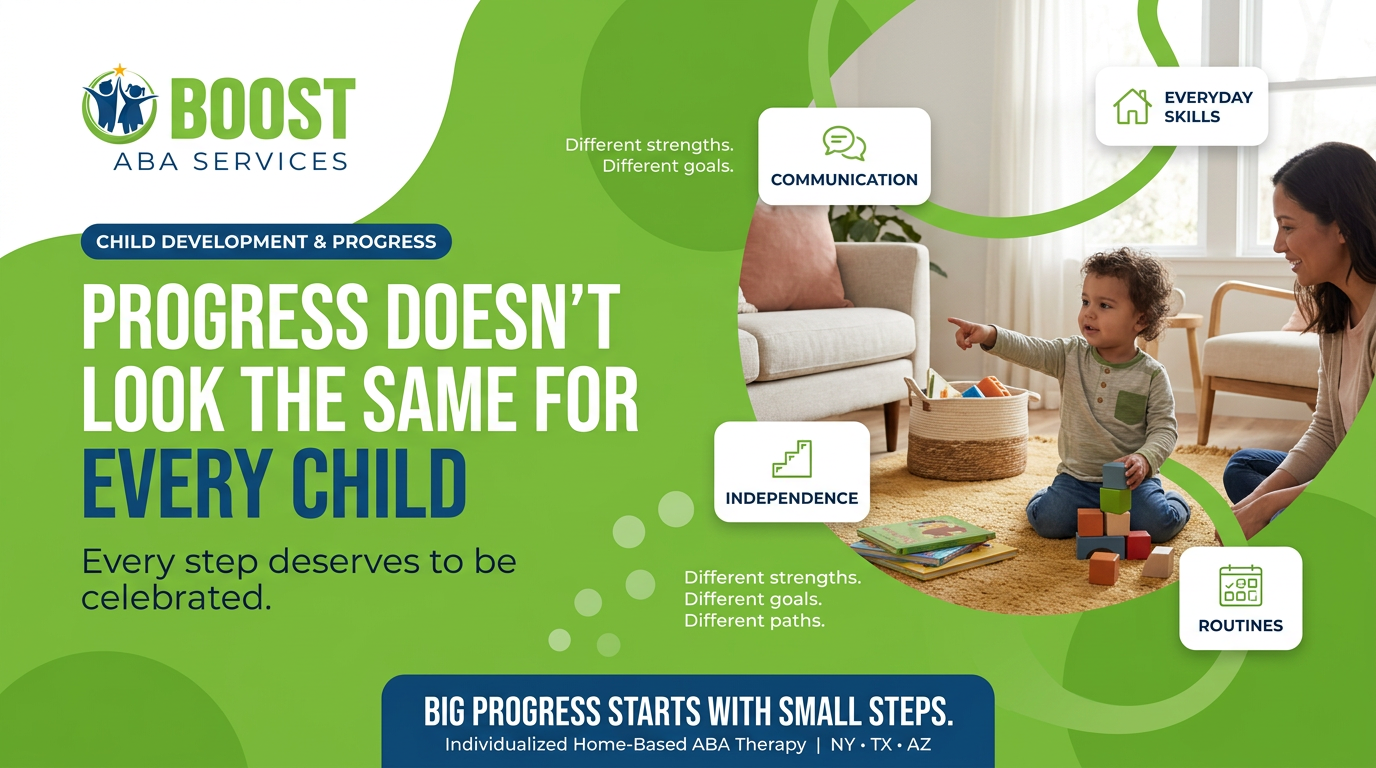
Progress doesn’t always look the way we expect it to.
For one child, progress might mean finding a new way to ask for help. For another, it might mean participating in part of a morning routine. It could be making a choice, communicating a need, practicing a daily living skill, or becoming more comfortable with a familiar activity.
At Boost ABA Services, we believe individualized ABA therapy for children should recognize something important: every child has different strengths, needs, communication styles, routines, and goals.
That’s why progress should never be measured by comparing one child to another.
Progress doesn’t look the same for every child, and every meaningful step deserves to be recognized.
What Does Progress in ABA Therapy Look Like?
There isn’t one definition of progress that applies to every child receiving ABA therapy.
ABA, or Applied Behavior Analysis, can focus on developing meaningful skills that connect with a child’s everyday life. The specific goals depend on the individual child and their treatment plan.
For some children, appropriate goals may involve:
- Functional communication
- Daily living skills
- Everyday routines
- Making choices
- Asking for help
- Navigating transitions
- Play skills
- Social interaction
- Participating in personal care routines
- Building greater independence
The goal of individualized ABA therapy is not to make every child reach the same milestones in the same way.
It is to create meaningful goals based on the individual child.
Every Child’s ABA Journey Is Different
Children develop skills at different rates and in different ways.
Two children receiving ABA services may have completely different treatment goals.
One child might be working on communicating when they need help.
That’s why child-centered ABA therapy should begin with understanding the child rather than comparing them with someone else.
At Boost ABA Services, our home-based ABA therapy approach allows appropriate goals to connect with the child’s familiar environment, everyday routines, and family life.
Communication Progress Can Take Many Forms
Communication is much more than spoken words.
Children may communicate through:
- Speech
- Gestures
- Pointing
- Facial expressions
- Pictures
- Signs
- AAC
- Other individualized communication methods
For one child, a meaningful communication goal might involve requesting a favorite activity.
For another, it could involve asking for a break.
Another child may be working on making choices or communicating that they need assistance.
These moments can be meaningful because communication helps children express themselves and participate more actively in everyday life.
ABA support should respect the child’s individual communication style while helping develop appropriate functional communication skills based on their needs.
Everyday Skills Matter
Some of the most meaningful skills aren’t dramatic.
They happen during ordinary moments at home.
Getting dressed.
Brushing teeth.
Cleaning up toys.
Choosing between two activities.
Participating in mealtime.
Following part of a morning routine.
Preparing for bedtime.
These everyday activities can involve communication, sequencing, motor skills, transitions, decision-making, and independence.
With home-based ABA therapy, appropriate daily living goals can be practiced within the environment where those activities naturally happen.
A familiar home environment can provide valuable context for learning and practicing skills connected to everyday life.
Building Independence One Step at a Time
Independence doesn’t mean a child has to do everything without help.
It can mean developing skills that allow the child to participate more actively in their own life.
Depending on the child, an individualized ABA plan may include appropriate goals involving:
- Making choices
- Requesting assistance
- Participating in dressing
- Following familiar routines
- Cleaning up
- Completing parts of personal care activities
- Moving between activities
- Communicating needs
- Participating in household routines
A larger skill may also be broken into smaller, more manageable steps.
Instead of focusing only on the final result, the ABA team can recognize the individual skills involved along the way.
Why Small Steps Matter
Imagine a child is working toward participating more independently in a morning routine.
That larger goal might involve many smaller skills:
- Recognizing what comes next
- Transitioning away from a preferred activity
- Finding clothing
- Making a choice
- Participating in getting dressed
- Asking for help when needed
- Moving to the next part of the routine
Looking only at the final outcome can make it easy to overlook everything the child is practicing along the way.
Recognizing smaller steps helps keep the focus on meaningful skill development rather than comparison.
Big progress can begin with small steps.
Home-Based ABA Therapy Connects Skills With Everyday Life
At Boost ABA Services, we provide home-based ABA therapy for children.
Bringing ABA into the home can allow appropriate treatment goals to connect with real routines and familiar activities.
Instead of practicing every skill in an unfamiliar environment, learning opportunities may occur during activities such as:
- Playtime
- Getting ready
- Snack or mealtime
- Cleanup
- Family routines
- Personal care
- Transitions
- Communication throughout the day
This is one reason home-based ABA can be valuable for families seeking support that connects with everyday life.
The home is not simply where therapy takes place.
It can also be where many meaningful skills are naturally used.
Individualized ABA Means Individualized Goals
There is no universal list of ABA goals that every child should follow.
An individualized treatment plan should consider factors such as:
- The child’s strengths
- Current skills
- Communication style
- Individual needs
- Interests and preferences
- Everyday routines
- Family priorities
- Areas where additional support may be helpful
Goals should also be reviewed as the child develops and circumstances change.
This is why individualized ABA therapy for children should not look identical from one child to another.
Parents and Caregivers Help Define What Matters
Parents and caregivers know their child’s everyday life in a way no therapist can learn from a single session.
That’s why family involvement is an important part of a family-centered ABA approach.
In home-based ABA, families and clinical professionals can collaborate around goals that connect with the child’s actual daily experiences.
Parents don’t need to become therapists.
They bring something equally valuable to the team: knowledge of their child.
Progress Shouldn’t Mean Comparing Children
It can be tempting to compare.
Parents may see another child communicating differently, navigating a routine independently, or reaching a particular developmental milestone and wonder where their own child “should” be.
But another child’s progress isn’t the standard for your child.
Meaningful progress should be considered in the context of the individual child’s abilities, needs, treatment plan, and goals.
ABA therapy should not be about forcing children toward one definition of what development must look like.
An individualized approach focuses on helping children develop useful, meaningful skills while respecting their differences.
Celebrating Progress Without Creating Pressure
Celebrating a meaningful step doesn’t mean expecting every day to move forward in a straight line.
Learning can have easier days and harder days.
That’s why it is important to look at development over time and within the context of the child’s individualized treatment plan.
Celebration should recognize effort, participation, communication, and meaningful skill development without creating pressure for a child to perform.
What Can Families Celebrate?
Every family’s answer will be different.
Depending on the child’s goals, meaningful moments might include:
Communication: Finding an effective way to request help, make a choice, or express a need.
Play: Participating in a new or familiar play activity.
Self-advocacy: Communicating a preference, asking for assistance, or requesting a break.
These are examples, not promises or milestones every child is expected to reach.
What matters should be determined individually.
The People Behind the Progress Matter Too
Children aren’t the only ones putting effort into the process.
Parents and caregivers are learning.
ABA professionals are observing and adapting.
BCBAs are reviewing treatment goals and progress.
RBTs and Behavior Technicians are helping implement individualized treatment plans.
Families are practicing, communicating, asking questions, and supporting their children throughout everyday life.
Meaningful ABA services involve collaboration.
At Boost ABA Services, we believe the child, family, and clinical team should work together around goals that matter to the individual child.
Home-Based ABA Therapy in New York, Texas & Arizona
Boost ABA Services provides individualized home-based ABA therapy in New York, Texas and Arizona.
Communication • Everyday Routines • Daily Living Skills • Transitions • Play • Social Skills • Independence
Service availability may vary by location.
Every Step Deserves to Be Celebrated
Progress doesn’t need to look dramatic to be meaningful.
It doesn’t need to happen on someone else’s timeline.
And it doesn’t need to look the same for every child.
A new way to communicate.
A meaningful choice.
A daily living skill being practiced.
A moment of greater independence.
These moments can matter.
Progress doesn’t look the same for every child.
Every step deserves to be celebrated. 💚
Looking for Home-Based ABA Therapy?
If you’re exploring individualized home-based ABA therapy for your child, contact Boost ABA Services to learn about our approach, service availability, and next steps.
Boost ABA Services
📍 Home-Based ABA Therapy | New York • Texas • Arizona
📞 845-377-0024
Open Monday – Friday
Big Progress Starts With Small Steps.
